
JYR8010-150W Multi-Band Antenna
4.6Editor score
Eight natural-resonance bands
150W SSB and CW
Thirty-nine-meter wire included
Our expert guide compares the best End Fed Antennas for Ham Radio, reviewing power handling, multiband support, baluns, portability, weather resistance, and
End fed antennas offer ham radio operators a practical way to reach multiple HF bands with a lightweight wire and a compact impedance-matching unit. A strong choice balances dependable power handling, useful wire configurations, simple installation, and enough construction for portable or permanent outdoor operation.
We compared the supplied products by examining their balun ratios, supported frequencies, stated power limits, included wire, mounting flexibility, weather resistance, and intended field use. The list includes no-tune models, tuner-dependent dual-ratio designs, portable short antennas, and longer installations suited to home stations.
Each review shows where a product stands out and where its specifications impose limits, helping you match the antenna to your radio, operating habits, and environment. Ratings and specifications reflect the current information supplied, while prices and availability can change over time.
4.6Editor score

4.7Editor score
4.6Editor score
The table below compares the principal antenna configurations, impedance ratios, frequency coverage, and stated power capabilities, making it easier to identify the model that matches your station and operating style.



The JYR4010-150W is a four-band end fed half-wave antenna with a 4.7 rating and a clear focus on dependable HF operation without routine tuner adjustments. Its 1:64 impedance transformer is designed for 40m, 20m, 15m, and 10m, making it a versatile option for operators who want one wire antenna to cover several common bands.
We may earn a commission when you buy through this link, at no additional cost to you.
The integrated matching system supports up to 150W on SSB and 100W for CW or FT8. It is described as working with Yaesu, Icom, Xiegu, Kenwood, and most other HF transceivers. The enclosure also incorporates a waterproof M-J connector, a large ferrite core, UV-resistant housing, and a convection-oriented cooling design intended to support stable operation during extended transmissions.
Installation flexibility is another major strength. The single-wire system can run horizontally, vertically, or diagonally, and the manufacturer recommends keeping it about three meters from obstacles and five meters from metal surfaces. Those clearances and the actual wire length remain important because environmental influence and installation details can affect tuning, even when the transformer reduces the need for an external tuner.
This is a strong recommendation for portable operators, campers, POTA and SOTA activators, and home operators seeking a straightforward four-band system. It is less suitable for someone who insists on a long random wire across many HF bands, but within its specified four-band design, it offers an unusually complete combination of power handling, flexible mounting, and reduced tuning dependence.
The 1:64 transformer is the central feature, allowing the antenna to support 40m, 20m, 15m, and 10m with low stated SWR across the supported bands. It is best suited to installations where the operator can provide reasonable clearance and tune the wire length accurately.
The ABS enclosure, reinforced end insulator, clamping system, and sealed housing are designed for extended outdoor deployments. Periodic inspections of the wire, supports, connectors, and guy lines remain sensible even when the materials are weather resistant.
We may earn a commission when you buy through this link, at no additional cost to you.
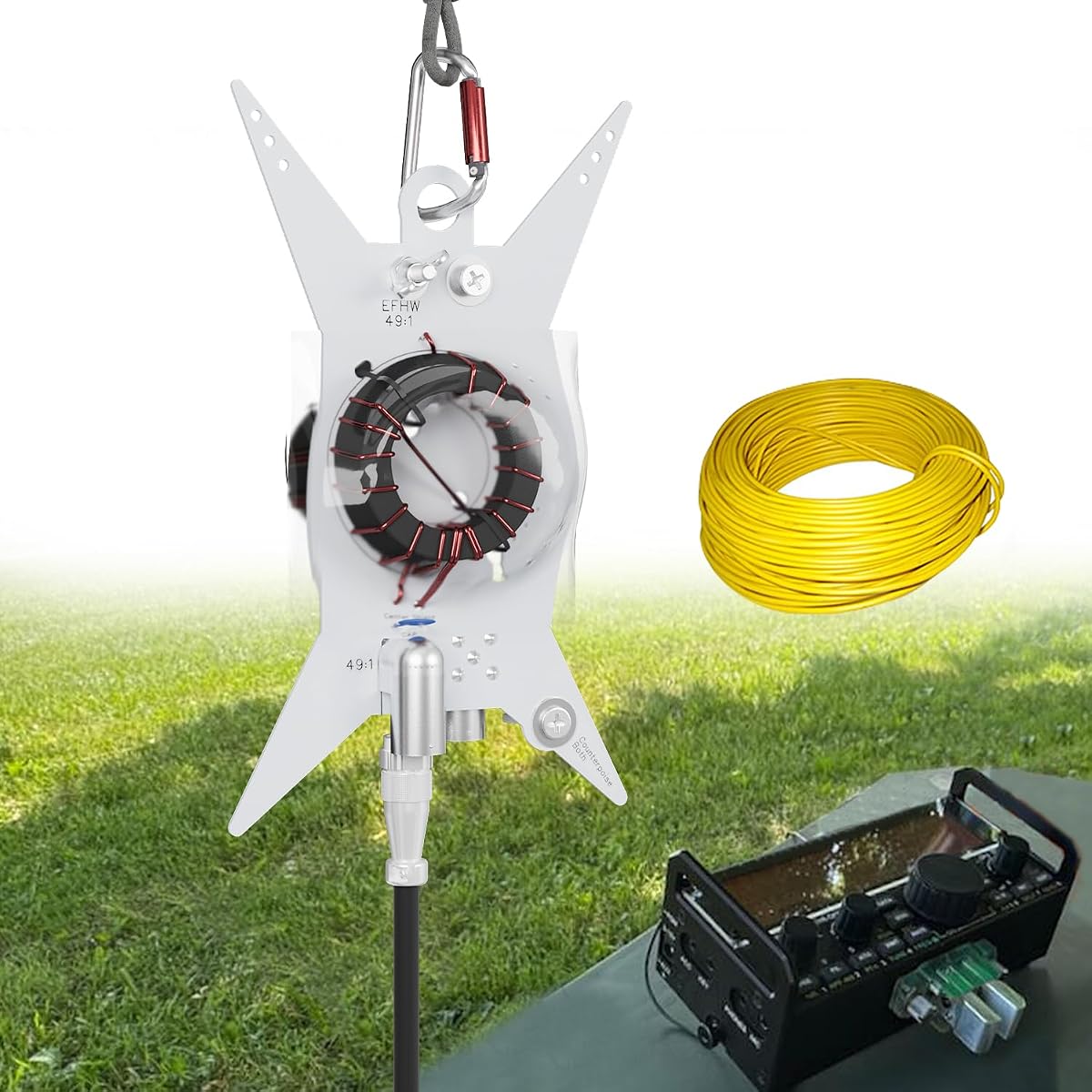
The Upgrade 49:1 and 9:1 Dual Mode antenna distinguishes itself by housing two impedance options in one unit. It has a 3.9 rating, the lowest in this group, but its versatility can appeal to operators who want both a resonant end fed arrangement and a random-wire setup without carrying two separate transformer assemblies.
We may earn a commission when you buy through this link, at no additional cost to you.
The 49:1 side is intended for end-fed resonant antennas, while the 9:1 side is intended for end-fed random-wire use across various HF bands with a tuner. That distinction is important. The dual design offers useful options, but the 9:1 side does not provide the same no-tune convenience implied by a matched resonant-wire configuration.
The antenna can be mounted horizontally, vertically, or diagonally, making it practical for POTA, SOTA, camping, and conventional field operations. Its compact, lightweight construction supports rapid deployment, and the product information describes the structure as windproof and rainproof for stable outdoor use.
Choose this model if you already understand impedance transformation or use an antenna tuner regularly. It is less convincing as a first antenna for someone expecting a single, simple setting to work across many bands. Its advantage lies in configuration flexibility rather than an especially strong rating or unusually high stated transmitter power.
Having both 49:1 and 9:1 modes lets the operator adapt the installation to a resonant wire or a longer random wire. This makes the unit useful for changing locations where finding an ideal resonant length may be difficult.
The lightweight housing and included wires support quick deployment. Vertical and diagonal layouts may be easier to create in field locations where a full horizontal run cannot be accommodated.
We may earn a commission when you buy through this link, at no additional cost to you.
This End Fed Half Wave Antenna for Ham Radio combines 49:1 and 9:1 transformer modes in a compact package. Its 4.6 rating places it among the better-reviewed options in the list, and the dual-ratio design offers a practical balance between resonant and random-wire flexibility.
We may earn a commission when you buy through this link, at no additional cost to you.
Operators can use the 49:1 side with an end-fed resonant wire or the 9:1 side with an end-fed random wire and an external tuner. As with the preceding dual-mode antenna, matching the operating style to the appropriate side is essential. A resonant arrangement is generally more predictable when the goal is to minimize dependence on a tuner.
Mounting options include horizontal, vertical, and diagonal configurations. The unit is described as compact, lightweight, windproof, and rainproof, with included wires intended to simplify setup for field operations, POTA, SOTA, camping, and DX work. Compatibility is described broadly across major radio brands.
This is a compelling portable option for an operator who appreciates having both transformer ratios in one enclosure. The main limitation is that the product information does not provide a clear maximum power rating, so users should verify transmitter output and thermal expectations before deployment. It is best for portable, tuner-equipped stations rather than high-power home installations.
The two transformer sides allow the same compact assembly to serve different wire strategies. Using a measured resonant wire with the 49:1 side can provide more predictable multiband behavior, while the 9:1 side offers greater freedom in wire length.
Included wires, a lightweight body, and multiple mounting orientations reduce the amount of equipment required for a field installation. Operators should still provide suitable supports and maintain clearance from nearby conductive structures.
We may earn a commission when you buy through this link, at no additional cost to you.
This 1-30MHz end fed antenna offers a broad stated frequency range, a 1:64 transformer, and a 100W power limit. Its 4.5 rating reflects a generally solid specification profile, while the requirement to prepare wire gives buyers control over the exact installation length.
We may earn a commission when you buy through this link, at no additional cost to you.
The product supports four-band and eight-band configurations. For the four-band arrangement, the supplied guidance calls for about 2.5 square meters of wire, with an indicated 20-meter or 65.6-foot length. The eight-band arrangement is associated with a 40.4-meter or 132.5-foot wire. Users must trim the wire to suit their target frequencies and have it tuned for best performance.
The stated limits are less than 100W for SSB and less than 60W for FT8, FM, and FSK. The ABS enclosure is described as hard and resistant to damage and wear, while the standard interface and compact housing support fast installation and transport.
This antenna is most suitable for portable operation with moderate transmitter output and for operators willing to prepare and trim the wire. Its broad frequency claim and multiple mode support are attractive, but the modest power ceiling and hands-on setup make it less compelling for a high-power permanent station.
Preparing the wire gives the operator control over the resonant length and the bands that can be optimized. It also means the buyer must have the tools, supports, and basic tuning knowledge needed to reach the antenna's intended performance.
The antenna is suitable for SSB, FT8, FM, and FSK within the stated output limits. Keeping the radio below those limits provides a sensible operating margin and avoids placing unnecessary stress on the transformer or connector.
We may earn a commission when you buy through this link, at no additional cost to you.
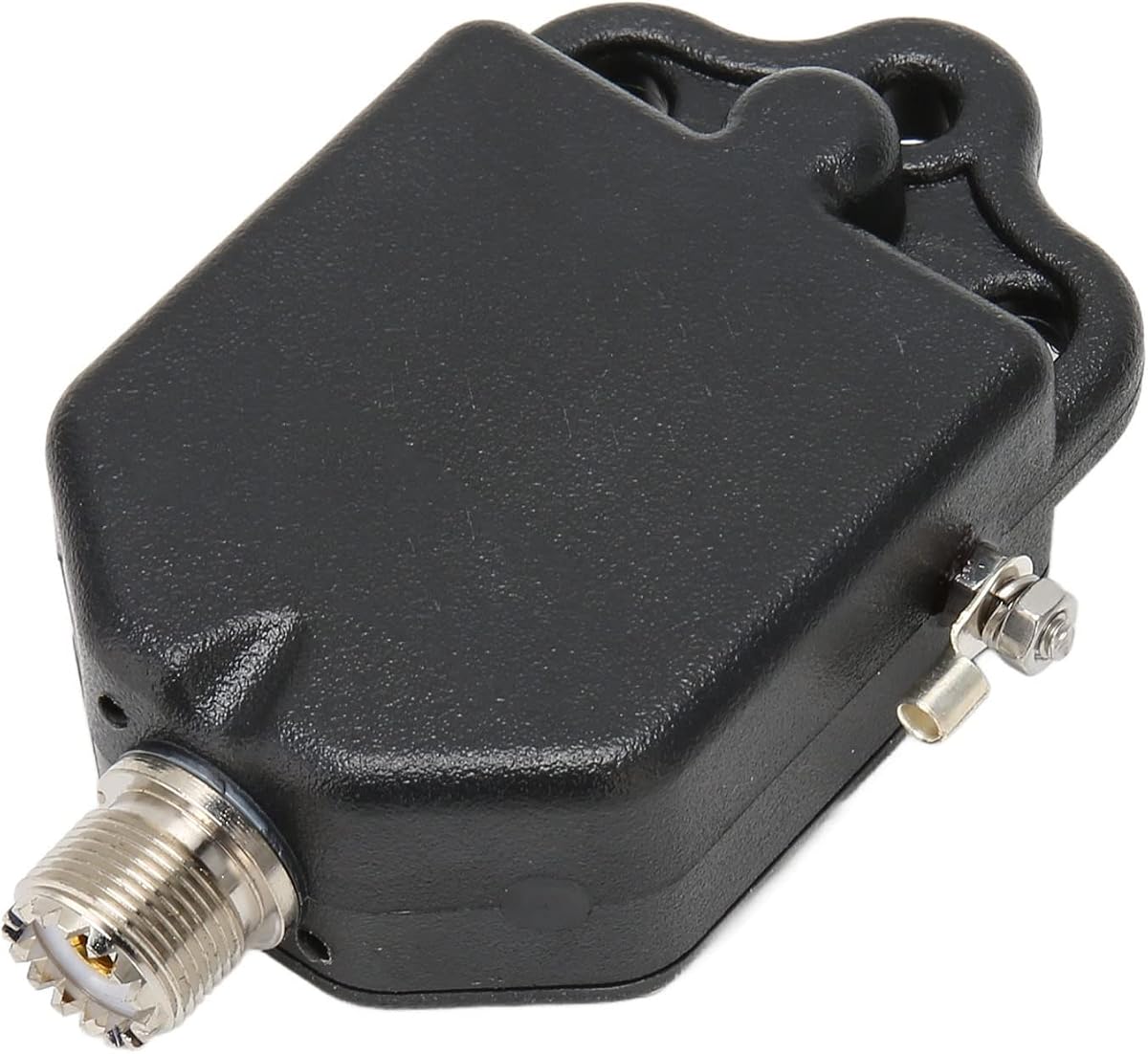
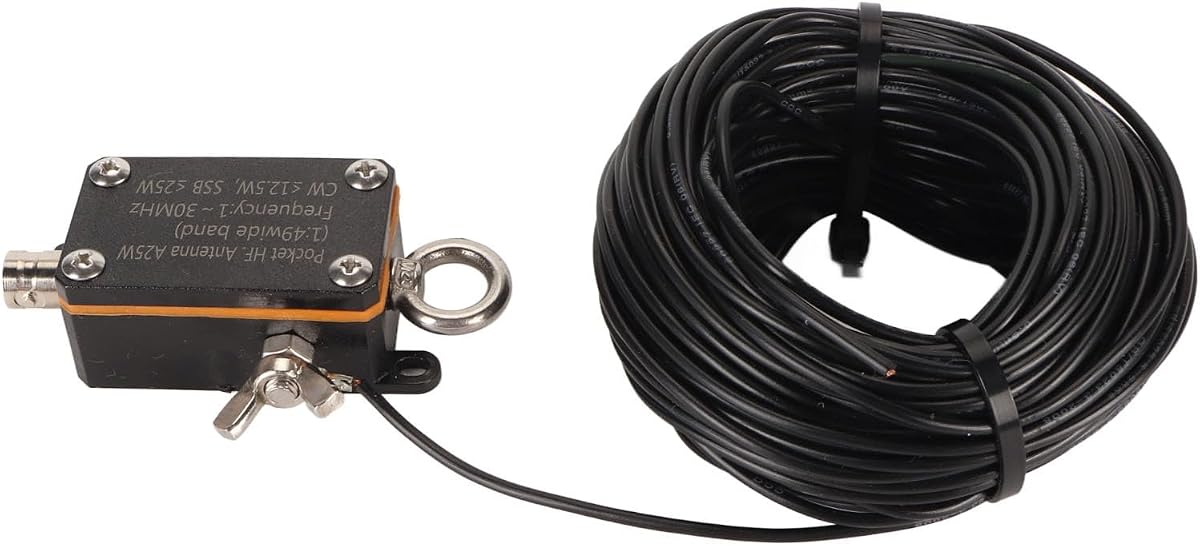
The Portable Short Antenna is built around a 1:49 balun and a compact PVC housing that emphasizes portability over high power. It covers a stated 1-30MHz range and has a 4.4 rating, making it a viable choice for light portable stations, travel, and operators using low-powered radios.
We may earn a commission when you buy through this link, at no additional cost to you.
Power handling is the defining constraint. The antenna is rated for less than 25W on SSB, less than 12.5W on CW, and less than 5W on FE8. These figures make the unit inappropriate for a conventional 100W station, but they align well with compact transceivers and battery-powered field setups where low weight and fast deployment matter more than maximum output.
The housing is described as high-hardness PVC intended to resist damage and wear. A standard interface, lightweight design, and straightforward installation process reduce setup complexity. Vertical, horizontal, or diagonal placement can be used as the site permits, although effective operation still depends on the wire and surrounding environment.
Buy this antenna if portability is the priority and your radio stays within the specified low-power limits. For a home station, a higher-powered model offers more flexibility. For a small FT8 or CW setup carried into parks, campsites, or remote locations, however, this compact design is particularly easy to justify.
The small PVC body is easy to carry and avoids the bulk of a conventional long-wire installation. It is a practical choice for operators who frequently move between temporary operating positions.
The stated output ceilings make expected performance easier to understand. Matching the radio and mode to those limits is essential for reliable operation and long-term component life.
We may earn a commission when you buy through this link, at no additional cost to you.
The LW-20 is presented as an HF 80-6m multiband long wire antenna, giving it an unusually broad stated band range. Its 5.0 rating is the highest supplied in this group, although the available product information is limited to identification as an HF long-wire antenna. That sparse specification makes careful review of the final listing especially important.
We may earn a commission when you buy through this link, at no additional cost to you.
Because the supplied details do not identify a balun ratio, connector, included accessories, power limit, or precise wire length, this model cannot be compared on those points with the more fully documented products. Its primary appeal is the potential coverage offered by a long-wire approach, which can support many HF bands with appropriate matching and tuning.
A long-wire antenna is often attractive to operators who want a simple radiating element and already own the necessary tuner, supports, and cable. It may also suit operators interested in experimenting with wire length and antenna behavior. Those same factors can make initial setup less predictable than selecting a purpose-built 1:64 or 1:49 end fed system.
The LW-20 is best considered by a buyer who wants a broad-band long wire and is comfortable managing matching. Confirm connector type, transformer details, maximum power, wire length, and included parts before ordering. Its excellent supplied rating is encouraging, but the sparse documentation means installation-specific performance should not be assumed from the product title alone.
The advertised 80-6m range makes the LW-20 appealing for operators interested in many HF bands. Actual performance will depend on the complete installation, its matching arrangement, and the operator's ability to tune the system.
Because the supplied listing information is brief, buyers should review the current product page for accessory details and operating limits. Those checks are especially important when connecting a long-wire antenna to a high-power transceiver.
We may earn a commission when you buy through this link, at no additional cost to you.
The WOOKLEA 150W End Fed has a 4.8 rating, the highest among the products with detailed specifications. It combines a 1:30MHz stated frequency range, a 1:64 matching ratio, and generous power ceilings in a portable ABS housing. It is designed to support SSB, CW, FM, AM, FT4, and FT8 across multiple HF bands.
We may earn a commission when you buy through this link, at no additional cost to you.
The stated power handling reaches 150W for SSB, 120W for CW, and 80W for FM, AM, FT4, and FT8. The listed band coverage includes 80m, 60m, 40m, 30m, 20m, 16m, 12m, 10m, and 6m, with four-band and eight-band wire configurations available.
Wire preparation is an important part of the product. The guidance calls for about 2.5 square meters of wire and identifies 20-meter and 40.4-meter configurations, which must be fine-tuned for the desired frequencies. A tuner or analyzer-based adjustment process may therefore be part of a proper installation, depending on the selected configuration.
This model is well suited to portable or permanent stations that need more power handling than the entry-level products provide. The ABS shell, compact size, and standard interfaces support both emergency deployment and longer-term use. The product title also references 1:49 and 1:64, so the buyer should confirm the ratio included with the particular package being purchased.
The antenna's stated ceilings are among the most capable in the group for SSB and CW. This makes it more relevant to a full-power radio while still preserving a compact form for field work.
Support for SSB, CW, FM, AM, FT4, and FT8 allows one installation to serve voice, data, and conventional modes. The correct output limit should always be observed for each mode.
We may earn a commission when you buy through this link, at no additional cost to you.
The Upgraded 150W HF End Fed is a well-rounded 1-30MHz antenna with a 4.6 rating. Its 1:64 balun and stated 150W SSB limit place it among the stronger high-power options, while the compact ABS body suits both permanent installations and temporary emergency communications.
We may earn a commission when you buy through this link, at no additional cost to you.
The product supports 80m, 60m, 40m, 30m, 20m, 16m, 12m, 10m, and 6m in four-band and eight-band configurations. SSB is listed below 150W, CW below 120W, and FM, AM, FT4, and FT8 below 80W. This range makes it useful for many common amateur-radio activities when operated within the correct mode-specific limit.
The ABS shell is presented as durable and capable of normal operation in poor weather, both indoors and outdoors. Its small size and straightforward setup make it easy to deploy quickly. The installation is not entirely hands-off, however: approximately 2.5 square meters of wire are needed, with the appropriate length trimmed to the intended frequency.
The listing specifically recommends an antenna analyzer to fine-tune the frequency for optimal performance. That recommendation makes this a good choice for operators who already own suitable test equipment or want to optimize a fixed installation carefully. It is less attractive for a quick deployment where a perfectly adjusted resonant length cannot be established.
The 1:64 transformer and 150W SSB rating provide useful capacity for ordinary HF stations. The same installation can also serve digital modes within their lower stated limits.
The sealed-looking ABS enclosure is intended for outdoor environments where the antenna will encounter rain, wind, and changing temperatures. Connections and supports still require periodic inspection.
We may earn a commission when you buy through this link, at no additional cost to you.
The Professional 1:64 End Fed has a 4.7 rating and emphasizes broad multiband coverage with a 1:64 transformer. It is designed for 1-30MHz operation without an external tuner, making the matching system appealing to users who want a simple way to work across multiple HF bands.
We may earn a commission when you buy through this link, at no additional cost to you.
The product supports up to 100W on SSB and 60W for FT8, FM, AM, and FSK. Those ratings put it in the middle of this group: more capable than the portable short model, but below several antennas that advertise 150W SSB handling. The high-hardness ABS housing is described as resistant to wear and suitable for outdoor conditions.
Four-band and eight-band wire guidelines are provided, with indicated lengths of 20 meters or 65.6 feet and 40.4 meters or 132.5 feet. The operator must trim the wire to the desired frequency, so even though the transformer is intended to reduce tuner dependence, accurate wire preparation remains an essential part of the installation.
This antenna is a good fit for home stations, field operations, and portable setups that need multiple bands without carrying a tuner. It may be the ideal middle ground for operators who need more capability than a 25W portable antenna but do not require the highest 150W power rating. Standard interfaces and a compact body simplify deployment.
The 1:64 transformer is intended to provide broad multiband operation without routine external tuning. That convenience is strongest when the wire is properly cut and the antenna is installed with reasonable clearance.
The 100W SSB ceiling is suitable for many standard HF transceivers. Operating below the stated mode limits gives the transformer and connector an appropriate operating margin.
We may earn a commission when you buy through this link, at no additional cost to you.
The JYR8010-150W is a complete eight-band end fed half-wave system with a 4.6 rating. It covers 3.5-29.7MHz and uses a 64:1 transformer to target 80m, 40m, 30m, 20m, 17m, 15m, 12m, and 10m without routine tuning, making it the most explicitly defined permanent-install system in the group.
We may earn a commission when you buy through this link, at no additional cost to you.
The package includes 39.6 meters or 130 feet of conductive resonant wire, cold-drawn multi-strand copper wire with a 2.5-millimeter square cross section, and a 20-meter installation rope. It also uses a sturdy 64:1 winding and an SO-239 connector. Those details make the package easier to assess because the principal installation components are identified.
Power handling reaches 150 watts for SSB and CW, while FT8, FM, AM, and FSK are limited to 100 watts. The stated SWR target is 2:1 or less across the eight natural-resonance bands. Best performance is expected when the antenna is kept about three meters away from buildings and the ground, which is an important constraint in many compact properties.
This premium pick is well suited to operators who can support a long wire and want broad multiband capability with high output. It is particularly attractive for home stations, portable setups with adequate space, and DX-focused operators. Those who need a more compact system should favor one of the shorter, user-prepared-wire designs, while those wanting a long random wire with a tuner can look to a 9:1 model.
The long conductor is specified for eight natural-resonance bands rather than relying solely on a generic long-wire configuration. This defined approach supports repeatable band changes without a tuner when the installation meets the stated clearance guidance.
A 39.6-meter wire and 20-meter rope are included, simplifying procurement. Suitable supports, a correct feed-point connection, and adequate separation from buildings and ground remain the operator's responsibility.
We may earn a commission when you buy through this link, at no additional cost to you.
The right end fed antenna depends on your radio's output, available space, operating bands, portability needs, and willingness to tune a wire. Compare transformer ratios, power limits, wire configurations, and installation requirements before making a selection.
The transformer ratio is central to how the radio sees the antenna. A 1:64 balun is commonly associated with a longer end-fed wire and broad HF operation, while 1:49 designs can support a different wire length and installation approach. Dual 49:1 and 9:1 units give the operator more choices, but the 9:1 side is generally used with a random wire and tuner. Match the ratio to the advertised wire configuration rather than assuming every end fed wire can use every transformer.
Power ratings vary substantially across the list. The JYR4010, WOOKLEA, Upgraded 150W, and JYR8010 models state 150W SSB capability, while other products are limited to 100W or much lower. Mode-specific limits also matter: CW, FT8, FM, AM, and FSK may have lower ceilings than SSB on the same antenna. Match the radio to the antenna, then use a sensible operating margin rather than treating a maximum rating as a target.
A four-band model covering 40m, 20m, 15m, and 10m may be simpler than an eight-band system if those are your primary operating bands. Other products advertise wider 1-30MHz coverage, while the JYR8010 identifies eight natural-resonance bands from 80m through 10m. Wider coverage can be useful, but actual performance depends on wire length, matching, surroundings, and whether the antenna is designed as a resonant half wave or a random wire.
End fed antennas still radiate partly through their surroundings, so metal objects, roofs, soil, and supporting structures can affect tuning and performance. The JYR4010 recommends approximately three meters from obstacles and five meters from metal surfaces, while the JYR8010 performs best three meters from buildings and the ground. A long-wire system also needs enough physical space for the conductor, supports, and safe separation. If these clearances are impossible, a compact or portable model may be more realistic than a nominally broader system.
A no-tune product can make band changing simpler after a careful initial installation, but no tuner does not mean no setup. Wire length still needs to be correct, and environmental changes can affect SWR. Dual 49:1 and 9:1 antennas are more flexible because the 9:1 side is intended for random-wire operation with a tuner. If you already operate a tuner, that flexibility may be valuable. If you do not, a matched 1:64 or 1:49 resonant-wire system is generally easier to manage.
Portable products place a higher value on compact size, low weight, quick setup, and simple interfaces. Some include supporting wire, while the JYR8010 includes a long conductor and installation rope. The FE8 model is exceptionally small but has much lower power limits. Before buying, identify whether you need a ready-to-deploy package, a short portable system, or only a transformer and mounting box. Missing wire, rope, or supports can change the practical value of an otherwise capable antenna.
Most models use ABS housings, while the FE8 product uses PVC. These materials are described as resistant to wear and suitable for outdoor deployment, but a weather-resistant enclosure does not eliminate inspection. Check the connector, feed point, wire terminations, supports, and guying periodically. A sealed housing, UV-resistant components, and secure clamping help protect internal components, while a drip path or strain relief at the cable entry helps reduce moisture-related problems.
Several products require the buyer to prepare approximately 2.5 square meters of wire or select a 20-meter or 40.4-meter length. This makes installation tools and measurement important. An antenna analyzer is specifically recommended for some models and can help locate a useful operating point. Even if a tuner is unnecessary during normal operation, an accurate initial trim can improve consistency, especially where nearby structures create a less predictable propagation environment.
Begin by identifying the transformer side or configuration intended for your selected wire. Cut the specified length, measure it carefully, and trim it as directed for your target bands. Install a proper feed-point connection according to the manufacturer's instructions, then provide the recommended clearance from buildings, metal surfaces, and the ground. Suitable insulators and supports are essential for keeping the conductor away from conductive structures.
Connect the radio at a low output setting and check SWR or impedance behavior on each planned band. If the product is designed to operate without a tuner, make small wire adjustments when needed and record the final length for each band or installation. For a 9:1 random-wire configuration, use the tuner as intended and avoid forcing the radio beyond the antenna's power or tuning limits.
For outdoor use, inspect the antenna and supports periodically, especially after storms or strong winds. Check the connector, soldered or clamped terminations, wire condition, insulator, and any guy ropes. Keep vegetation and conductive objects from touching the wire, and never transmit during a thunderstorm. In cold weather, inspect again for ice loading and brittle supports, and remove or reinstall the antenna seasonally if that better protects the hardware.
It depends on the design and installation. Products with a 1:64 or 1:49 transformer and a correctly prepared resonant wire may operate across their stated bands without routine tuning. A 9:1 random-wire configuration generally uses a tuner because the wire length and installation are less predictable. Even a no-tune antenna should be checked with an SWR meter or antenna analyzer after installation.
The numbers describe the impedance transformation ratio between the radio feed point and the antenna wire. A 1:64 ratio is intended to accommodate the high impedance presented by a suitably prepared end-fed wire and is commonly associated with long-wire installations. A 1:49 ratio is used with a different intended wire configuration. The correct ratio is the one specified for the wire and installation method.
Many products in this list permit horizontal, vertical, or diagonal mounting. The available space and surrounding structures matter more than the orientation label. A vertical antenna can be useful where a long horizontal run is impossible, but it may produce different radiation patterns and tuning behavior. Keep the feed point properly connected, support the wire safely, and preserve the manufacturer's recommended clearance.
It depends on the product. Several 1:64 models call for approximately 2.5 square meters of wire and identify 20-meter and 40.4-meter configurations. The JYR8010 includes 39.6 meters of wire, while the JYR4010 is described as a long-wire design. Use the length specified for the selected product and bands rather than substituting a random length without checking SWR.
Most can support digital and CW operation within their mode-specific power limits. Several products list FT8, FM, AM, and FSK at lower levels than SSB, while the FE8 model has a much lower ceiling and is oriented toward portable low-power work. Confirm the published limit for the exact mode and keep the transmitter output below it.
They can function near buildings, but the surroundings may change impedance and SWR. The JYR4010 recommends keeping the antenna about three meters from obstacles and five meters from metal surfaces, and the JYR8010 performs best three meters from buildings and the ground. If those clearances cannot be achieved, expect more installation-specific tuning and consider a tuner-capable design.
Use secure supports, appropriate insulators, strain relief at the feed point, and guy lines where needed. Inspect the ABS or PVC housing, connector, wire terminations, wire, and rope for wear after storms and at regular intervals. Avoid letting vegetation or metal contact the antenna, and take it down when severe weather is forecast if it cannot be safely supported.
No. A high rating does not determine power capacity, band behavior, wire requirements, or installation suitability. The JYR4010, JYR8010, and WOOKLEA provide detailed information for higher-output use, while the FE8 prioritizes portability. The best choice is the model whose transformer, power rating, wire configuration, and physical requirements fit your station.
The JYR4010-150W is the strongest all-around choice for operators seeking four defined bands, substantial power capability, and little routine tuning. The JYR8010-150W stands out as the premium system because it includes a long wire and rope for eight natural-resonance bands, while the WOOKLEA 150W combines broad frequency coverage, multiple modes, and high power handling in a portable enclosure.
Prioritize the transformer ratio, mode-specific power limit, available space, and willingness to tune the wire before choosing. Compact low-power models can be ideal for travel, dual-ratio units can serve resonant and random-wire setups, and long-wire systems are strongest when the site provides adequate clearance and support.
Finally, check the current product listing, included accessories, connector details, and availability before ordering. Technical specifications, ratings, and prices can change, so current seller information helps ensure that the selected antenna still matches your radio, bands, and operating location.