
67W Three-Port Fast Charger
4.7Editor score
67W combined three-port output
USB-C and USB-A flexibility
Three-foot charging cable included
Our iPhone Duo Car Charger guide compares charging speed, port options, cable support, safety features, and vehicle fit to help you choose with confidence.
An iPhone Duo car charger should deliver dependable power without competing for dashboard space or leaving cables tangled across the cabin. The most useful options combine fast USB-C charging, intelligent power distribution, broad device compatibility, and a secure fit in a standard 12-volt accessory socket.
This guide compares ten chargers based on their stated ports, maximum power, supported charging protocols, included cables, safety systems, physical design, and compatibility with iPhone models, tablets, and other mobile devices. It also distinguishes between USB-C, Lightning, and mixed-port designs for different vehicle routines.
The entries reveal which products prioritize budget charging, high total output, multiple-device use, retractable cable management, or MFi-certified accessories. Ratings reflect the supplied customer feedback, while current product details and prices can change, so readers should confirm specifications and availability before buying.
Every charger in the list is designed to support at least one common in-car charging setup, but the ideal choice depends on connector type, passenger count, cable preferences, and the power demands of the devices being charged.
4.7Editor score

4.8Editor score

4.8Editor score
The comparison below highlights each charger's core power output, port configuration, physical design, and strongest practical advantage for iPhone owners and passengers.




The Anker 40W 2-Port PowerIQ 3.0 ranks first because it combines strong customer feedback, a compact physical design, and practical two-port charging in a package suited to everyday driving. Its 4.8 rating reflects broad user approval, while the stated PowerIQ 3.0 technology targets rapid charging for compatible USB-C phones, tablets, and other accessories.
We may earn a commission when you buy through this link, at no additional cost to you.
The main advantage is the balance between power and footprint. Rather than crowding the console with a large three-port adapter, this model keeps the dashboard area accessible while offering enough combined output for common charging tasks. A second device can be connected at the same time, which is particularly useful when a passenger needs a top-up during the same journey.
One limitation is that no cable is listed in the package, so owners must use suitable USB-C cables they already own or purchase separately. Its two-port layout also lacks the USB-A flexibility found on several competing models. Despite those trade-offs, Anker's established charging reputation, safety-focused design, and compact proportions make this a particularly balanced recommendation.
This is the most broadly appealing choice for an iPhone Duo owner who wants fast, uncomplicated charging without an oversized adapter. It is especially suitable for solo commuters or couples carrying USB-C devices, while drivers who routinely need three connections may prefer one of the multi-port alternatives in the comparison.
PowerIQ 3.0 is designed to recognize compatible USB-C devices and provide faster power delivery when the connected phone, tablet, and cable support the relevant standard. The compact build is especially useful in vehicles whose center-console socket sits close to steering controls or storage areas.
The two-port configuration gives an iPhone and a second USB-C device a practical way to charge together. It is a simpler alternative to larger three-port adapters and may be a better fit when passenger charging needs are occasional rather than constant.
We may earn a commission when you buy through this link, at no additional cost to you.
The 67W three-port fast charger offers one of the strongest combinations of flexibility and value in this roundup. It carries a 4.7 rating, includes a three-foot USB-C to USB-C cable, and provides two USB-C ports plus one USB-A port for devices that still rely on the older connector.
We may earn a commission when you buy through this link, at no additional cost to you.
Its stated output can reach 67 watts in total, with up to 37 watts through USB-C and 30 watts through USB-A under the listed conditions. That makes it suitable for an iPhone Duo, an additional phone, and a smaller USB-A accessory at the same time. The included three-foot cable also gives new owners one less item to source.
The main drawback is that the title uses unusual generic branding, which may make the listing feel less recognizable. Buyers should pay close attention to the shared-output behavior: maximum total power does not mean every port receives its full rating when several devices are connected. Even so, the port mix, protocol support, and included cable create strong everyday utility.
Choose this model when you want more ports and mixed-device flexibility without moving to a larger premium design. It is a good match for families, shared vehicles, and commuters who often carry a phone, tablet, headphones, and an older USB-A accessory.
Two USB-C ports serve modern phones and tablets, while the USB-A port supports older accessories and cables. This mixed arrangement is often more practical than a USB-C-only adapter for households that have not replaced every legacy cable.
The included three-foot USB-C to USB-C cable allows immediate charging for compatible devices. Its length is practical for reaching a phone mounted near the windshield while avoiding an excessively long cable around the center console.
We may earn a commission when you buy through this link, at no additional cost to you.
The LISEN 90W Car Charger is a premium-oriented option for drivers who want substantial output without a bulky adapter. Its 4.6 rating reflects solid user feedback, and the product combines two USB-C ports with a stated 90-watt total capacity and up to 45 watts per port when both are used.
We may earn a commission when you buy through this link, at no additional cost to you.
The bundle is especially thoughtful because it includes both a 60-watt USB-C to USB-C cable and a 27-watt USB-C to Lightning cable. That supports newer USB-C iPhones as well as numerous Lightning-based models. The full aluminum housing is also designed to resist scratches, dissipate heat, and protrude only slightly from the socket.
Its main limitation is that there is no USB-A port. Travelers who need to charge an older accessory directly may need to carry an additional adapter. The 90-watt headline also describes aggregate capability rather than a guarantee that every connected device will receive 90 watts. Even so, the strong per-port output, complete cable selection, and compact body create an unusually versatile package.
This charger is best for an iPhone Duo owner who prioritizes premium materials, high output, and carrying both modern and legacy cables. It is a particularly strong choice when two USB-C devices need meaningful charging power at once and a compact metal body is important in the vehicle.
At only 2.1 inches long and 0.9 inches wide, the charger is designed to fit closely within many cigarette-lighter receptacles. Its aluminum construction adds a more refined appearance and provides stronger heat dissipation than a basic plastic shell.
The USB-C to Lightning cable gives Lightning-equipped iPhones a direct path to the adapter, while the USB-C to USB-C cable serves newer devices. This broadens the bundle's usefulness across a mixed personal-device collection.
We may earn a commission when you buy through this link, at no additional cost to you.
The 60W dual charger two-pack is built for drivers who want an adapter in more than one vehicle or want a spare readily available. It includes two charger bodies along with a three-foot USB-C to USB-C cable and a three-foot USB-C to Lightning cable, providing useful coverage for both connector generations.
We may earn a commission when you buy through this link, at no additional cost to you.
Its stated charging arrangement reaches up to 60 watts when both USB-C ports are active, with each port listed at up to 30 watts. The intelligent chipset is described as detecting connected iPhones, selecting an appropriate current, and monitoring temperature. A blue ring indicator also helps locate the ports in low-light conditions.
The bundle is larger and more redundant than a single-adapter purchase, which may not suit drivers who want to minimize stored accessories. It also omits USB-A, and the speed of a given iPhone still depends on its model, cable, and the charging protocol it supports. The supplied compatibility information is extensive, but buyers should check whether their exact device is listed.
This is a sensible choice for households with multiple vehicles, shared work vehicles, or a preference for keeping a replacement adapter in the glove box. The dual adapters and paired cables create especially convenient support for USB-C and Lightning iPhones without requiring a separate purchase.
The two-pack places a charger in each of two cars or keeps a replacement close at hand. For commuters who regularly move between vehicles, this saves the need to transfer a single adapter and its associated cable every day.
The listed temperature-control system is intended to reduce the risk of overheating during sustained charging. MFi-certified USB-C and Lightning cables add an established compatibility and safety standard for supported Apple devices.
We may earn a commission when you buy through this link, at no additional cost to you.
The Linocell 90W dual USB-C charger targets owners of current USB-C-equipped iPhones who want to charge two supported devices at once. Its 4.5 customer rating indicates generally positive reception, while the stated specifications emphasize 45 watts per port when both outputs are active.
We may earn a commission when you buy through this link, at no additional cost to you.
A major strength is the MFi-certified braided USB-C cable, which uses an embedded E-Marker chip and an original connector according to the product information. The charger also includes dynamic temperature sensing, power tuning, and protection against over-voltage, overheating, and over-current for a more controlled high-output setup.
There is no USB-A port or included Lightning cable, so users of older iPhone models may need to carry an additional cable. Its high-output design is also more than some phones require, making the premium construction and simultaneous USB-C capability the more relevant reasons to choose it.
This model fits drivers who regularly use two modern Apple devices and value a certified cable with a durable braided exterior. It is less suitable for a mixed collection dominated by Lightning connectors, but for a USB-C-centered setup it offers an attractive combination of power, monitoring, and material quality.
The supplied MFi-certified cable is intended to work safely and efficiently with compatible USB-C devices. Bundling the cable with the adapter removes uncertainty over whether a generic cable supports the charger's intended fast-charging functions.
A dynamic temperature sensor allows the charger to monitor operating conditions as charging proceeds. The aluminum-alloy housing and gold-plated tubing are also intended to improve heat dissipation during sustained high-power use.
We may earn a commission when you buy through this link, at no additional cost to you.
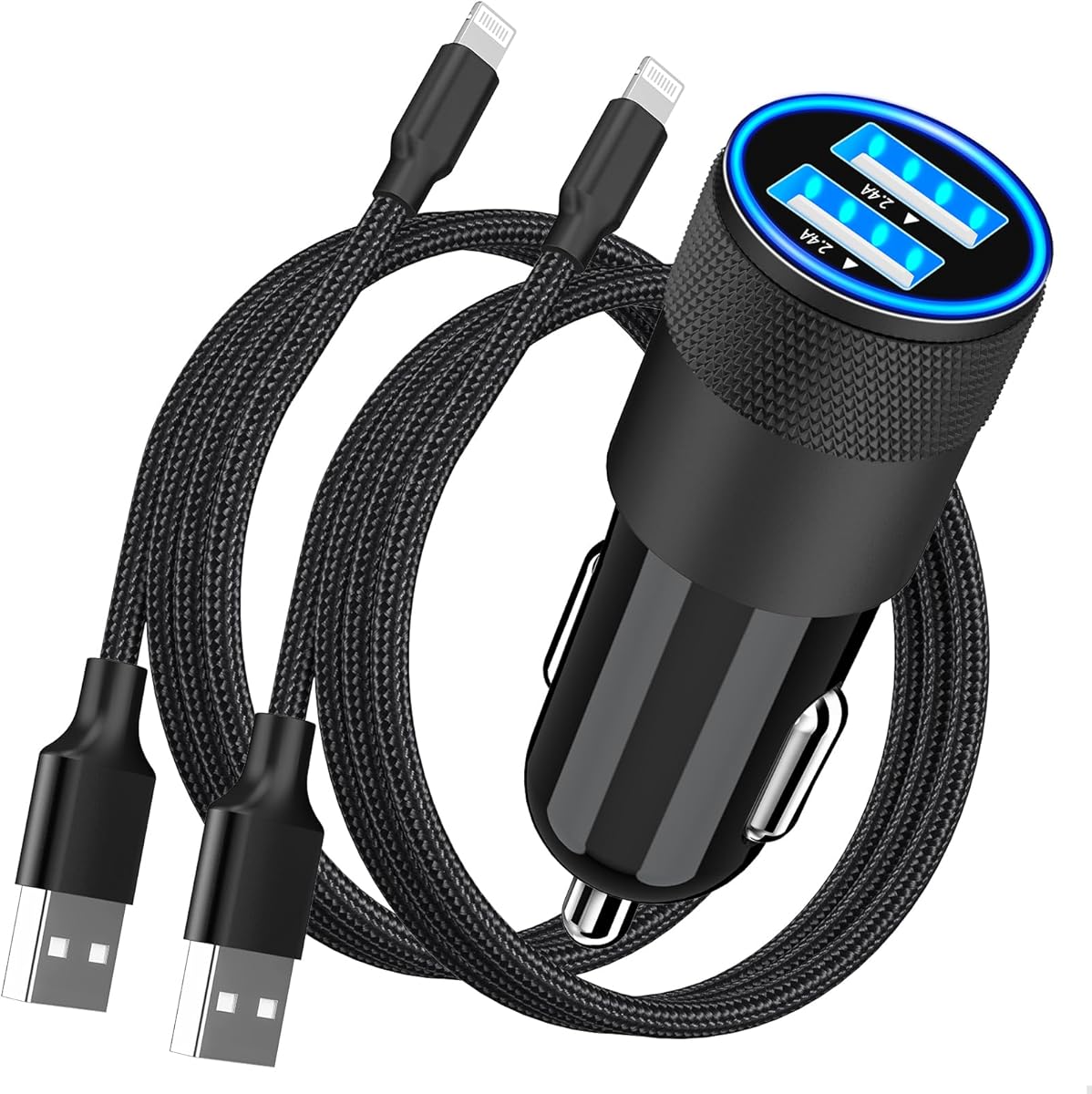
The Rombica 24W dual charger is a straightforward option for vehicles still centered on Lightning-equipped iPhones. It carries a 4.5 rating, includes two MFi-certified braided Lightning cables, and can charge two compatible devices through its dual USB-A ports.
We may earn a commission when you buy through this link, at no additional cost to you.
Output reaches 12 watts with one connected device and 24 watts when both ports are used, according to the supplied information. Its intelligent power-management system is described as automatically matching current to the attached device, while a dynamic temperature sensor and overload protection add layers of control.
The decisive limitation is the absence of USB-C. That makes this charger less future-oriented than most modern entries in the roundup, particularly for iPhone Duo users with USB-C cables or newer tablets. It also offers less total power than the 67-, 70-, 90-, and 99-watt alternatives.
Despite that limitation, the charger remains practical for older iPhones, iPads, and AirPods that use Lightning. The two included certified cables and straightforward plug-in operation make it appealing to drivers who want dependable basic charging rather than a complex multi-protocol setup.
The included cable pair is a major convenience for households with multiple Lightning-compatible devices. The listed iPhone 14, 13, 12, 11, X, 8, 7, 6, and SE families provide extensive backward-device coverage.
The two-port format is easy to understand and can serve two older iPhones at once. A blue ring indicator makes the ports easier to find, while the compact body is intended to fit closely around the vehicle socket.
We may earn a commission when you buy through this link, at no additional cost to you.
The 90W three-port USB-C adapter stands out for its strong 4.8 rating and flexible port arrangement. Two USB-C ports can deliver up to 45 watts each, while the USB-A port supports QC output, making the charger appropriate for an iPhone Duo, a passenger's phone, and an additional accessory.
We may earn a commission when you buy through this link, at no additional cost to you.
Its 90-watt maximum is reached with two USB-C devices according to the product data. Adding the USB-A connection changes the distribution, with one USB-C port and the USB-A port jointly receiving 15 watts while the remaining USB-C port continues to output up to 45 watts. Buyers who expect the headline output to remain unchanged across every port should note this distinction.
Thermal design is a notable strength. A ring of ventilation holes supports heat dissipation during high-power use, and the housing is made from PC-grade fire-resistant material. A subtle blue ring provides a clear operating indication without appearing visually dominant inside the cabin.
This is the most versatile premium option for people who regularly travel with several devices. It also includes two adapters, which is useful for multiple vehicles. It is a particularly strong recommendation when two USB-C phones need high output and a third, lower-power USB-A accessory only needs a modest top-up.
The pair of 45-watt USB-C outputs can provide meaningful charging to two compatible phones at once. This makes the adapter more relevant than conventional low-wait adapters for shared vehicles and longer commutes.
Ventilation holes around the body provide an additional path for heat to escape during sustained charging. Combined with the fire-resistant PC shell, this construction addresses one of the practical concerns associated with powerful automotive charging adapters.
We may earn a commission when you buy through this link, at no additional cost to you.
The SUPERONE 99W retractable charger is the most distinctive cable-management option in the list. Its 4.6 rating and 99-watt stated capacity make it appealing for drivers who want one central charging hub without leaving several loose cables across the center console.
We may earn a commission when you buy through this link, at no additional cost to you.
Two extendable cables measure 80 centimeters and retract into the body when not needed. One is a 30-watt USB-C cable, while the other is a 12-watt Apple cable. Additional fixed outputs include three 15-watt USB-C ports and one 12-watt USB-A port, allowing the product to serve as many as six devices according to the listing.
The 99-watt headline requires careful interpretation because the supplied information does not map every output combination to a specific wattage. Retractable cables can also be less convenient than fixed long cables for users who need to reach a device stored in a bag. Nevertheless, the compact 2.14-inch body and adjustable 180-degree plug offer clear advantages for travel and rough roads.
This charger is ideal for people who value a tidy cabin, carry several devices, and prefer not to pack separate charging leads. Its broad connector selection makes it useful for both USB-C and Lightning accessories, while the retractable format reduces visual clutter.
The built-in cables pull out only as far as needed and return inside the housing afterward. This keeps the center console clearer and makes the charger convenient for vehicles that are used for both commuting and longer road trips.
Two retractable cables and four additional ports create a centralized charging arrangement for phones, tablets, and accessories. The fixed 180-degree plug can also be repositioned to fit different socket orientations more securely.
We may earn a commission when you buy through this link, at no additional cost to you.
The YEAHFUN 70W three-port charger is a practical mixed-port option, with a 4.6 rating and compatibility across many older and newer iPhone families. It provides one USB-C port and two USB-A ports, allowing an iPhone, navigation device, and smaller accessory to charge together.
We may earn a commission when you buy through this link, at no additional cost to you.
Its maximum listed output is 70 watts, with up to 36 watts available through USB-C and two USB-A connections rated at 17 watts each. Support for PD, PPS, and QC broadens its usefulness with compatible Android devices, while the 12-volt to 24-volt range suits cars, SUVs, trucks, vans, taxis, and RVs.
The most appealing included accessory is the USB-A to iPhone CarPlay cable, which can support compatible vehicle infotainment functions alongside the separate USB-C to Lightning charging cable. On the other hand, the product's compatibility emphasis centers on iPhone 14 through older models, and a single USB-C port is limiting for households with multiple modern phones.
This charger makes the most sense for drivers whose vehicle has a CarPlay-oriented USB-A input or who still carry several USB-A accessories. It remains a capable three-device solution, but newer iPhone Duo users prioritizing all-USB-C charging may find a dual- or triple-USB-C alternative more future-oriented.
The included USB-A to iPhone cable can connect a compatible phone to a supported vehicle infotainment system. A separate three-foot USB-C to Lightning lead handles charging, reducing the need to carry multiple specialized cables.
The stated 12-volt to 24-volt compatibility allows the same charger to serve passenger cars, larger vehicles, and commercial settings. Always confirm that the vehicle has a suitable accessory socket before relying on this product.
We may earn a commission when you buy through this link, at no additional cost to you.
The Caiinei 24W coiled Lightning charger is aimed at drivers who need a long Apple-device cable and value a simpler approach to power management. Its 4.3 rating is the lowest in this roundup, but the distinctive cable design and certified connector give it a clear use case.
We may earn a commission when you buy through this link, at no additional cost to you.
The coiled cable naturally rests at approximately 1.3 feet and can extend to six feet when pulled. That makes it easier to reach an iPhone mounted near the windshield or placed farther across the cabin without permanently leaving a long cable stretched across the console. It uses a 12-watt maximum output when charged as a single device.
The dual USB-A arrangement delivers up to 24 watts when both ports are used, with intelligent distribution and temperature monitoring. However, there is no USB-C port, so this is not a natural fit for an iPhone Duo owner whose priority is the newest connector standard. The lower output also places it behind modern high-watt adapters.
This is a sensible legacy-oriented option for Lightning iPhones, iPads, and AirPods that need a long, tidy cable. For current USB-C devices or passengers who need faster simultaneous charging, one of the higher-output alternatives will be more appropriate.
The coiled design retracts toward the adapter between uses but can extend far enough for mounted devices. It is particularly useful for vehicles where the distance from the accessory socket to the driver's phone is greater than a short built-in lead can cover.
The C89 terminal, pull-up resistor, and MFi-certified chip are intended to support correct device recognition and safer power delivery. The included Lightning lead is designed for numerous older iPhone, iPad, and AirPods models.
We may earn a commission when you buy through this link, at no additional cost to you.
The right automotive charger depends less on the largest advertised wattage and more on connector compatibility, sustained output, safety controls, physical fit, and the number and types of devices used during a drive.
Begin by identifying the connector used by your iPhone Duo and every other device that needs power in the car. USB-C is the more forward-looking choice and supports the highest-output options in this roundup, while Lightning remains necessary for older iPhones, many accessories, and some iPad models. A mixed USB-C and USB-A charger offers a middle ground, whereas a Lightning-only bundle may leave you carrying an additional adapter.
Match the charger to the devices you actually use today and plan to use next year. A USB-C-only model is ideal for an all-USB-C collection, while a mixed-port adapter is more adaptable to mixed vehicles and passenger devices.
A 90-watt label does not mean every connected device receives 90 watts. Some products distribute their total capacity across all active ports, while others specify up to 45 watts on each of two USB-C connections when only those ports are used. The 67-, 70-, 90-, and 99-watt chargers therefore serve different use cases depending on the number of devices connected.
Look for both total output and the stated allocation for each port. If one iPhone receives the primary charge, per-port output matters more than the aggregate number. If several passengers need power at once, verify that sharing the output will still provide useful charging speeds.
USB Power Delivery is central to modern fast charging, while PPS and QC protocols are useful for many compatible Android devices. A charger that supports several protocols can serve a mixed phone collection, and PD, PPS, and QC support appears in several of the strongest multi-device options. The attached cable must also support the desired standard for a phone to take full advantage of the adapter.
Prioritize the protocols used by your regular devices rather than treating the longest protocol list as the only consideration. For an all-Apple setup, PD and a certified cable are the most relevant points of comparison.
A cable can determine whether a powerful charger delivers its intended performance, so the included lead deserves attention. MFi certification is particularly relevant for Apple-device compatibility, while braided or retractable constructions can improve durability and cabin organization. The LISEN, Linocell, Rombica, and Caiinei bundles include Lightning or MFi-certified cables, while the Anker charger leaves cable selection to the buyer.
Check the connector type, length, and certification of any included cable. If a product omits the correct lead, plan to purchase a quality cable that supports both your device and the charger's output level.
Automotive adapters operate in a confined environment, and sustained high-power charging can produce heat. Ventilation holes, temperature sensors, power-management chips, and thermal monitoring are therefore more meaningful than decorative features. Several products also list protection against over-current, over-voltage, overheating, and short circuits, which provides useful reassurance for daily charging.
Favor chargers with active temperature monitoring, intelligent output adjustment, and a housing material designed for heat dissipation. Avoid leaving cords pinched, tightly bent, or positioned where they can interfere with pedals and other controls.
A compact charger is easier to use when it does not protrude excessively from the accessory socket or obstruct nearby dashboard functions. The Anker and LISEN models emphasize small dimensions, while the SUPERONE charger offers an adjustable 180-degree plug for different socket orientations. A low-profile design is particularly helpful in compact vehicles, but it should remain easy to grip when removal is needed.
Measure the available clearance and consider whether passengers need direct access to the ports. Select a form factor that remains visible enough to operate without leaning awkwardly across the center console.
Retractable and coiled cables can keep the console clean, but they may be less useful for devices stored in a bag or mounted far from the socket. Fixed short leads are tidier when everything remains close to the charger, while longer cables offer placement flexibility. Aluminum, ABS, and PC housings provide different combinations of weight, scratch resistance, durability, and heat handling.
Think about where phones and accessories are placed before choosing a cable system. For frequent passengers, compact fixed leads may be simplest; for drivers who value a clean cabin or need to reach a windshield-mounted device, retractable or extended cables are worth considering.
A two-port charger is adequate for occasional passenger charging, but a three-port unit is more useful when every ride includes a phone, tablet, and accessory. The SUPERONE model goes further with six stated charging positions, including retractable cables. More ports do not automatically mean better performance, so port count should be balanced against output allocation, physical size, and the number of legacy devices.
Count the devices that need power on a typical trip rather than the maximum number imaginable. Also account for adapters, because a USB-C phone may still require a USB-C-to-Lightning cable for older accessories.
Start the vehicle and position the charger firmly in the appropriate 12-volt accessory socket. Connect the charger first, plug the device into the appropriate port, and then open the phone or accessory to begin charging. For a mounted iPhone, route the cable so it cannot cross a control, obscure the driver's view, or interfere with the gear selector.
When the charger includes multiple cables, use the connector that matches the device and the charging standard it supports. A Lightning-equipped iPhone needs a USB-C-to-Lightning lead, while a current USB-C iPhone needs a suitable USB-C-to-USB-C cable. Avoid very old or low-quality cables, and do not expect every phone to draw the maximum output listed for the charger.
Remove the adapter before turning the vehicle off if the socket remains live, and never force the plug sideways. Keep the socket clean, avoid liquids near the charger, and inspect cables for damaged insulation. Do not use a charger that feels excessively hot, smells unusual, or shows discoloration; disconnect it and seek a replacement or professional inspection.
The correct connector depends on the iPhone Duo model and the cable you use. Newer USB-C-equipped models require a USB-C-to-USB-C cable, while Lightning-equipped versions require a USB-C-to-Lightning lead. Check the device's charging port and the accessories included with the charger before ordering.
Yes, provided the charger has at least two output ports and each device is connected with an appropriate cable. Actual charging speed depends on the total-output allocation, the phone models, and the protocols each device supports. Some high-output adapters reserve most power for one port when several devices are connected.
A 90-watt figure generally describes the adapter's maximum combined output across its ports. It may provide up to 45 watts on each of two USB-C ports when only those two are used, but the allocation can change when a third connection is added. It is an upper limit, not a guarantee that every phone will accept 90 watts.
An MFi-certified cable provides assurance that the connector and electronics meet Apple's compatibility and safety standards. It is especially useful for Lightning connections and for owners who want reliable fast charging. USB-C cables can still work well, but buyers should check the cable's supported power and data ratings.
Retractable cables are designed to shorten the amount of loose cable inside the vehicle, which can make the console tidier. Their long-term durability depends on how frequently they are extended, the quality of the internal winding mechanism, and whether they are pulled beyond their rated length. Treat the cable as a normal charging lead rather than tugging it sharply to retract it.
Most automotive chargers work with both 12-volt passenger vehicles and 24-volt larger vehicles, but compatibility should be confirmed for the specific product. The car must also have a suitable accessory socket rather than relying on a domestic wall outlet. Check the vehicle manual and charger specifications before installation.
Charging while the vehicle is parked can create concerns because the battery may not be maintained, temperature can fluctuate, and the charging session can extend for many hours. Use a charger with temperature monitoring and standard protections, avoid exposed heat, and unplug the device when it is no longer needed.
The cause may involve the charger, cable, phone model, device temperature, or how power is distributed among connected ports. A low-quality or incompatible cable can prevent fast charging, while adding several devices may reduce the output available to each one. Check the supported protocols and ensure the phone is not too hot or displaying a reduced charging state.
The Anker 40W PowerIQ 3.0 is the most balanced overall recommendation, combining a 4.8 rating, fast USB-C charging, a compact body, and two-port flexibility. The 67W three-port model offers the strongest value-oriented combination of mixed connectors, a 4.7 rating, and an included cable, while the 90W three-port USB-C adapter stands out as the most adaptable premium option.
Prioritize the connector your iPhone Duo actually uses, then match output to the number of devices that need charging. Cable management, heat controls, socket clearance, and the inclusion of a certified cable can be more important in daily use than a higher headline wattage. A two-port compact model is often sufficient for solo or couple travel, while three-port designs suit shared vehicles and passenger charging.
Before purchasing, verify the exact device compatibility, included accessories, vehicle socket requirements, and current listing details. Ratings and technical specifications can change over time, and prices fluctuate more frequently, so checking the latest product page helps ensure that the selected charger still matches your needs and budget.