
Eaton Tripp Lite Heavy-Duty Power Cord
4.8Editor score
Heavy-duty 14AWG conductors
Six-foot NEMA connection
Lifetime manufacturer warranty
Extension cord for sewing machine guide comparing 10 options for length, gauge, safety, plug design, and compatibility to help you choose confidently.
An extension cord for a sewing machine should provide a safe, convenient connection without creating a trip hazard at your worktable. Length, wire gauge, grounding, plug design, and compatibility with the machine’s power requirements all affect the result. The best choice depends on your outlet placement and workspace.
This guide compares ten extension cords using the supplied product specifications, including length, conductor size, current rating, certification, connector style, and intended applications. It includes general-purpose cords for household equipment, flat models for compact spaces, outdoor-rated options, and a dedicated sewing-machine replacement cable.
Each product is evaluated for the role it appears best suited to handle, from shorter indoor runs to longer, heavy-duty connections. The ratings and listed features help distinguish the options, although product availability, configuration, and prices can change, so readers should confirm the latest details before purchasing.
4.8Editor score

4.8Editor score

4.8Editor score
The comparison below highlights each cord’s length, wire size, electrical rating, and most useful physical feature. These details make it easier to identify the right option for a sewing table, a compact room, a heavy appliance, or an outdoor installation.



This heavy-duty extension cord is built for larger equipment rather than being designed specifically for sewing machines. It uses 14-gauge wire, carries a stated maximum of 15 amps at 125 volts, and supports up to 1875 watts. Its three-prong grounded connection and UL listing make it a robust option when a sewing table shares power with demanding household equipment.
We may earn a commission when you buy through this link, at no additional cost to you.
The standout feature is the angled plug, which is intended to keep the connection close to the wall where space is limited. That design can be helpful behind a sewing cabinet, especially when a standard projecting plug would prevent the cabinet from sitting flush. The six-foot length provides a short, manageable run rather than encouraging an unnecessarily long extension.
The tradeoff is that a short heavy-duty cable may not reach the nearest outlet, while its 14-gauge construction is more than many ordinary sewing machines require. It is also not the most discreet option because the cable is a traditional round design. Buyers should avoid daisy-chaining it with another extension cord just to obtain extra reach.
This cord makes the most sense for someone who prioritizes a grounded, higher-capacity connection over maximum cable length. It is a sensible choice when the wall outlet is close to the sewing area and the machine has a standard three-prong power connection. For a longer or machine-specific setup, one of the longer or dedicated sewing cables may be a better fit.
The 15-amp rating and 14-gauge construction provide ample capacity for a typical sewing machine and leave more margin for a connected accessory. This makes the cord practical in a craft room where other grounded tools may also need access to the same nearby outlet.
The angled plug can reduce the gap between a receptacle and nearby furniture or cabinetry. That is especially useful in a narrow sewing area where the machine’s own cord would otherwise be forced into an awkward bend.
We may earn a commission when you buy through this link, at no additional cost to you.
The Maximm cord combines a useful 15-foot length with a low-profile flat cable and a rotating plug. It is rated for 13 amps at 125 volts, or up to 1625 watts, using 16-gauge copper conductors. Although not a sewing-machine-specific cable, its combination of reach, flexibility, and space-saving construction fits many sewing-room layouts.
We may earn a commission when you buy through this link, at no additional cost to you.
The 360-degree rotating plug is the most distinctive feature. It can be turned toward the direction of the cable without sharply bending the plug body, which helps in receptacles placed behind furniture or close to a wall. The flat wire is easier to run under carpeting or along a baseboard than a thick round cable, and it is less likely to create an obvious raised obstacle at a worktable.
Because it has only one outlet, this is not a convenient mini power strip for a sewing machine, lamp, and several other devices at once. Its 16-gauge rating is suitable for many household electronics and standard sewing equipment, but users should compare the sewing machine’s electrical requirements with the cord’s limits. The product information describes it for home use rather than outdoor exposure.
Overall, this is a strong all-around extension cord for a sewing space where the outlet is several feet away and furniture is packed tightly. It is particularly useful when routing flexibility and outlet clearance matter more than having several receptacles. The rotating plug, long reach, and flat profile make it easier to install neatly around a craft table.
A plug that rotates through 360 degrees can follow the cable’s direction instead of forcing the conductors to twist at the receptacle. This may reduce stress at the connection and simplifies setup in recessed or awkwardly positioned outlets.
The slim 16/3 cable is listed as thinner than a standard round extension cord. That profile can fit under rugs or run beside baseboards, while the single-outlet format avoids adding another bulky block near the sewing area.
We may earn a commission when you buy through this link, at no additional cost to you.
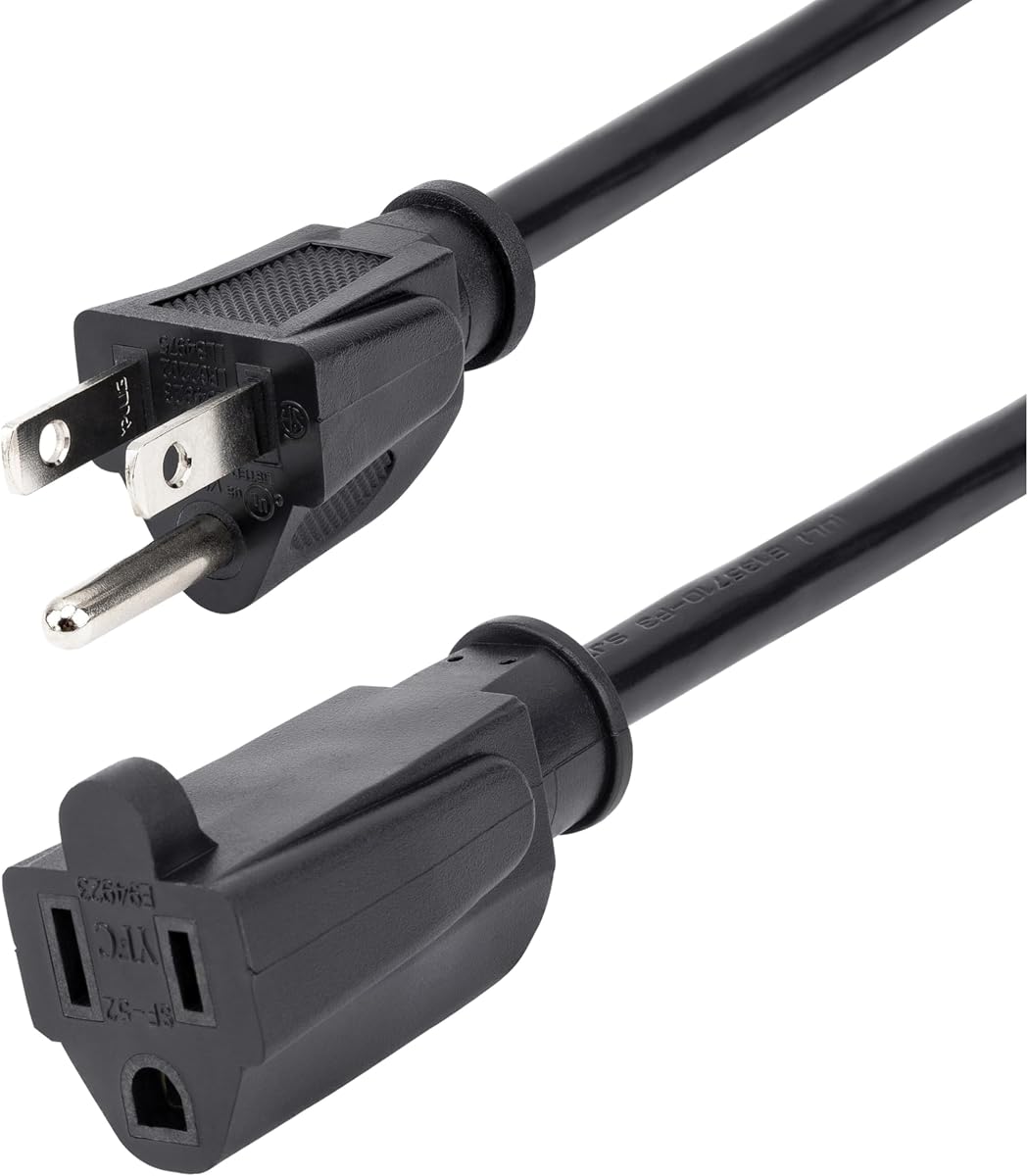
The Eaton Tripp Lite P024-006 is a premium heavy-duty extension cable intended for equipment that benefits from heavier-gauge wiring. It uses 14AWG conductors, is rated for 15 amps at 120 volts, and features NEMA 5-15P to NEMA 5-15R connections. The result is a conventional, professionally oriented cord that can serve a sewing machine near a nearby outlet.
We may earn a commission when you buy through this link, at no additional cost to you.
Its main advantages are clear construction specifications, UL listing, and a lifetime limited manufacturer’s warranty. The male-to-female NEMA configuration is familiar in North American homes and offices, making it straightforward to identify compatibility. Because the cable is only six feet long, it can keep a sewing setup visually orderly while still providing heavier-gauge capacity.
The six-foot reach is the primary limitation for a sewing table positioned away from a wall outlet. Users should not connect multiple extension cords to obtain more distance, as that can create unsafe loading and connection conditions. A conventional round profile also takes up slightly more visual space than the flat alternatives in this guide.
This cord is best for buyers who want a recognized heavy-duty construction and a long warranty rather than maximum reach. It is especially appropriate when the sewing machine has a standard grounded plug and the nearest outlet is close to the table. Those needing a machine-specific replacement interface should instead confirm the connector shape before ordering.
The 14AWG construction and 15-amp rating provide useful capacity for standard household equipment. That makes this cable a sensible choice in a shared sewing space where it may also be used for another suitable grounded appliance.
NEMA 5-15 connectors make the connection format clear, while UL listing and a lifetime limited warranty add confidence. These details are useful for buyers who value established electrical specifications over a specialized sewing-machine connector.
We may earn a commission when you buy through this link, at no additional cost to you.
StarTech’s PAC10110 provides a conventional 10-foot extension cord for workstations, home offices, and household equipment. It is listed for indoor use, uses 16AWG wire, and is rated to carry 13 amps at 125 volts. That combination gives a sewing machine a moderate amount of extra reach without turning the cord into a sprawling cable across the floor.
We may earn a commission when you buy through this link, at no additional cost to you.
The molded strain relief at the connectors is designed to improve durability where the cable enters the plug and receptacle. The product is UL listed under UL62 and UL817, carries a VW-1 fire rating, and uses 100 percent copper wire. Its NEMA 5-15P-to-5-15R arrangement is compatible with standard North American three-prong outlets.
Its round 0.33-inch jacket is less space-efficient than a flat cable, and the ten-foot length may still fall short if the sewing table is at the far side of a room. The product information is oriented toward indoor electronics and equipment, so it should not be treated as a weather-resistant outdoor cable. The listing also includes an 18AWG line within its specifications despite identifying the product as 16AWG, so buyers should rely on the title and verify the conductor marking on the actual package if wire size is critical.
For a sewing setup with a standard grounded connection and a moderate distance to the wall, this is a straightforward choice. It works particularly well when the cord can be routed behind the table rather than across a walkway. Buyers prioritizing a low-profile design or explicit sewing-machine compatibility should consider a flatter or dedicated alternative.
The fully molded strain relief helps protect the points where the cable meets its connectors. That matters in an active craft space because repeated movement near the plug is a common source of wear on otherwise serviceable extension cords.
A 10-foot length gives a sewing table some flexibility without creating the excess cable associated with a much longer cord. It can also be secured along a wall or table support to keep the main work area clear.
We may earn a commission when you buy through this link, at no additional cost to you.
This EP extension cord is a compact three-foot option with notably heavy 12/3 SJTW construction. It is rated for 15 amps, 125 volts, and 1875 watts, and the three-prong plug adds grounding for compatible equipment. For a sewing machine positioned immediately beside a wall outlet, its short length can be an advantage because there is little excess cable to gather or route.
We may earn a commission when you buy through this link, at no additional cost to you.
The flexible vinyl jacket is intended to resist moisture, abrasion, and direct sunlight, while the product information highlights reinforced blades designed to reduce bending or breakage. The cord is ETL listed, and the stated temperature range is from minus 40 degrees Fahrenheit to 140 degrees Fahrenheit. It is also described as remaining flexible in cold conditions rather than becoming stiff or cracked.
The obvious limitation is reach. A three-foot cord cannot solve a meaningful distance between the sewing table and the outlet, and connecting it to another extension is not a good workaround. It is also an indoor cord despite its heavy-duty construction, so weather exposure should be avoided. Its larger wire size may be unnecessary for a modest sewing machine.
The product is best treated as a short, robust link for a nearby outlet or as a tidy alternative to a much longer cord. It may also suit other household appliances within its stated rating, provided the connection and environment are appropriate. Buyers whose outlet is several feet away should look to the ten- or fifteen-foot options instead.
At three feet, the cord can be easier to conceal than a long extension. That makes it useful beside a desk, cabinet, or sewing table positioned immediately beside a receptacle where excess cable would otherwise collect in the work zone.
The product description emphasizes reinforced blades and a flexible jacket. These features are intended to withstand routine handling, although the cord should still be unplugged by the plug rather than pulled by the cable.
We may earn a commission when you buy through this link, at no additional cost to you.
The Vockjour 10-foot extension cord is designed for both indoor and outdoor use. It uses 16-gauge conductors, is rated for 13 amps at 125 volts, and has a 5-15P/R three-prong configuration. That broad environmental focus makes it useful for a sewing room with nearby outdoor project space, though it is not specifically designed for sewing machines.
We may earn a commission when you buy through this link, at no additional cost to you.
Its polyethylene sheath is described as weatherproof, flame retardant, cold resistant, heat resistant, and abrasion resistant. The listed temperature range extends from minus 58 degrees Fahrenheit to 158 degrees Fahrenheit. The product also features rugged strain relief rated in the description for more than 20,000 bends, along with hanging hooks and a non-slip plug design.
Outdoor electrical use still requires responsible placement. The IP65 material rating does not mean the cord should be submerged, and exposed connections should be protected from standing water. Sewing machines are generally intended for dry indoor operation, so the main value for a sewing setup is the same as for any indoor area: a versatile cord with durable strain relief and a useful ten-foot length.
This is a good selection for users who want one cable to handle indoor and outdoor accessories, provided they follow the stated electrical limits. It may be particularly useful for a patio craft area, workshop, or sewing room near a garage. For a dedicated machine connection, buyers should still verify the plug shape and power requirements.
The listed outdoor capabilities broaden the cord’s usefulness beyond a dedicated sewing area. It can support suitable small appliances, lights, or tools around the home, provided connections remain dry and all electrical ratings are observed.
Built-in hooks make it easier to keep the cord elevated and organized when it is not in use. That can reduce floor clutter and simplify storage in a workshop, garage, or craft area.
We may earn a commission when you buy through this link, at no additional cost to you.
This 14/3 indoor power cable combines heavy-duty electrical specifications with a space-saving 45-degree flat plug. It is rated for 15 amps, 125 volts, and 1875 watts, making it suitable for a standard sewing machine when the connector matches. The three-foot length keeps it focused on installations where the wall receptacle is very close.
We may earn a commission when you buy through this link, at no additional cost to you.
The low-profile right-angle plug is intended to sit flush against a wall, allowing furniture or appliances to remain closer without sharply bending the cord. The product also describes a 45-degree design that keeps the second outlet on the receptacle accessible. Reinforced strain relief at both ends is intended to protect against fraying, and the neutral gray jacket blends into home or office environments.
Its three-foot length offers little flexibility, and the internal product description refers to major appliances and other higher-power equipment rather than a dedicated sewing-machine application. It is also designated for indoor use, so it should not be left exposed to weather. Users should verify the machine’s cord connector rather than assuming a standard three-prong configuration will fit every model.
The cord is best for a sewing cabinet placed right beside an outlet, especially when the plug needs to remain flat against the wall. Its heavy gauge and 15-amp rating provide ample electrical capacity, while the low-profile plug improves furniture clearance. If the machine is farther from the receptacle, a longer cable is more practical.
The 45-degree plug allows the connection to occupy less depth than a conventional projecting plug. That can create useful clearance behind a narrow sewing cabinet, cabinetry, or a piece of furniture positioned against the wall.
The short cable is easy to bend and conceal immediately beside a receptacle. Reinforced strain relief at both ends supports durability in an active workspace, provided the cord is not repeatedly pulled sharply.
We may earn a commission when you buy through this link, at no additional cost to you.
The TROND extension cord is a compact flat power strip with three grounded outlets placed on different sides. Its six-foot cable uses SPT 16/3 copper conductors, and the product is rated for a maximum of 1625 watts at 125 volts and 13 amps. It is particularly useful when a sewing table needs access to several low-draw devices without crowding the wall receptacle.
We may earn a commission when you buy through this link, at no additional cost to you.
Its patented right-angle plug is only 0.33 inches in profile and is designed to keep furniture close to a wall while freeing the lower outlet on a standard receptacle. The three-way arrangement allows multiple plugs to approach from different directions, reducing blockage. UL94 V-0 flame-retardant PC and ABS materials form the outlet housing, while a PVC insulator surrounds the copper conductors.
The product is intended for indoor use and is not suitable for recessed floor outlets. The description also warns that the sockets are tight, so plugs may need firm insertion. Its total 13-amp rating applies to the cord and should not be treated as independent capacity for every outlet. A sewing machine and a light could share it, but multiple high-draw appliances could exceed the combined limit.
This cord is a good match for compact sewing stations that need a small number of connections in one place. It is less appropriate for someone who wants a long single cable or a dedicated low-profile wire running under furniture. Buyers should confirm that the sewing machine’s plug fits the tight socket and stay within the stated wattage.
Outlets located on multiple sides allow adjacent plugs to occupy different directions instead of competing for the same space. That is helpful beside a sewing table where the machine, lamp, and another accessory may all need power.
The low-profile right-angle design is intended to free the bottom receptacle position. Its 0.33-inch profile also makes the connection easier to conceal behind furniture when the surrounding clearance is limited.
We may earn a commission when you buy through this link, at no additional cost to you.
The Amazon Basics 10-foot extension cord is a general-purpose indoor cord with a familiar three-prong format. It is rated for 13 amps at 125 volts and uses 16AWG conductors, making it suitable for many standard household electronics and compatible sewing machines. Its white finish is designed to blend into home and office environments.
We may earn a commission when you buy through this link, at no additional cost to you.
The cord plugs into a standard three-prong outlet and accepts either two- or three-prong device plugs. That flexibility makes it useful when a worktable must support a sewing machine alongside accessories that have different plug formats. A ten-foot length provides useful positioning flexibility without the excess cable associated with a substantially longer extension.
The design is relatively basic, with one outlet and no rotating or angled plug to help with awkward receptacles. It is also designated for indoor use. Buyers should still confirm the sewing machine’s electrical requirements and connector shape, and they should avoid adding the machine to a daisy-chained arrangement or exceeding the stated rating.
This cord is a practical choice for a standard sewing room where the wall outlet is moderately distant and the cable can be routed behind the table. It is a sensible alternative to a specialized cable when the machine uses a standard plug. Those wanting extra outlets or a flatter profile should compare the TROND or Maximm options instead.
Accepting both two- and three-prong device plugs makes the outlet useful for a varied group of accessories. That is helpful in a sewing room where lamps, small tools, and the main machine may not all use the same connector format.
The white cable is intended to blend with common home and office finishes. It is easiest to keep inconspicuous when routed along a baseboard, behind a sewing table, or parallel to a wall.
We may earn a commission when you buy through this link, at no additional cost to you.
This is the only product in the list built specifically as a sewing-machine power cord. The six-foot replacement cable uses a two-slot American connector, 18AWG wire, and includes stated over-current and over-temperature protection. It is intended to replace a lost or damaged original cord while supporting a broad list of machines from major sewing brands.
We may earn a commission when you buy through this link, at no additional cost to you.
The stated compatibility covers many Brother, Singer, Baby-Lock, Viking, Pfaff, and Bernina models. The product description includes long lists of compatible model numbers, including Brother CS6000i and CS80, Singer CE-150 and 9940, and various Bernina and Pfaff machines. It also notes American UL certification under E205765 and provides a one-year warranty with stated customer service support.
Compatibility must still be checked carefully. The description emphasizes that one end is square and the other is round, so a machine with a different physical interface will not work merely because the brand name appears on the list. Sewing machines that require a three-prong grounded connection are not a match for this two-slot cord. Buyers should compare the machine’s existing connector, model number, and manual before ordering.
This cable is the strongest choice for a buyer whose machine is explicitly listed and whose original cord is missing or damaged. It avoids the uncertainty of adapting a general household extension cord to a specialized machine connector. For a machine with a standard three-prong plug or for a longer reach, one of the conventional extension cords in the guide will be more appropriate.
The square-to-round connector format is designed around sewing-machine power leads rather than general household appliances. It provides a direct replacement solution for the many models included in the supplied compatibility list.
The listing identifies over-current and over-temperature protection along with American UL certification information. Buyers should still match the connector and model number before installation and follow the sewing machine manufacturer’s guidance.
We may earn a commission when you buy through this link, at no additional cost to you.
The most useful extension cord is one that matches the machine’s connector, stays within its electrical rating, and reaches the nearest outlet without creating clutter. Length, gauge, plug geometry, certification, and environmental suitability should be considered together rather than independently.
Begin with the plug on the sewing machine, not with the extension cord’s generic description. A dedicated sewing-machine cord may use a two-slot, square-to-round interface, while many modern machines use a standard three-prong plug. The dedicated six-foot cable in this guide lists compatibility for many Brother, Singer, Baby-Lock, Viking, Pfaff, and Bernina models, but the exact model number still needs to be confirmed. A standard household extension cord is appropriate only when its male and female connectors physically and electrically match the equipment.
In short, match the connector shape, model number, and grounding requirements before considering length or appearance.
Measure from the wall receptacle to the sewing machine and then allow a small amount of slack for servicing and connector bending. Three feet works well only for a table immediately beside an outlet. Six feet offers more flexibility while remaining easy to conceal, while ten or fifteen feet can reach a farther wall or another side of the room. A longer cord is not automatically better because excess cable can bunch under the table, snag a foot, or create a needlessly complex path.
In short, choose the shortest length that reaches comfortably and can be routed without a trip hazard.
Wire gauge helps determine how much current the cord can carry safely. The products in this guide range from 18AWG in the dedicated sewing-machine replacement cord to 12/3 and 14-gauge constructions among the heavy-duty general-purpose cords. The stated limits range from 13 amps and 1625 watts to 15 amps and 1875 watts. Most standard sewing machines fall well within these figures, but the machine’s manual and label should be checked, especially if an accessory draws additional power or several devices share one cord.
In short, select a cord whose listed amperage and wattage comfortably cover the intended load without approaching its limit.
A three-prong connection provides grounding when both the machine and the cord use compatible grounded plugs. It should be inserted into a properly grounded wall receptacle rather than a loose or damaged outlet. Two-slot dedicated sewing cords serve a different purpose and should be used only with compatible machines. The cords in this guide feature NEMA connectors, rotating plugs, angled plugs, reinforced blades, or molded strain relief, each intended to make the connection more secure.
In short, preserve the intended grounding arrangement and never alter a plug to make an incompatible cord fit.
The shape of the plug and cable can be more important than the stated length in a crowded sewing area. A low-profile angled plug may fit behind a narrow cabinet, while a flat cable can run beneath a rug or along a baseboard. The Maximm and TROND models use flat cable designs, and the Maximm plug rotates through 360 degrees for easier routing. These features help reduce bulk, although a flat cable still needs to be secured where it crosses a walking area.
In short, choose a low-profile option when furniture clearance and cable concealment matter more than multiple outlets.
A single-outlet cord is often preferable when the sewing machine has a dedicated connection and other devices can use nearby receptacles. The TROND model offers three grounded outlets on different sides, making it useful for a compact multi-device station. The combined current still cannot exceed the cord’s 13-amp and 1625-watt rating, so multiple high-draw appliances should not be connected together.
In short, use a multi-outlet model for convenience, but treat its outlets as one shared electrical circuit.
Most sewing machines are used indoors, so an indoor cord is normally the correct choice. The Vockjour product is the exception in this group, with a weather-resistant polyethylene sheath, broad temperature range, and IP65 material rating. That makes it more suitable for outdoor accessories and damp-area planning, although it should not be assumed to be waterproof in every installation. Connections and receptacles still need to remain dry, and extension cords should never be used beyond their listed environment.
In short, choose a weather-resistant cord for exposed outdoor equipment, but keep the sewing machine itself in a dry indoor area.
UL or ETL listing provides useful evidence that a cord has been evaluated for recognized safety standards. Certification does not make every application safe, so buyers must still follow the voltage, current, wattage, and environmental limits. Look for adequate insulation, a suitable jacket, and strain relief where the cable enters the plug. The listed products variously mention heavy-duty vinyl, PVC, SJTW, SPT insulation, molded strain relief, and reinforced blades. A sturdy jacket and secure connector are particularly valuable in an active sewing area where cords are moved and plugged in regularly.
In short, favor a recognized listing, intact insulation, and reinforced connector ends for dependable everyday use.
Before connecting the cord, inspect the entire cable and both connectors for cuts, crushed sections, loose prongs, discoloration, or damaged insulation. Confirm that the cord’s connector matches the machine and that its voltage and current ratings cover the equipment. Plug the extension cord into a sound, properly grounded wall receptacle, then connect the sewing machine only after the extension is fully seated.
Route the cable so it does not cross an open walkway, sit under a rug, contact moisture, or become pinched beneath furniture. Flat cables can be secured along a baseboard or table support, while longer cords should be loosely coiled rather than wrapped tightly around the plug. Do not use staples, sharp fasteners, or adhesive that could damage the jacket, and do not coil a cord while it is carrying a heavy load.
Unplug the extension cord when changing needles, servicing the machine, leaving the room for extended periods, or noticing unusual heat, discoloration, buzzing, or a damaged connector. Pull from the plug rather than the cable. Keep the cord away from hot irons, space heaters, sewing-machine motors, and water, and never join multiple extension cords to increase reach. Periodic inspection helps ensure the insulation and connections remain in safe condition.
An extension cord can be used when its connectors match the machine, its voltage and current ratings cover the load, and the cord is in good condition. Most standard sewing machines operate well within the 13-amp limits of the products reviewed, but the machine’s manual and label should be checked. A dedicated sewing-machine cord should be used only with compatible models.
A three-prong cord is appropriate when the sewing machine has a three-prong plug and the wall outlet is properly grounded. It maintains the intended grounding path. Machines designed for a two-slot sewing-machine connector require the correct dedicated cable rather than a generic three-prong extension.
The best length is the shortest one that reaches without stretching or creating excess cable. Three feet suits a table directly beside an outlet, while six, ten, or fifteen feet offers more placement flexibility. Measure the actual route and allow enough slack to connect and disconnect the machine without pulling against the plug.
It is best to avoid daisy-chaining because it can exceed the intended rating, create difficult-to-inspect connections, and increase resistance. Use a single cord that is long enough and rated for the load. If an outlet is too far away, using a properly rated cord with one additional grounded receptacle may be more suitable than linking extension cords together.
A flat cord can be easier to route under furniture or along a baseboard because it creates a lower profile. It should not be placed under a rug if heat buildup or concealed damage is possible, and it must remain clear of moving furniture, sewing-machine parts, and foot traffic. Secure the cable and inspect it regularly.
A heavy-gauge cord is not automatically necessary for every sewing machine, because many models consume relatively little power. The 16-gauge options are commonly sufficient, while 14-gauge and 12/3 cords provide additional capacity for heavier loads. Confirm the machine’s electrical rating and avoid exceeding the cord’s listed limits.
The Maximm flat cord is useful when long reach and a rotating plug matter, while the TROND model is useful when several devices need access to one compact block. The short flat-plug options work best immediately beside an outlet. The right choice depends on connector type, nearby clearance, and the number of devices involved.
First identify the connector shape and the machine’s exact model number. Then compare those details with the manufacturer’s manual and the replacement cord’s compatibility list. A dedicated two-slot cord is appropriate only when the machine uses that interface, while a standard three-prong cord requires a matching three-prong machine plug.
The Maximm 15-foot rotating flat cord stands out for flexible routing, useful reach, and a space-saving profile. The Eaton Tripp Lite cord is the premium heavy-duty option for buyers who prioritize 14AWG construction, recognized connectors, and a lifetime limited warranty. The dedicated sewing-machine power cord is the most targeted choice for a compatible model whose original two-slot cord is missing.
For all other setups, prioritize the connector first, followed by the required length, current rating, and intended indoor or outdoor environment. A flat plug can improve clearance around furniture, while a multi-outlet model can organize a compact station. Whichever format is selected, the cord should be routed carefully, kept dry, and inspected for damage.
Ratings, availability, configurations, and prices can change, so check the current product listing before making a final decision. Confirm the sewing machine’s model and power requirements, compare them with the cord specifications, and review the seller’s latest details. Those checks will help ensure that the selected extension cord fits both the machine and the intended workspace.
