
Reotemp K83B1
4.7Editor score
12-inch corrosion-resistant probe
Digital composting guide included
Waterproof dustproof construction
Fahrenheit and Celsius scales
Digital Soil Thermometer guide comparing temperature displays, probe lengths, moisture functions, composting features, and monitoring capabilities.
A digital soil thermometer helps gardeners, composters, farmers, and plant owners check temperature below the soil surface, where root and worm activity may differ noticeably from the weather above ground. The right model can make watering, planting, transplanting, composting, and greenhouse decisions more informed and consistent.
This guide compares ten digital and digital-hybrid soil monitoring tools across the functions supported by their published specifications. We considered soil-temperature readings, display visibility, probe design, moisture and pH measurements, composting guidance, wireless monitoring, and suitability for indoor or outdoor growing environments.
Each review identifies the product's strongest use case, important limitations, and ideal buyer. Ratings and product details reflect the supplied listings, while availability, included accessories, and prices can change, so readers should confirm current listing information before making a final purchase decision.
4.7Editor score

4.4Editor score

4.2Editor score
The comparison below highlights core temperature, display, probe, and monitoring capabilities to help buyers identify the most appropriate soil thermometer for gardening, composting, or connected plant care.




The YAMRON 4-in-1 is a digital plant-care meter that combines soil moisture, pH, temperature, and sunlight readings in one instrument. Its 4.2 rating reflects a generally useful feature set, while the large backlit display, adjustable head, and support for both indoor and outdoor plants make it a practical choice for users who want more than temperature alone.
We may earn a commission when you buy through this link, at no additional cost to you.
The main advantage is its combination of functions. A grower can check whether the soil is wet enough, inspect its pH, see the root-zone temperature, and evaluate the light reaching the growing area without switching between separate tools. The screen uses numbers and simple graphics, and the 45-degree rotating head helps reduce the need to crouch awkwardly when the probe is already in a pot or garden bed.
The listing includes a meaningful care instruction: the probe should be inserted about four inches into suitable soil, but it should not be forced into extremely dry, hard ground. The test area should be moistened and allowed to settle before insertion. For pH and moisture, the manufacturer recommends checking at least five locations and averaging the readings, which is sensible for uneven garden soil. Four AAA batteries are required, and liquid testing is not supported.
This model makes the most sense for houseplant owners and general gardeners seeking a compact, all-around soil-condition meter. It may not be the first choice for a dedicated compost thermometer or a remotely monitored sensor network, but its broad measurements and readable display make it a strong general-purpose option. Consider it when one handheld instrument should cover watering, acidity, temperature, and light checks.
Combining moisture, pH, temperature, and sunlight readings reduces the need for separate tools. That makes the YAMRON especially convenient for routine checks involving houseplants, raised beds, succulents, and outdoor gardens.
The backlit LCD and rotating head make the results easier to inspect without repeatedly bending over the probe. This is particularly useful when the device is left in a pot while the display is viewed from different positions.
We may earn a commission when you buy through this link, at no additional cost to you.
The Luster Leaf 1625 is a focused digital soil thermometer rated 4.2 by customers. Rather than trying to serve as a general plant-condition meter, it concentrates on soil temperature, a measurement that matters when deciding whether to plant early in the season or when a transplant is likely to experience stress.
We may earn a commission when you buy through this link, at no additional cost to you.
Its appeal lies in simplicity. Gardeners who already understand their soil and only need a temperature reading may prefer a tool with a narrower purpose over a multifunction device. A clear soil-temperature reading can help inform early planting, transplanting, and general awareness of the ground conditions surrounding crops or garden beds.
The supplied information is concise and does not list secondary measurements such as moisture, pH, light, or humidity. It also does not describe a large display, wireless transmission, probe length, or included accessories. As a result, buyers should verify those physical details in the current listing if a particular feature is important. The advantage is focus; the limitation is that it does not replace a multifunction soil tester.
Choose the Luster Leaf 1625 when temperature is the only reading you need, particularly around seasonal planting and transplanting. It is less appropriate for users who want to monitor moisture, pH, light, or multiple plants from one device. Its uncomplicated design may be exactly what a gardener wants for a narrow, practical temperature-checking task.
Soil temperature can provide useful context when deciding whether the ground is ready for early planting or transplanting. A focused thermometer helps keep that decision centered on a measurable condition rather than general guesswork.
The Luster Leaf 1625 is best for buyers who do not need a large suite of readings. Its narrower scope can make routine temperature checks more direct and uncomplicated.
We may earn a commission when you buy through this link, at no additional cost to you.
The 7-in-1 Digital Soil Tester Kit has a 4.4 rating and offers one of the broadest measurement suites in this guide. It measures soil moisture, pH, temperature, light intensity, and fertility, while EC and TDS functions are also provided. That makes it a strong all-around choice for gardeners who want a broad view of growing conditions rather than a temperature-only instrument.
We may earn a commission when you buy through this link, at no additional cost to you.
Its large LCD screen and white backlight support easy reading in daylight or darkness. The listed display format combines numerical results with intuitive symbols, helping beginners interpret the information. Readings are presented after inserting the probe approximately 10 centimeters into the soil and waiting about 10 seconds. The product is intended for gardens, beds, potted plants, succulents, greenhouses, and other indoor or outdoor situations.
The manufacturer cautions against using the tester directly in liquids and against forcing the probe into dry, hard soil. Users should moisten a very dry area and wait before testing. Four AAA batteries are needed and are not included. Also important is the distinction between the EC and TDS functions, which are described as water-quality measurements, and the other functions used to assess soil. Buyers seeking strict soil temperature alone may find this device more elaborate than necessary.
This is the pick for users who want a broad diagnostic tool in one package. It combines temperature with the measurements most often used to evaluate houseplants, garden beds, and other growing media. It is less suited to someone who wants a simple thermometer or a wireless network with history and alerts, but for comprehensive handheld plant care, it offers the most balanced feature set.
Seven functions allow the instrument to cover moisture, pH, fertility, light, temperature, EC, and TDS. Buyers should still distinguish functions intended for soil from those described for water-quality assessment.
A large, white-backlit display helps users read numerical readings in a dark room or shaded growing area. The visual symbols also help make the results approachable for new plant owners.
We may earn a commission when you buy through this link, at no additional cost to you.
The Reotemp K83B1 earns a 4.7 rating, the highest listed rating among the products reviewed. It is designed specifically for soil and compost temperature monitoring, with a 12-inch stem, a 32–178-degree Fahrenheit range, Celsius support, and an included digital composting guide for beginner composters.
We may earn a commission when you buy through this link, at no additional cost to you.
The longer stem is well suited to smaller compost bins, compost piles, and soil temperature measurement. Its 304 stainless steel case and bezel, quality glass lens, and waterproof and dustproof construction are also important features for an instrument expected to encounter moisture, soil, and outdoor conditions. The digital guide provides context for starting and managing a compost pile, adding educational value beyond the physical thermometer.
This is a temperature-focused product rather than a multifunction moisture meter. It does not provide the pH, light, EC, or humidity functions found on several digital soil testers. That is not a flaw for a composter or gardener whose central question is how warm the soil or pile has become, but it makes the K83B1 less versatile for indoor plant diagnostics. Its specialization also gives it a clearer role than a general-purpose gadget.
The Reotemp K83B1 is a compelling option for beginner composters and gardeners who want a dependable, straightforward thermometer without paying for unrelated features. The included guide, long stem, protective construction, and strong rating make it an especially attractive budget-minded choice for measuring compost and soil.
A 12-inch stem reaches into smaller bins and piles, while the included digital guide helps beginner composters interpret readings and manage the pile more effectively.
The stainless steel case, bezel, and glass lens are paired with waterproof and dustproof construction. Those qualities suit a tool used around damp compost and outdoor soil.
We may earn a commission when you buy through this link, at no additional cost to you.
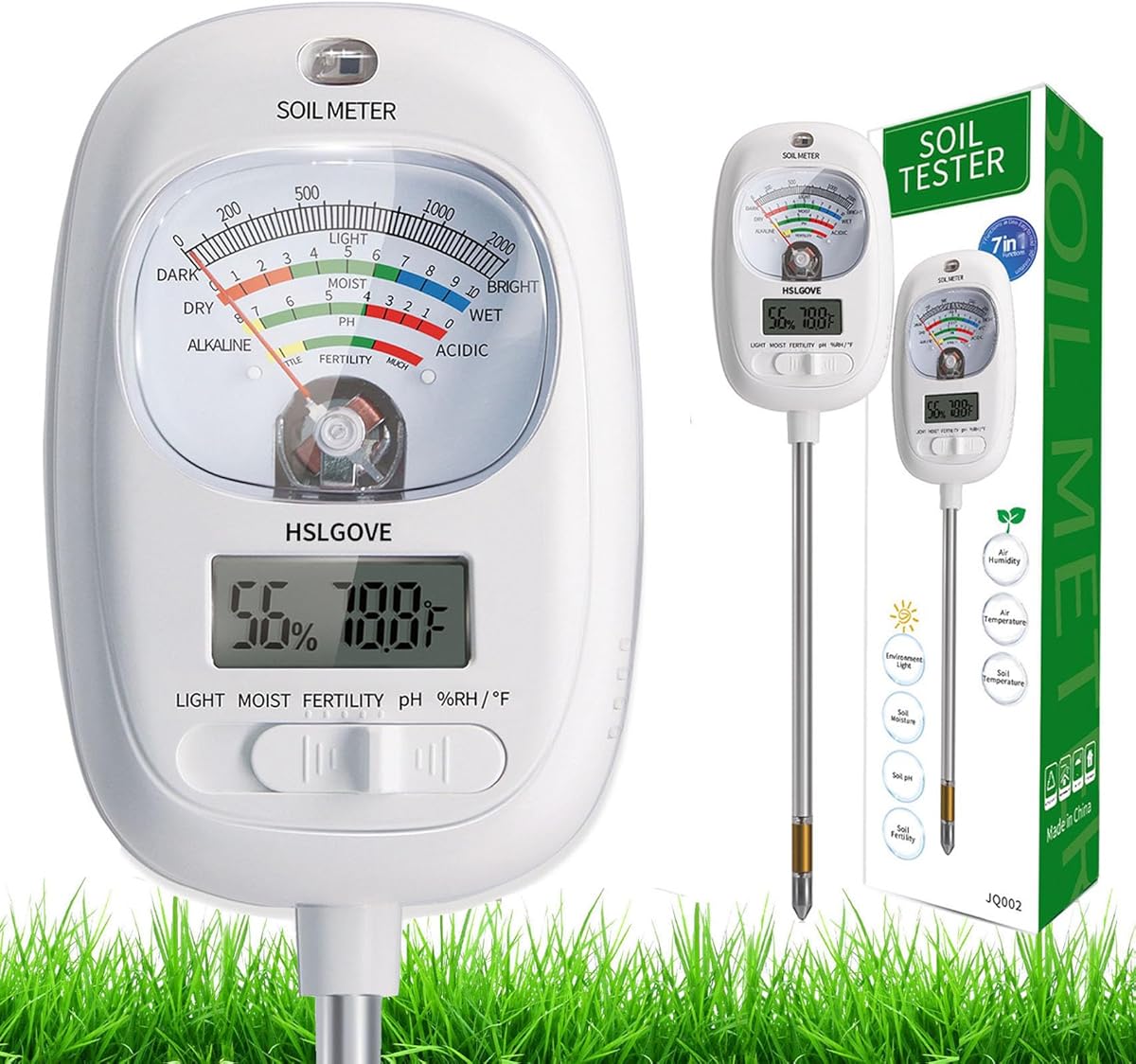
The HSLGOVE Soil Test Kit has a 4.4 rating and combines a conventional-looking soil meter with digital environmental readings. It measures soil moisture, pH, fertility, temperature, and light while also displaying indoor temperature and humidity, giving users a broader picture of both the root zone and surrounding environment.
We may earn a commission when you buy through this link, at no additional cost to you.
Its dual-dial and dual-screen design is distinctive. A single button controls the electronic functions and toggles between percentage relative humidity and degrees Fahrenheit, while the analog-style dial handles the soil-related measurements. The listed 1.6-inch circuit board and large display are intended to produce quick, legible results. The three-metal probe is approximately 6.8 inches long, which suits medium to large potted plants and garden applications.
There are operational considerations. The manufacturer states that all three batteries should be replaced or installed when setting up the meter, and results may take three to five minutes to read. The product is explicitly not a water moisture meter and should not be used to test liquid. The single-probe design is said to reduce disturbance to roots, although users should still insert it carefully in accordance with the instructions.
This kit is a good match for indoor plant enthusiasts who want humidity and temperature information alongside soil readings. It is also suitable for lawns, farms, flowers, vegetables, and other outdoor beds. Those who want purely digital controls and remote monitoring may prefer a different design, but the HSLGOVE's combination of analog soil readings and digital ambient data gives it a distinctive place in this category.
Temperature and humidity readings add context that a basic soil probe cannot provide. This is useful for indoor growers comparing root-zone conditions with the climate around the plant.
The single probe is designed to limit root disturbance and reduce the amount of soil removed during testing. It remains important to insert the probe carefully and follow the stated setup procedure.
We may earn a commission when you buy through this link, at no additional cost to you.
The Urban Worm Soil Thermometer has a 4.6 rating and uses a straightforward color-coded scale instead of a complex digital interface. Green, yellow, and red tick marks make the current temperature easy to interpret at a glance, while the five-inch stainless steel stem reaches into garden soil or worm compost.
We may earn a commission when you buy through this link, at no additional cost to you.
Its strongest specialization is vermiculture. The listed guidance notes that worms are happiest between 55 and 90 degrees Fahrenheit and indicates when a worm bin may need cooling or relocation to a warmer location. That simple interpretation is useful for beginners because it converts a numerical temperature into an immediate care decision without requiring the user to navigate settings or menus.
This is not a multifunction digital soil tester despite its broad appeal to gardeners. It does not list pH, moisture, light, humidity, wireless monitoring, or digital data functions. The five-inch stem may also be shallower than the Reotemp K83B1 for larger piles, although it is described as appropriate for worm compost and garden soil. Buyers who want a dedicated worm-bin thermometer will find the color scale faster to interpret than a numeric display.
Choose this model for worm owners, compost educators, and gardeners who prefer immediate visual guidance. It is particularly valuable when the main goal is maintaining a comfortable temperature for worms rather than collecting a broad set of plant measurements. Its concise, purpose-built design makes it a practical specialist tool.
The green, yellow, and red scale gives an immediate visual indication of the worm-bin temperature range. That format helps owners decide when cooling or warming may be necessary without interpreting detailed data.
The five-inch stainless steel stem is intended to penetrate garden soil and worm compost to a practical depth. It is especially relevant to owners who check small bins as part of a regular care routine.
We may earn a commission when you buy through this link, at no additional cost to you.
The ECOWITT WN34BS is a connected soil-temperature sensor rated 4.2. Unlike a simple handheld thermometer, it can transmit readings to compatible receiving equipment, support multiple monitoring locations, and provide history through the ECOWITT ecosystem. The 11.8-inch stainless steel probe and IP65 waterproof housing suit gardens, farms, lawns, greenhouses, and potted plants.
We may earn a commission when you buy through this link, at no additional cost to you.
Its standout feature is monitoring flexibility. When paired with a separately sold GW1100 Wi-Fi gateway, readings can be viewed in the WS View Plus app or through the Ecowitt app when the phone and gateway share a Wi-Fi network. The device can also upload data to the Ecowitt Weather server, where users can view current readings, historical records, and graphs, as well as receive email alerts. It supports up to eight locations when additional compatible sensors are used.
The sensor transmits readings every 77 seconds over an RF signal listed at up to 300 feet in open areas. It is not a standalone network system, however: a gateway is required for the described app experience, and additional sensors are sold separately. The total number of compatible probe and cable sensors supported by one receiver cannot exceed eight. Buyers should therefore treat the WN34BS as part of a compatible ecosystem rather than a completely independent device.
This is the premium pick for gardeners, greenhouse operators, or anyone who wants to check soil temperature remotely and examine history. The temperature-only focus keeps the data clear, while long-range wireless reporting and multi-channel support add value across larger properties. It is less attractive for a single-pot owner who simply wants to walk over and read a display, but it is the most capable connected option in this guide.
Compatible app and web access lets users review current temperatures and historical data away from the soil itself. This is valuable for multiple beds, greenhouses, lawns, and farm areas.
The receiver can support up to eight compatible sensors, with additional units sold separately. Users can build a multi-location system without replacing the core receiving setup.
We may earn a commission when you buy through this link, at no additional cost to you.
The Digital Soil EC Meter is a two-function specialist with a 4.1 rating. It measures soil electrical conductivity and temperature, giving growers focused information about salt-related conditions and root-zone warmth. The corded 5.4-inch probe is rated IP67 for protection against water and dust, while the backlit LCD presents readings more clearly than a traditional dial meter.
We may earn a commission when you buy through this link, at no additional cost to you.
A major technical feature is automatic temperature compensation across a listed 0–50-degree Celsius range. This means the EC measurement is adjusted according to temperature, which is important for a conductivity-based reading that can otherwise vary with conditions. The device also offers a straightforward calibration process: immerse the electrode in 1413 microsiemens per centimeter calibration solution, stir gently, and long-press the CAL button. The solution itself is not included.
The narrow measurement focus is the primary trade-off. Unlike the YAMRON, HSLGOVE, and other multifunction meters, this model does not list pH, moisture, light, or humidity readings. That makes it less useful for general houseplant watering, but more appropriate for users who specifically need EC and temperature. The corded sensor also differs from the integrated probes found on many handheld garden meters, and three AAA batteries are included.
Choose the Digital Soil EC Meter when salt content and conductivity are central to your monitoring plan, such as in soil-focused plant care or lawn and nutrient testing. It is a strong choice for users who value temperature compensation and calibration control. For ordinary watering decisions, a meter with moisture and pH functions will be more immediately useful.
EC indicates the soil's electrical conductivity and serves as an indicator of salt content. Paired with temperature, it can provide a more informed view of the root-zone environment.
Automatic temperature compensation helps account for changing soil temperatures. A dedicated CAL control also provides a repeatable calibration routine when the correct solution is available.
We may earn a commission when you buy through this link, at no additional cost to you.
The EDGEVEIL 4-in-1 is a wireless plant-monitoring system rated 4.5. Its display combines soil moisture, temperature, light level, and a real-time clock, allowing users to check important conditions without walking from pot to pot. A low-moisture alert adds a visible warning function, while the listed wireless range of up to 328 feet supports monitoring around homes, offices, balconies, and yards.
We may earn a commission when you buy through this link, at no additional cost to you.
Its sensor uses triple-probe TDR technology to measure moisture from multiple contact points. The waterproof, corrosion-resistant probe is intended for flowers, raised beds, lawns, gardens, and outdoor planting areas. Another useful design detail is the recommendation to insert the probe once and leave it in place for continuous monitoring. This reduces the repeated root disturbance associated with taking out and repositioning a conventional meter.
The central trade-off is system expansion. A single display can monitor up to 12 plants or sensors, but using that capacity for a larger collection requires additional sensors, which may increase the total cost. The product is also a combined monitoring system rather than the simplest single-probe handheld. Buyers who only have one or two small pots and want an inexpensive immediate reading may find a basic meter more convenient.
The EDGEVEIL is an excellent choice for plant owners who want continuous readings from multiple locations and prefer one central display. It stands out for its low-moisture warning, broad stated range, and continuous-monitoring approach. For a single plant or a minimal toolset, its wireless system architecture may be unnecessary, but for a larger indoor or outdoor collection it offers strong convenience.
The central display can support up to 12 sensors, making it practical for houseplant collections, balcony pots, raised beds, and greenhouse areas. It reduces the need to carry a meter from location to location.
Continuous placement avoids repeated insertion and removal, which can disturb roots. The triple-probe TDR design also gathers moisture information from several contact points for steadier readings.
We may earn a commission when you buy through this link, at no additional cost to you.
The 5-Probe 7-in-1 Soil Meter is a feature-dense digital tester with a 3.9 rating. It measures pH, sunlight, fertility, soil temperature, air temperature, and humidity, providing broad information about plant conditions. Its most distinctive physical feature is the five-metal-probe configuration, which the manufacturer associates with faster readings and improved precision.
We may earn a commission when you buy through this link, at no additional cost to you.
The split HD display presents large digits and an intuitive interface, allowing the user to monitor pH and moisture without repeatedly crouching. The product is aimed at farms, gardens, lawns, greenhouses, and indoor pots. Its corrosion-resistant probe construction is designed to tolerate compacted soil and prolonged outdoor exposure, and the probe may remain buried when continuous placement is needed.
The measurement routine requires more care than the fastest models. For pH, the soil should be evenly moist, and the value may need about 60 seconds to settle. Users are advised to compare three to five locations for a clearer trend. The meter supports soil and growing media but should not be immersed in water for extended periods; after hydroponic substrate use, the probes should be cleaned and stored dry. The lowest rating in the group also deserves attention when weighing the extensive feature set.
This meter is most appropriate for advanced growers and larger growing areas where multiple environmental variables matter. Its five-probe construction, large display, and durable design are compelling for intensive plant monitoring. A buyer who values a simple temperature display, a very low rating concerns, or the fastest possible readings may prefer one of the more specialized alternatives.
Five metal probes create multiple points of contact with the soil. The manufacturer positions this configuration as a way to obtain quicker readings and a more representative picture than simpler two- or three-probe designs.
Soil and air temperature, humidity, pH, sunlight, fertility, and moisture are presented in one device. That breadth supports a more complete assessment of indoor and outdoor growing conditions.
We may earn a commission when you buy through this link, at no additional cost to you.
The best digital soil thermometer depends on whether you need a focused temperature tool, a broad plant diagnostic, a compost accessory, or a connected monitoring system. These factors help separate the most useful options for different gardening routines.
A dedicated thermometer is simplest when temperature is your only concern. The Luster Leaf 1625 focuses on planting and transplanting conditions, while the Reotemp K83B1 adds a composting guide. Multifunction meters such as the YAMRON, 7-in-1 Digital Soil Tester Kit, HSLGOVE, EDGEVEIL, and 5-Probe model also report moisture, pH, light, fertility, or humidity, providing a broader view of plant conditions but adding complexity.
A backlit display is valuable in shaded gardens, greenhouses, and dim indoor spaces. Large numerals, intuitive symbols, and a rotating or split screen can make readings easier to interpret. The YAMRON offers a rotating head, the HSLGOVE uses dual screens, and the 5-Probe model uses a split display. Buyers who value immediate legibility should also consider whether the device can be read while remaining in the soil.
Probe length determines how deeply the instrument can measure and how easily it fits into a pot, worm bin, compost pile, or garden bed. The Reotemp uses a 12-inch stem, ECOWITT uses an 11.8-inch probe, HSLGOVE lists approximately 6.8 inches, and the Urban Worm model uses 5 inches. Stainless steel and corrosion-resistant materials are especially relevant for outdoor use, wet soil, and compost.
Compost users should look for guidance that translates temperature into pile-management decisions. The Reotemp includes a digital composting guide, while the Urban Worm Soil Thermometer uses color-coded marks and identifies a 55–90-degree Fahrenheit comfort range for worms. A longer stem can reach deeper into a pile, whereas a shorter stem is often easier to position in a small worm bin.
Wireless systems are valuable when several locations need attention or when frequent physical checks are inconvenient. The EDGEVEIL display can support up to 12 sensors and lists a range of up to 328 feet. The ECOWITT WN34BS supports up to eight channels and can transmit readings to compatible receiving equipment. Remote features often require gateways, apps, additional sensors, or a compatible ecosystem, so verify those requirements before buying.
Outdoor tools encounter rain, irrigation, wet soil, and dust. The ECOWITT WN34BS has an IP65 rating, the Digital Soil EC Meter's corded probe is IP67, and the Reotemp is described as waterproof and dustproof. Other models use corrosion-resistant probe materials but do not list a formal ingress-protection rating. Buyers who plan continuous outdoor placement should distinguish general durability from a stated waterproof certification.
A single insertion can be misleading in uneven soil. The YAMRON recommends at least five locations for pH and moisture, while the 5-Probe model recommends comparing three to five spots and allowing pH readings to settle. Multiple probes or multi-point sampling can provide a more representative result, but they may also increase insertion effort. Consider pot size, root density, and how evenly moisture is distributed through the growing medium.
Battery requirements vary across the category. The YAMRON and 7-in-1 Digital Soil Tester Kit require four AAA batteries that are not included, the Digital Soil EC Meter includes three AAA batteries, and the HSLGOVE requires installing or replacing three batteries. The ECOWITT also requires compatible receiving and gateway equipment for its connected functions. Check included batteries, calibration solutions, gateways, and extra sensors before ordering.
Begin by choosing a representative location. For a potted plant, insert the probe into the main root zone without striking the pot wall or major roots. For a bed or compost pile, take readings in several places because surface and subsurface conditions can differ. Follow the product-specific depth guidance, which ranges from about four inches on the YAMRON to 10 centimeters on the 7-in-1 model and longer stems on dedicated thermometers.
Prepare the soil before inserting delicate electronic probes. If the ground is extremely dry or hard, the supplied instructions warn against forcing the device in. Lightly moisten the test area, wait for the soil to settle, and then insert the probe gently. After switching on the model and selecting the required mode, allow the specified stabilization time. For pH, this may be as short as 10 seconds on some models or around 60 seconds on the 5-Probe meter, so check the relevant instructions.
Clean and store each device according to its manual. Remove a probe from soil or growing media after the reading, wipe away clinging material, and avoid immersing models that are not designed for liquid use. The 5-Probe 7-in-1 Soil Meter should be cleaned and dried after hydroponic substrate testing. For wired or connected devices, protect the cable and connections from damage, and keep electronic surfaces dry even when the probe is rated for outdoor use.
A digital soil thermometer measures temperature below the soil surface, helping gardeners evaluate root-zone conditions, compost activity, planting windows, and transplant timing. Worm keepers can use the same type of tool to determine whether a bin is too cold or too warm. Some multifunction versions also report moisture, pH, light, fertility, EC, or humidity.
It depends on the model and how it was designed to be used. The EDGEVEIL explicitly supports continuous placement, and the 5-Probe model says its structure can remain buried when needed. Other handheld meters are generally removed after a reading to clean and store them. For sensors intended to remain installed, secure the probe and protect any exposed electronics or cables.
Some models support liquid or water measurements, but others explicitly cannot be used directly for liquid testing. The YAMRON and 7-in-1 Digital Soil Tester Kit are not designed for direct liquid use, while the 7-in-1 kit includes EC and TDS functions for water quality. ECOWITT also offers a separate cable-version sensor for water temperature, distinct from its soil probe.
Soil moisture, pH, and temperature can vary considerably between the surface, the root zone, and different parts of a garden bed. Taking several readings and comparing the results gives a more useful trend than relying on one location. The YAMRON recommends at least five locations for pH and moisture, while the 5-Probe model suggests comparing three to five spots for pH.
A longer probe is useful when the measurement needs to reach deeper into a compost pile, raised bed, or larger soil volume. A shorter probe can be easier to use in small pots and worm bins. The best choice depends on the intended container and the depth at which you need to monitor conditions, rather than length alone.
The ECOWITT WN34BS requires a compatible GW1100 Wi-Fi gateway for the described app and network functions, and that gateway is sold separately. The EDGEVEIL uses a central display to communicate with its sensors, while additional sensors expand the number of monitored plants. Buyers should confirm exactly which receiver, app, hub, or accessories are included before ordering.
Many can, although their guidance differs. The Reotemp K83B1 is explicitly designed for compost and soil and includes a digital composting guide. The Urban Worm Soil Thermometer is optimized for worm compost, using color-coded marks and a worm-comfort range. The Luster Leaf 1625 is suited to general soil-temperature checks around planting and transplanting.
The Digital Soil EC Meter uses a stated process involving 1413 microsiemens per centimeter calibration solution, gentle stirring, and a long press of the CAL button. The solution is not included, so it must be obtained separately if calibration is required. Users should follow the manufacturer's full instructions and avoid immersing probes in unsuitable liquids.
The Reotemp K83B1 is the best budget-oriented choice because it combines a strong customer rating, a 12-inch stem, protective construction, and a digital composting guide. The 7-in-1 Digital Soil Tester Kit is the editor's choice for its broad collection of soil, fertility, EC, TDS, temperature, moisture, pH, and light functions, while the ECOWITT WN34BS is the premium option for connected remote monitoring and multi-location coverage.
The right priority depends on the task. Choose a specialized temperature tool for simple planting checks, a worm-bin model for color-coded temperature guidance, or a compost-focused thermometer for deeper pile monitoring. Select a multifunction meter when watering, acidity, and growing conditions need to be evaluated together, and consider wireless systems only when remote access or continuous monitoring justifies the additional equipment.
Finally, check the current listing before ordering, because prices, package contents, availability, and connected accessories can change. Pay particular attention to required batteries, calibration solution, gateways, additional sensors, probe depth, and whether the product is designed for soil, liquids, growing media, or all three.
