
UGREEN Bluetooth 6.0 Receiver
4.4Editor score
LDAC and 24-bit decoding
Dual-device pairing
Portable battery design
This Bluetooth Audio Receiver guide compares ten receivers for sound quality, range, connections, features, and ease of use, helping you modernize your stereo.
A Bluetooth audio receiver adds wireless streaming to speakers, amplifiers, and stereo components that lack modern connectivity. The right model can improve everyday listening while preserving the equipment you already own. Important considerations include codec support, DAC quality, range, output options, controls, and straightforward setup.
This guide compares ten Bluetooth audio receivers across those practical priorities, from budget-friendly adapters to premium models with advanced decoding, displays, and long-range antennas. One selection is a complete home stereo receiver rather than a standalone adapter, providing useful context for shoppers deciding between adding Bluetooth and replacing a system.
Each review explains the standout features, limitations, and ideal buyer so you can match the receiver to your equipment and listening habits. Ratings and specifications reflect the supplied product information, while availability and pricing can change, so confirm current details and compatibility before purchasing.
4.4Editor score

4.7Editor score

4.6Editor score
The comparison below covers ten receivers with different priorities, including dedicated DACs, multiple digital outputs, extended wireless range, portable power, and complete stereo functionality. Ratings are shown separately from short specifications, and all products should be checked for the output connections required by your speakers or amplifier.




The Auris Blume HD is a feature-rich Bluetooth receiver intended to bring modern wireless playback to an existing stereo, AV receiver, or amplifier. It carries a 4.6 rating and stands out for combining Bluetooth 5.3, LDAC, aptX HD, aptX Low Latency, AAC, and a dedicated audiophile DAC. That makes it one of the most technically complete conventional adapters in this guide.
We may earn a commission when you buy through this link, at no additional cost to you.
Its true Hi-Fi DAC is specified for 384kHz/32-bit upsampling, while the receiver supports the major high-quality codecs available across Android and Apple devices. The special circuitry and precision-tuned antenna are designed to extend operation to more than 100 feet and through multiple walls, although actual range varies with the room, obstacles, and transmitting device. Both analog RCA and digital optical SPDIF outputs allow you to match the receiver to different stereo components.
The trade-off is that this is not the simplest bare-bones adapter. Its extensive codec and DAC features may be more than a listener needs, and the device must be connected to power during use. It also remains strictly a receiver, so it sends audio from a phone, tablet, or computer to a stereo rather than transmitting sound to Bluetooth headphones. Even so, the combination of flexible outputs, long-range hardware, and high-resolution decoding makes it a strong all-around choice.
This model is best for listeners who already own capable speakers or an amplifier and want a meaningful wireless upgrade rather than a basic convenience adapter. It suits anyone interested in LDAC or aptX HD, those who want both analog and digital connections, and buyers who value a dedicated DAC. For a straightforward high-quality Bluetooth upgrade, the Auris Blume HD is a particularly complete recommendation.
The receiver's analog RCA and digital optical outputs make it adaptable to legacy stereo systems as well as modern amplifiers and AV receivers. Included RCA-to-AUX connectivity also helps it work with suitable auxiliary inputs, so it is not tied to one particular generation of equipment.
Support for LDAC, aptX HD, aptX Low Latency, and AAC gives the listener several options when the transmitting device and content support them. The dedicated DAC and upsampling circuitry add detail and refinement, although the ultimate result still depends on the source, codec, stereo, and speakers.
We may earn a commission when you buy through this link, at no additional cost to you.
The Esinkin Bluetooth Audio Adapter is a straightforward way to add wireless streaming to powered speakers, a home stereo, a computer speaker system, or an AV receiver. It has a 4.5 rating and focuses on the essentials: familiar 3.5mm and RCA connections, quick pairing, and automatic reconnection to a previously paired device. It is a practical choice for a first wireless upgrade.
We may earn a commission when you buy through this link, at no additional cost to you.
Setup is refreshingly direct. Connect the appropriate cable between the adapter and the existing sound system, power the receiver, and pair it with a compatible phone, tablet, or computer. A central Bluetooth button handles connection, disconnection, and power functions, while the adapter can reconnect automatically after a powered restart. Its stated indoor range is approximately 30 to 40 feet in an unobstructed environment.
Its main limitation is that it does not emphasize newer codecs, advanced DAC specifications, long-range antennas, digital outputs, or a display. The result is likely to be more satisfying for convenient everyday streaming than for listeners who want to maximize technical audio performance. It also requires a continuous power source because there is no built-in battery, and it cannot transmit audio to Bluetooth headphones.
Choose this adapter when you want a simple, inexpensive way to stream from a phone to speakers that already work well. It is particularly suitable for a bedroom setup, office system, kitchen stereo, or other straightforward installation where short-range coverage and familiar outputs are enough. Those wanting more flexibility or premium decoding should look at one of the advanced 1Mii, Audioengine, or Auris models.
A single clearly identified Bluetooth button handles the main functions, making the adapter approachable for users who do not want to navigate complicated menus. Automatic reconnection reduces the need to pair the same phone or tablet every time the system is switched on.
The included 3.5mm and RCA connection options cover a wide range of powered speakers, home stereo systems, and A/V receivers. Because it adds wireless capability without replacing the original system, it is an economical way to modernize equipment that still sounds good.
We may earn a commission when you buy through this link, at no additional cost to you.
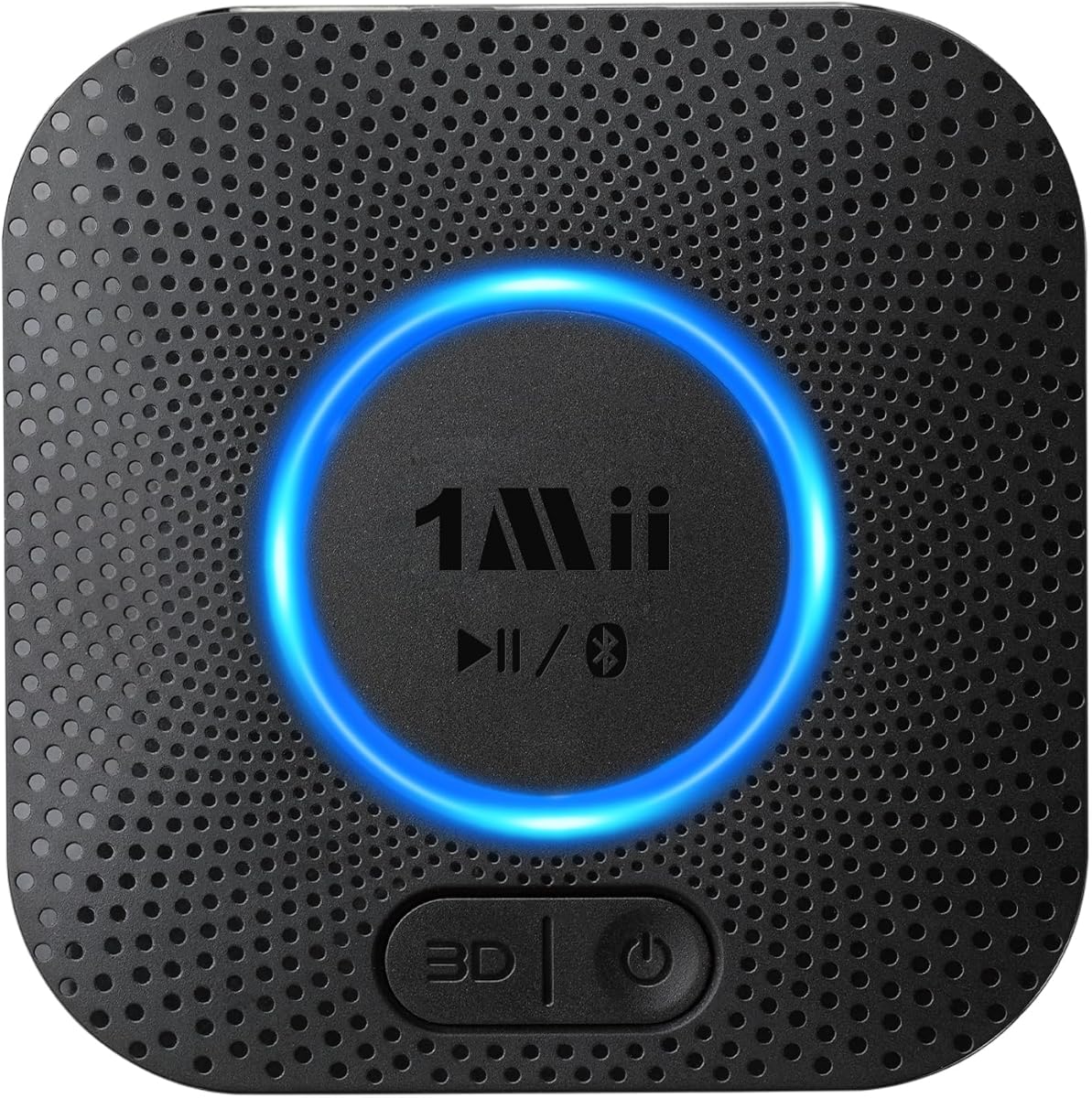
The 1Mii B06+ is a well-equipped Bluetooth 5.3 receiver designed to add flexible wireless streaming to an existing stereo, amplifier, or set of powered speakers. Its 4.4 rating reflects a capable package that includes aptX HD, aptX Adaptive, 3D surround processing, dual-device pairing, and a long advertised operating range.
We may earn a commission when you buy through this link, at no additional cost to you.
Its most useful feature is the ability to pair with two Bluetooth devices simultaneously, reducing the need to unpair one source before moving to another. The 3D button lets users activate or disable a sound-processing mode, with a green indicator showing when it is enabled. The included USB power adapter and 3.5mm or RCA connections support simple plug-and-play use across many existing systems.
Range is specified at up to 98 feet in open air and approximately 50 to 70 feet indoors without obstacles, giving it ample reach for most homes. The receiver can also power on and reconnect automatically when plugged into a power outlet. Its limitations are the absence of listed digital outputs and the need to decide whether the optional 3D processing suits a particular speaker system or source.
The B06+ is a good match for households that alternate between two phones or tablets and want more codec support than a basic adapter. It is especially useful for powered speakers and stereo receivers that have 3.5mm or RCA inputs. If digital hookup, a DAC specification, or an information display is important, the DS200Pro or B06Pro+ may offer a better fit.
Simultaneous pairing lets a household keep a phone and tablet connected to the same receiver. This is convenient for shared listening spaces where different people may want to play their own music without repeatedly deleting and entering a pairing.
The dedicated 3D control gives listeners access to an optional expanded sound effect without making it the only operating mode. Automatic reconnection after power returns further supports the receiver's plug-and-play positioning in a permanent stereo setup.
We may earn a commission when you buy through this link, at no additional cost to you.
The Audioengine B1 is a dedicated Bluetooth 5.3 receiver for adding wireless playback to a quality home audio system. It earns a 4.7 rating, the highest listed score in this guide, and is built around a dedicated 32-bit DAC, flexible RCA and optical outputs, and a stated range of up to 100 feet. It is designed for listeners who want technology to enhance—not merely replace—an existing setup.
We may earn a commission when you buy through this link, at no additional cost to you.
The dedicated digital-to-analog conversion is intended to preserve detail, clarity, and dynamics from wireless sources. Output flexibility lets it feed stereo receivers, integrated amplifiers, powered speakers, DACs, home theater systems, or active bookshelf speakers. An RCA extension cable and simple plug-and-play setup make it approachable, while its compact 3.5 by 4 by 1-inch dimensions should be easy to accommodate near an audio system.
The tradeoff is that the B1 does not provide the advanced information screen or equally broad set of digital outputs found on some premium rivals. It also remains a receiver rather than a transmitter, and its specifications do not list a battery for portable use. In exchange, it focuses on a clean, conventional design centered on sound quality, flexible connectivity, and long-range operation.
This is our top overall choice for readers who want a refined and uncomplicated way to modernize a stereo. It is a particularly strong fit for owners of powered speakers or quality amplifiers with RCA or optical inputs. Choose the B1 when straightforward integration and a dedicated DAC matter more than an OLED display, extensive transport controls, or a battery.
A dedicated 32-bit DAC is the centerpiece of the B1's design, with the stated goal of retaining musical detail and dynamics after wireless transmission. While no receiver can restore information absent from the original file, this focused conversion stage is designed to handle the received signal carefully.
RCA and optical outputs make the receiver useful across both analog and digital stereo equipment. The included extension cable and compact enclosure support an easy installation without asking the owner to reorganize an entire living-room setup.
We may earn a commission when you buy through this link, at no additional cost to you.
The 1Mii DS200Pro is a high-resolution Bluetooth receiver intended to turn an amplifier, home stereo, AV receiver, or powered speakers into a modern wireless system. Its 4.6 rating reflects a strong combination of Bluetooth 5.3, LDAC, aptX HD, aptX Low Latency, AAC, an ESS Sabre DAC, and long-range hardware.
We may earn a commission when you buy through this link, at no additional cost to you.
The built-in DAC is specified to reduce noise and distortion while revealing additional detail and depth. LDAC support makes it particularly interesting for compatible Android source devices, while aptX HD, Low Latency, and AAC broaden compatibility with other phones, tablets, and computers. A Class 1 chipset and external antenna support a stated range of up to 100 feet, although walls and other obstacles can affect the result.
Both RCA and optical TOSLINK outputs are provided, and the relevant cables are included for a straightforward installation. This lets the receiver work with analog amplifiers and newer digital equipment without requiring a separate converter. The limitations are modest: there is no built-in display, and it does not offer the B06Pro's coaxial output, onboard controls, or dual-antenna configuration.
The DS200Pro is a strong recommendation for a listener who wants high-resolution codecs, a dedicated audiophile-oriented DAC, and flexible digital connectivity in a compact adapter. It is well suited to an existing quality stereo that lacks Bluetooth but has RCA or optical inputs. If a status display would improve daily operation, the B06Pro+ or Auris Blume Pro may be easier to manage at a glance.
LDAC and aptX HD support allow the receiver to work with high-quality Bluetooth streams when the source device makes those codecs available. The ESS Sabre DAC then handles the received digital signal, with the stated objective of lowering noise and distortion.
The external antenna is intended to support a stable connection across rooms and around household obstacles. It is especially useful when the receiver must remain near the audio equipment while the phone or tablet moves around the listening area.
We may earn a commission when you buy through this link, at no additional cost to you.
The 1Mii B06Pro is a long-range Bluetooth 5.3 receiver with one of the broadest output selections in this guide. It supports 3.5mm AUX, RCA, coaxial, and optical connections, allowing it to fit a wide range of home stereo equipment. Its 4.4 rating reflects a capable package for listeners who prioritize flexibility and wireless reach.
We may earn a commission when you buy through this link, at no additional cost to you.
Two antennas and Class 1 Bluetooth technology support a stated maximum of 197 feet in open air and approximately 60 to 100 feet indoors without obstacles. It also supports aptX HD and aptX Low Latency, while a 3D button enables or disables the receiver's optional surround processing. Onboard volume and track controls reduce the need to return to the phone for every adjustment.
The most important limitation is that LDAC is not listed among this model's supported codecs, so buyers whose priority is LDAC should examine the B06Pro+ or DS200Pro. Real-world range also depends on walls, Wi-Fi routers, antennas, and the capabilities of the transmitting device. It is a receiver only and cannot send audio to Bluetooth headphones or televisions.
The B06Pro is best for a large home, a stereo with an unusual input requirement, or a listener who wants maximum cable-choice flexibility. It also suits setups where convenient physical controls are valuable. For a more compact digital specification or advanced codec priority, the B06Pro+ adds LDAC and an LCD, while the DS200Pro adds an external antenna and premium DAC.
RCA, optical, coaxial, and 3.5mm outputs make this one of the most accommodating receivers in the guide. The variety is valuable when an amplifier has only a legacy input, an AV receiver expects digital audio, or a compact speaker system uses a 3.5mm connection.
The dual antennas are designed to maintain a dependable link when the phone is separated from the stereo equipment. Physical volume and track buttons add convenience once the receiver is positioned beside the speakers, although the stated maximum remains an open-air figure.
We may earn a commission when you buy through this link, at no additional cost to you.
The 1Mii B06Pro+ combines high-resolution Bluetooth decoding, a dedicated ESS DAC, long-range antennas, physical controls, and an LCD display. It is a capable upgrade for an old-fashioned home stereo, and its 4.3 rating reflects a broad feature set. The model is particularly interesting for listeners who want LDAC without moving to the more premium Auris design.
We may earn a commission when you buy through this link, at no additional cost to you.
Qualcomm's Bluetooth 5.3 platform supports LDAC, aptX HD, aptX Low Latency, aptX, and AAC decoding. The built-in ESS DAC is designed for efficient decoding of high-quality files, while the 1.3-inch-class information area is listed as showing song names, volume, Bluetooth codes, and other status details. Physical buttons allow volume adjustment and track changes, reducing dependence on the source device.
The dual-antenna design is specified for up to 197 feet in open air and 60 to 100 feet indoors without obstacles. Connections include 3.5mm, coaxial, and optical options, making the receiver suitable for many legacy and modern systems. Its limitations include a lower listed rating than several rivals, no stated simultaneous two-device pairing, and the absence of RCA from the listed connection set.
This model is a good fit for a serious home setup where codec support and on-device information are more important than dual-device convenience. It is also attractive for anyone who prefers to see the active codec, track, volume, and pairing information without unlocking a phone. Buyers who require RCA or the most extensive codec and DAC specifications may prefer the DS200Pro or Auris Blume Pro.
The LCD display turns the receiver from a simple hidden adapter into a more interactive component. Seeing the track, volume, pairing codes, and other status details can make everyday operation easier, particularly for households with multiple people or shared audio sources.
LDAC is joined by aptX HD, aptX Low Latency, aptX, and AAC, offering several options across compatible source devices. The ESS DAC then processes the received signal with an emphasis on efficient high-quality playback.
We may earn a commission when you buy through this link, at no additional cost to you.
The Sony STRDH190 is different from the other products in this guide because it is a complete two-channel home stereo receiver with Bluetooth already built in. Its 4.5 rating reflects a capable all-in-one package, combining wireless streaming, amplification, radio, and multiple analog inputs. It is most appropriate when you are building a new system rather than adding a small adapter to one you already own.
We may earn a commission when you buy through this link, at no additional cost to you.
The receiver is specified to deliver 100 watts per channel into 8 ohms at 1kHz, with speaker impedance support from 6 to 16 ohms. It includes a phono input, four stereo RCA audio inputs, a 3.5mm input, stereo RCA output, and a full-size headphone jack. A/B switching allows up to four speakers to play together or in separate zones.
Its main limitation is that it does not solve the problem of adding Bluetooth to an existing amplifier or stereo system. It is also less focused on the high-resolution codec and DAC specifications emphasized by several dedicated receivers. Buyers seeking a lightweight, inexpensive Bluetooth adapter or a unit with optical and coaxial outputs will need a different product category.
The STRDH190 is a strong choice for someone starting a new two-channel system and wanting built-in Bluetooth, FM radio, phono support, and room for multiple speakers. It may also appeal to buyers who value an all-in-one design over a separate streaming box. If preserving and upgrading an existing stereo is the goal, a dedicated Bluetooth receiver offers a more appropriate path.
Rather than functioning only as a streaming accessory, the Sony combines an amplifier and receiver in one low-profile enclosure. That integrated design can simplify the creation of a new living-room, office, or listening-room system.
The A/B switching function can support up to four speakers, either together or in separate zones. Phono, RCA, 3.5mm, headphone, FM radio, and Bluetooth connections make it a broader hub than a dedicated streaming adapter.
We may earn a commission when you buy through this link, at no additional cost to you.
The UGREEN Bluetooth 6.0 Receiver is a budget-focused adapter that combines LDAC, portable battery operation, and dual-device pairing. Its 4.4 rating makes it a notable value-oriented choice, particularly for listeners who want to move the receiver between a home stereo, wired speakers, and other 3.5mm or RCA-equipped equipment without carrying a separate power supply.
We may earn a commission when you buy through this link, at no additional cost to you.
Its LDAC implementation supports sampling rates up to 24-bit/96kHz and has received Hi-Res Audio Gold Label certification according to the product information. Bluetooth 6.0 is intended to improve connection stability, lower latency, and reduce power consumption, although the Bluetooth version itself does not determine sound quality. Two phones can be paired simultaneously, with playback from one requiring the other to be paused.
The internal battery provides up to 15 hours of uninterrupted playback, supports USB-C charging, and can operate while charging. A full charge is stated to take two hours. The package includes a USB-C cable and 3.5mm audio cable, but not an RCA cable or wall charger. The receiver also does not automatically reconnect after a disconnection on iPhones and Galaxy devices, although a power cycle restores automatic reconnection.
The UGREEN is best for a listener who values portability and LDAC without moving into premium receiver pricing. It is also useful for testing whether Bluetooth suits an existing system before making a larger commitment. Buyers who need the full range of digital outputs or a more sophisticated display should compare it with the 1Mii models, while those seeking a permanent installation may prefer a continuously powered adapter.
The rechargeable design allows the receiver to accompany a phone to another room or to be used with different speaker systems. This flexibility is unusual among continuously powered adapters and makes the UGREEN appealing for renters, travelers, or multi-room listening.
LDAC, 24-bit/96kHz support, and the stated certification make this more technically ambitious than a basic adapter. The Bluetooth 6.0 platform focuses primarily on connection behavior and efficiency, while codec and DAC quality remain separate considerations.
We may earn a commission when you buy through this link, at no additional cost to you.
The Auris Blume Pro is a premium Bluetooth 5.3 receiver designed to modernize a quality vintage stereo, AV receiver, or amplifier. It has a 4.6 rating and stands out through its broad codec support, audiophile-grade ESS Sabre DAC, external gain antenna, anodized aluminum enclosure, and 1.3-inch OLED display. It is the most fully featured dedicated receiver in this comparison.
We may earn a commission when you buy through this link, at no additional cost to you.
The receiver supports Sony LDAC, Qualcomm aptX Adaptive, aptX HD, aptX Low Latency, aptX, and AAC decoding. Its ESS Sabre upsampling DAC is specified for 32-bit/384kHz conversion, while a separate Cirrus Logic chip handles digital audio conversion for the optical and coaxial outputs. The display can present connection status, active codec, sampling rate, and song information, reducing the need to navigate a phone's settings.
The special circuitry and external gain antenna support a stated range of up to 30 meters, or more than 100 feet, including through multiple walls. Analog RCA, optical, and coaxial outputs provide broad compatibility. The principal disadvantages are its premium feature level and lack of a battery, as it is intended for a permanent connection to a home system. It remains a receiver, not a transmitter for headphones or televisions.
The Blume Pro is best for a listener with capable equipment who wants comprehensive format support, detailed status information, and high-end conversion in one box. Its display and broad output selection make it especially useful for a carefully arranged stereo installation. If the same core priorities can be met with a less elaborate adapter, the DS200Pro offers many of the key audio features without the OLED and coaxial emphasis.
The OLED screen presents the active codec, sampling rate, connection state, and song information at a glance. That visibility is valuable for listeners comparing streams or confirming that a source is using the expected Bluetooth mode.
The ESS Sabre upsampling DAC and Cirrus Logic digital conversion chip support the receiver's emphasis on high-resolution playback. Optical and coaxial outputs complement analog RCA, allowing the same premium unit to serve legacy amplifiers and digitally equipped stereo components.
We may earn a commission when you buy through this link, at no additional cost to you.
Choosing a Bluetooth audio receiver means balancing codec quality, wireless coverage, output compatibility, power, and control features. Start with the ports on your existing stereo, then consider the source devices, listening environment, and level of technical detail that will genuinely improve your setup.
In short, inspect both ends of the audio path and purchase only a receiver that offers a compatible, correctly wired connection.
Choose codecs that your source device supports, prioritizing the formats you will actually use rather than the longest advertised list.
For a capable stereo, a dedicated DAC is worth considering, but prioritize accurate playback and compatible outputs over a headline specification alone.
Compare realistic indoor reach rather than the largest headline number, especially if the stereo is in a different room from the phone.
Choose continuous power for a fixed installation and battery operation only when portability will regularly improve your listening experience.
Pick onboard controls for convenient everyday operation and a display when you want visible confirmation of connection and playback status.
Use dual pairing when several people share a system, but treat it as a convenience feature rather than a substitute for sound quality or stable range.
Choose a compact receiver to upgrade existing equipment; choose a complete stereo system only when you intend to replace or build the central audio hub.
Begin by identifying the correct output on the receiver and the matching input on your stereo, amplifier, or powered speakers. Connect the supplied or appropriate cable before powering the unit, then choose the receiver in your phone or computer's Bluetooth menu. Put the receiver into pairing mode using its central button or documented control, select its name, and wait for the connection to be confirmed. Once paired, start audio at a moderate volume and then adjust the level through the receiver, source device, or stereo as appropriate.
Position the receiver near the audio system with its antennas unobstructed, especially for models that rely on external or dual antennas. Keep it away from crowded USB power hubs, poorly shielded cables, and unnecessary electronic interference where practical. For a permanent setup, use continuous power and test the range from the places where you normally use your phone. Wireless performance can vary with walls and other devices, so moving the receiver or changing the connection can sometimes improve stability.
Keep the unit ventilated, dry, and free from liquid or heavy impact. Do not open the enclosure, and follow the manufacturer's guidance for the power adapter, charging unit, and cables. If sound is weak, verify that the stereo input is selected correctly and that the source volume is high enough. When pairing becomes unreliable, power the receiver off and on, remove the stale device entry from Bluetooth settings if needed, and pair again. For portable models, recharge before long sessions and use the specified USB-C cable.
A Bluetooth audio receiver adds wireless streaming to speakers, amplifiers, stereo receivers, and other powered audio systems that lack Bluetooth. It receives music or other audio from a phone, tablet, or computer and sends that sound to the connected system. Most receivers in this guide are not transmitters and therefore cannot send audio to Bluetooth headphones or televisions.
Both are high-quality Bluetooth codecs, but a receiver supporting both gives you more options across source devices. LDAC can provide very high-resolution audio on compatible Android devices, while aptX HD is widely found on other phones and computers. Actual quality also depends on the original file, codec support on the transmitter, the DAC, and the connected audio system.
Not always, but it can be valuable when your amplifier or home theater receiver accepts digital audio. An optical connection may suit a system designed around digital inputs, while RCA is appropriate for most analog stereo equipment. Check the available inputs before choosing, and remember that a receiver cannot connect directly to passive speakers without an amplifier.
A range of 30 to 50 feet is generally adequate for many apartments and single-floor homes, especially if there are few walls. Longer advertised distances are usually open-air maximums and may not apply through multiple walls. Models with external or dual antennas, including the Audioengine B1 and several 1Mii and Auris receivers, may offer more practical placement flexibility.
The 1Mii B06+ and UGREEN Bluetooth 6.0 Receiver support simultaneous pairing with two Bluetooth devices. This makes it easier for household members to alternate between phones without repeatedly pairing from scratch. One device must usually pause playback before the other becomes the active audio source, so it is convenient rather than a true simultaneous-listening feature.
First confirm that the correct input is selected on the stereo and that the receiver is connected to the right output. Next check the volume hierarchy: the source device, receiver, and stereo may each have separate volume controls. The UGREEN guidance also recommends enabling Volume Sync in the source device's Bluetooth settings if playback is unexpectedly quiet.
No. The dedicated Bluetooth receivers in this guide are designed to send audio from a phone, tablet, or computer to a wired stereo, amplifier, or powered speakers. The Auris, Esinkin, 1Mii, Audioengine, and UGREEN listings all identify their products as receivers rather than transmitters. A separate Bluetooth transmitter would be required for headphones.
Choose a receiver when you already own speakers or an amplifier and want to add wireless streaming without replacing the system. Choose a complete home stereo when you need an amplifier, source controls, radio, and wireless connectivity in one new unit. The Sony STRDH190 represents the second approach, while the other featured products are dedicated Bluetooth receivers.
The Audioengine B1 is the strongest all-around recommendation for its dedicated 32-bit DAC, flexible RCA and optical outputs, extended range, and highest listed rating. The UGREEN Bluetooth 6.0 Receiver stands out as the best budget and portable option, while the Auris Blume Pro takes the premium position with extensive codec support, a sophisticated DAC, digital outputs, and an OLED display.
Prioritize the connection your stereo actually requires, then choose a codec and DAC that improve the devices you use every day. Range matters when the phone regularly moves between rooms, while displays, dual-device pairing, and physical controls matter more when convenience is the main goal. Ensure that the receiver will connect to powered speakers or an amplifier, and verify the included cables before ordering.
Ratings, product configurations, and prices can change over time, so review the current listing and confirm compatibility before making a purchase. With the right output, codec support, and power arrangement, a Bluetooth audio receiver can make a good existing stereo considerably more convenient without forcing you to replace the equipment you already enjoy.