
App-Controlled Battery Disconnect
4.3Editor score
Smartphone app control
Twenty-meter operating range
240A continuous current capacity
1200A peak starting capacity
Multi-voltage compatibility
Explore the best anti theft kill switch remote battery disconnect options and compare voltage protection, current capacity, controls, fit, and installation.
An anti theft kill switch remote battery disconnect adds a layer of protection against unauthorized starts, parasitic battery drain, and accidental illumination of vehicle electronics. The best model combines dependable current handling, clear voltage controls, safe remote behavior, and a wiring design suited to your vehicle.
We compared the ten options in this guide by examining their control methods, supported electrical systems, continuous and surge ratings, standby consumption, installation requirements, battery-terminal compatibility, and built-in safeguards. The list covers key-fob, manual-control, and smartphone-control designs for cars, trucks, RVs, boats, motorcycles, and recreational vehicles.
Each review identifies the feature that sets the product apart while noting practical limitations, compatibility details, and the type of driver or vehicle for whom it makes the most sense. Product listings, features, and availability can change, so confirm current specifications and fit before purchasing.
4.3Editor score
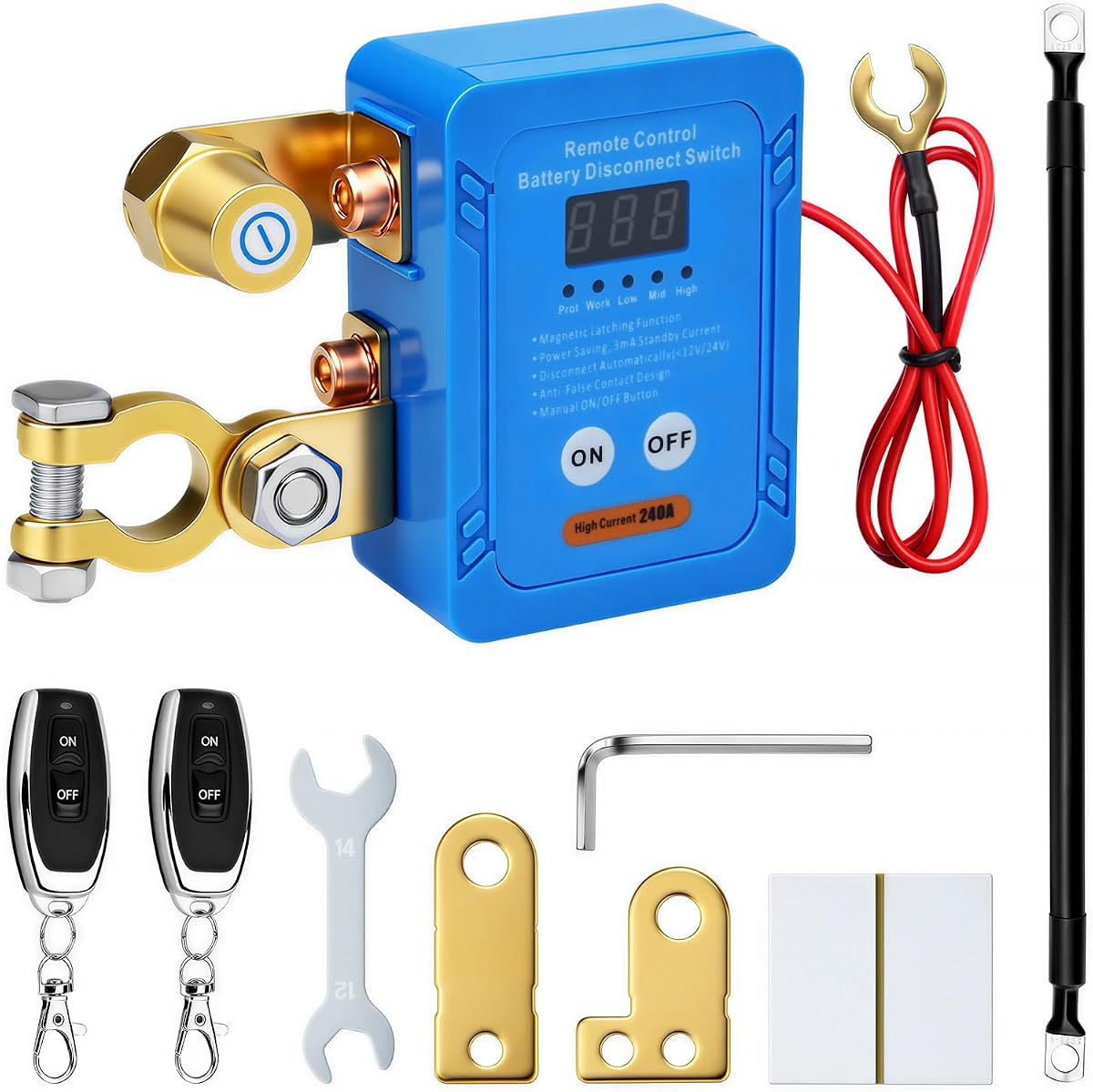
4.8Editor score

4.1Editor score
The comparison below places the ten remote battery disconnect switches side by side, emphasizing control style, voltage support, current handling, standby draw, installation features, and practical limitations.


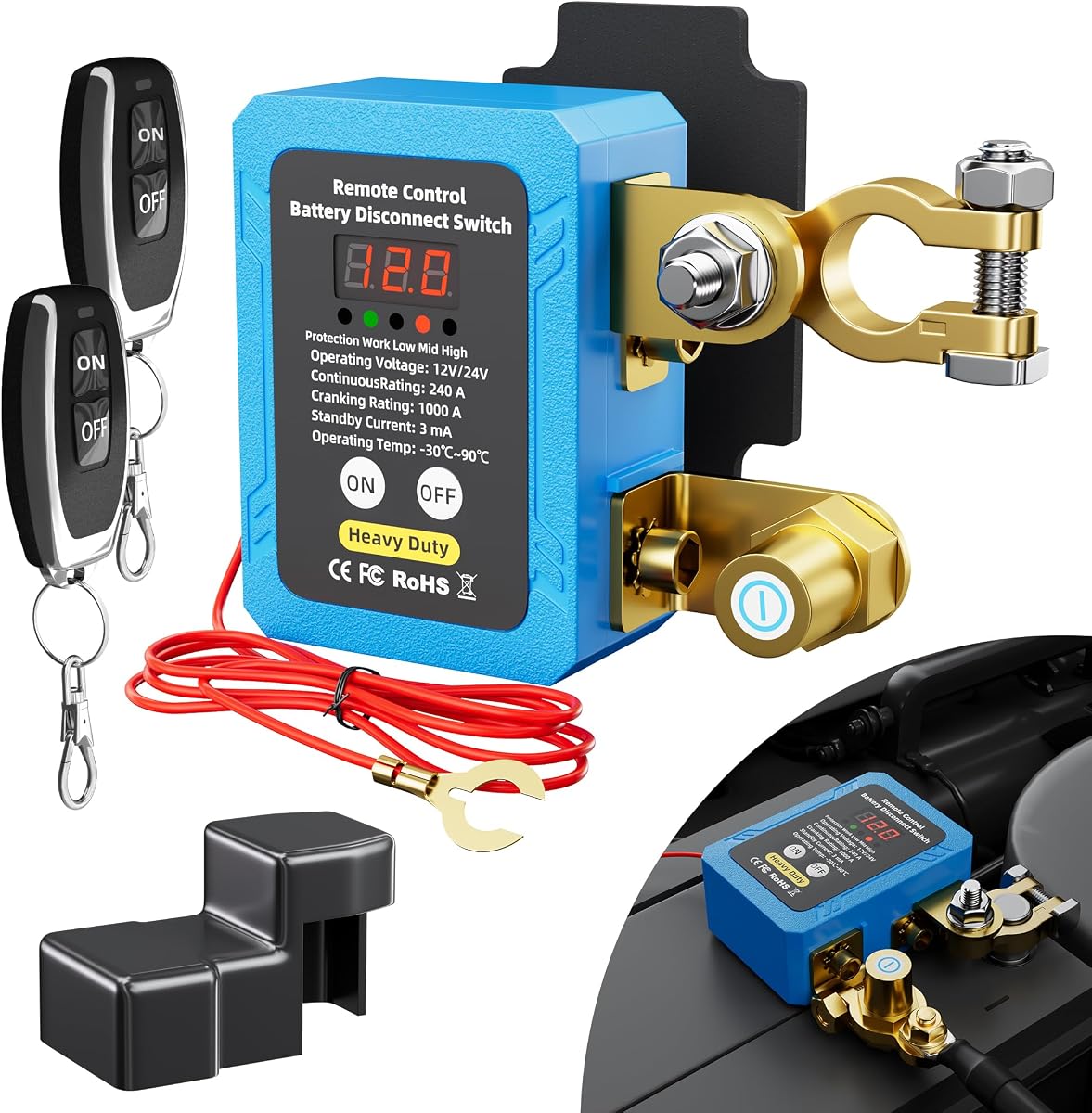
This remote battery disconnect earns its place near the top through a restrained, practical design that focuses on conserving standby power. Its 4.3 rating reflects a favorable balance of remote convenience, low-drain engineering, and emergency access. The mechanical magnetic switch is designed to avoid the larger parasitic draw associated with continuously energized control systems.
We may earn a commission when you buy through this link, at no additional cost to you.
Its smart voltage behavior adds useful protection without making operation confusing. The listing says the unit automatically cuts power after 120 seconds when voltage falls below 11.8V. At voltages above 13.2V, the remote is disabled so a stray button press cannot interrupt power while driving. A manual control option lets the owner operate the switch directly when the wireless command is unavailable or the vehicle requires servicing.
The main limitation is the narrower electrical scope. This model is described specifically as a 12V system, so it does not offer the broader 12V/24V compatibility found among several competitors. There is also no LED voltage display, which means users must rely on separate instrumentation to check battery condition. Those omissions matter less for a basic anti-theft installation than for an owner who wants real-time battery monitoring.
This is a good fit for ordinary cars and trucks that spend significant time parked, especially when standby draw is a priority. It is also attractive to owners who want manual access alongside a key-fob remote. Verify the wiring configuration and terminal clearance before installation, but for a straightforward 12V setup, this is one of the more thoughtfully engineered choices in the group.
The stated 0.003A standby draw is the headline benefit for vehicles parked for weeks. A magnetic latching design is intended to preserve standby power better than systems that continuously energize a relay, helping the switch avoid adding meaningful parasitic consumption while protection is enabled.
Automatic remote lockout above 13.2V reduces the chance of accidentally cutting vehicle power while moving. Manual operation remains useful for maintenance, and the combination of remote and direct control makes the unit adaptable to both routine security and hands-on electrical work.
We may earn a commission when you buy through this link, at no additional cost to you.
This switch delivers the core anti-theft remote-disconnect experience at a focused, budget-conscious level. Its 4.1 rating indicates generally positive customer sentiment, and the product stands out for straightforward installation, substantial current figures, and use of copper wiring. It is aimed at drivers who want reliable power isolation without a large collection of electronic monitoring features.
We may earn a commission when you buy through this link, at no additional cost to you.
The listed maximum instantaneous current is 450A, while continuous current is listed at 250A. That makes it a credible option for many passenger vehicles, trucks, and other 12V applications where engines draw a pronounced starting surge. The simplified negative-terminal installation reduces the number of connections, and the upgraded receiver modules are described as improving signal reception.
The trade-offs are important. There is no visible voltage display, and the product data does not describe automatic low-voltage shutdown or a driving-state remote lockout. Users therefore receive a more basic anti-theft and battery-saving function. It is also important to follow the listed guidance about disconnecting the negative terminal, since changing the positive-terminal arrangement can create vehicle or battery problems.
Best for owners seeking an uncomplicated remote switch for a standard 12V vehicle, this product is especially attractive when installation simplicity and current capacity matter more than app control or real-time monitoring. It suits cars, trucks, RVs, trailers, campers, motorcycles, and other 12V engine applications after confirming post size and cable routing.
The 250A continuous and 450A instantaneous current figures provide useful capacity for many 12V vehicles. Comparing those numbers with your vehicle's starter demand is important, particularly for large engines, heavily loaded electrical systems, or equipment that operates while parked.
Connecting the main switch at the negative battery pole reduces installation complexity and aligns with common automotive practice. Fewer wires can make routing easier in crowded engine compartments, although cable routing, terminal security, and the vehicle manufacturer's guidance remain essential.
We may earn a commission when you buy through this link, at no additional cost to you.
With a 4.8 rating, this is the strongest all-around product in the group and the Editor's Choice for a comprehensive installation. It combines dual remotes, an LED voltage display, 12V/24V compatibility, a 240A continuous current rating, and a broad installation kit. That combination addresses both the convenience of remote operation and the practical needs of a properly installed battery isolator.
We may earn a commission when you buy through this link, at no additional cost to you.
The voltage display is especially useful because it lets the owner see battery status without adding another meter. The stated display accuracy is plus or minus 0.5V, while the all-inclusive package contains two remotes, 10AWG wiring, mounting brackets, terminal clamps, wrenches, and a hex key. Reinforced ABS housing, gold-plated copper terminals, and a listed temperature range of -22°F to 194°F add further confidence for outdoor vehicle use.
Its main limitation is the starting specification. Continuous current is listed at 240A, peak surge at 500A for one second, and the product is explicitly not recommended for heavy construction vehicles or engines exceeding 600A starting current. The extensive accessory set also requires careful organization during installation, and suitability should be checked against unusual battery systems.
This is the most attractive option for a driver who values visibility, a complete kit, and flexible 12V/24V use without paying for smartphone control. It fits cars, trucks, SUVs, RVs, ATVs, boats, and off-road vehicles, while side-terminal adapters expand its battery-post options. For most mainstream vehicles, it delivers the broadest mix of features with the highest customer rating.
The integrated LED voltage display provides a useful check on battery condition without requiring separate equipment. A stated plus or minus 0.5V accuracy makes it a practical reference for assessing state of charge, provided the reading is interpreted correctly for the battery chemistry and resting voltage.
Two remotes, thick wiring, terminal clamps, brackets, mounting pads, and basic tools reduce the likelihood of discovering missing pieces after opening the package. Side-terminal adapters and adjustable mounting options also broaden compatibility with different battery layouts.
We may earn a commission when you buy through this link, at no additional cost to you.
This 4.2-rated model stands out for strong current handling and thoughtful voltage safeguards. Its listed 250A continuous current and 1200A cranking current provide ample headroom for a wide range of 12V vehicles. It is particularly compelling for owners whose starter or electrical system draws more current than the modest capacity of a basic switch.
We may earn a commission when you buy through this link, at no additional cost to you.
The smart system continuously monitors voltage. Below 11.8V, the switch cuts power after a brief delay to limit over-discharge, while above 13.6V it disables the remote so the switch cannot be accidentally operated while the engine is charging. The remote range is listed at 30–70 meters, and a manual override provides a fallback for emergency or maintenance use.
Its tradeoff is the absence of an LED voltage display, so users cannot see the exact battery reading on the unit. The product is also limited to 12V systems. The 0.005A standby current is low, but it is not as low as the figures claimed by the 0.001A and 0.003A alternatives, which could matter during very long storage periods.
This model is well suited to performance-oriented cars, trucks, RVs, and boats with substantial 12V starter demands. The combination of remote and manual controls, high cranking specification, adjustable shims, and automatic protection makes it a strong general-purpose choice when future monitoring features are not essential.
A listed 1200A cranking rating offers a significant safety margin for many 12V engines and starting systems. It makes the switch appealing for performance vehicles and trucks, although installation quality and battery condition ultimately determine starting performance.
Automatic cutoff below 11.8V helps preserve a depleted battery, while remote lockout above 13.6V protects against accidental shutdown during charging or driving. These thresholds make routine operation more predictable without removing manual service access.
We may earn a commission when you buy through this link, at no additional cost to you.
This dual-mode switch combines 12V and 24V support with a stated 250A continuous current capacity. Its 4.1 rating reflects its usefulness across cars, trucks, RVs, trailers, ATVs, and marine applications. Five green LEDs provide immediate confirmation of operating state, while a compact remote and manual button cover routine and emergency use.
We may earn a commission when you buy through this link, at no additional cost to you.
Voltage protection is more granular than in many competing products. In smart mode, the remote is disabled below 11.4V to prevent accidental shutdowns, and normal remote operation is specified within 11.4–14V for a 12V system or 23–27V for a 24V system. If voltage falls below 6.5V, the device stops functioning, while manual control remains available between 6.5V and 11V.
The installation warning is significant: the product only fits tapered battery posts measuring 15–17mm. It also needs all screws secured tightly, and the external spring-shaped antenna should be extended for stronger remote reception. Although the standby figure is very low at 0.7mA, the numerous protection states can take time for a new owner to understand.
This is a good choice for owners with mixed 12V and 24V equipment who want a dedicated remote plus a manual fallback. It is less suitable for unusual post sizes, industrial machinery, or anyone who needs the remote to remain fully active at every possible battery voltage. Checking the battery dimensions before purchase can prevent installation frustration.
Support for both 12V and 24V systems is valuable for owners of multiple vehicle types or mixed stored equipment. It simplifies the decision when one switch must cover different power systems, provided the battery, wiring, and current requirements are appropriate.
Five green LEDs make it easier to confirm when a remote command has been accepted. The extendable antenna can improve reception in larger vehicles or storage areas, while manual operation provides an essential alternative when wireless control is disabled by a protection state.
We may earn a commission when you buy through this link, at no additional cost to you.
This 4.3-rated model offers a broad stated operating range and one of the clearest monitoring-focused designs. It works with 8V–30V batteries rated from 50Ah to 100Ah, uses an LED voltage display, and provides 140A of continuous current capacity. Those characteristics make it most compelling for smaller 12V/24V vehicles and applications where extreme starter current is not the central concern.
We may earn a commission when you buy through this link, at no additional cost to you.
The protection logic is designed to prevent two common mistakes. When voltage is below 11.8V, or in the stated 17V–24V band, the switch auto-disconnects after 300 seconds. During charging ranges of 13.6V–17V or 27.2V–30V, the remote becomes unresponsive and only the manual buttons can operate it. Latching-relay technology is used to keep standby consumption low.
Two constraints deserve close attention. The 140A continuous capacity is lower than the 240A–250A offered by several alternatives, and the product explicitly excludes lithium and valve-regulated batteries. It also connects at the negative terminal, with slotted tabs and transfer shims for different mounting positions. Those limitations make compatibility verification essential.
This switch is best for smaller cars, motorcycles, boats, RVs, trailers, tractors, ATVs, and UTVs that fall within the listed battery and voltage parameters. It is less attractive for heavily loaded systems or high-output starter applications. Drivers who prioritize an integrated voltage display and wide low-voltage support will find the trade-offs reasonable.
The LED display gives users immediate feedback about system voltage, which is especially useful before cranking a stored vehicle. This visibility can help distinguish a low battery condition from other starting issues, although a single switch display should not replace proper battery testing.
Delayed disconnection in specified low-voltage ranges reduces deep discharge, while remote lockout during charging prevents accidental shutdown. The five-minute delay gives the user time to react before the unit fully isolates the battery.
We may earn a commission when you buy through this link, at no additional cost to you.
With a 4.6 rating and a stated standby consumption of just 0.001A, this model offers one of the most attractive efficiency profiles in the guide. It combines a 240A continuous current rating, a 1200A starting-current specification, a latching relay, and an LED voltage display. It is a strong premium pick for owners focused on long-term storage and dependable power preservation.
We may earn a commission when you buy through this link, at no additional cost to you.
Smart protection automatically powers the unit off after 300 seconds when voltage falls below 11.8V. Above 13.6V, remote control locks and manual operation becomes available, reducing the likelihood of accidental shutdown while the vehicle is running. The negative-terminal installation uses transfer shims and a terminal shim cap to accommodate flat and side battery-post arrangements.
Compared with the app-controlled model, this switch is more focused and less dependent on smartphone compatibility. It also lacks some of the weather-resistance and expanded hardware packaging highlighted by the 4.8-rated all-in-one kit. The product information primarily describes 12V vehicles despite referring to 12V/24V in the title, so buyers should verify whether their exact system is supported.
This is an excellent choice for classic cars, show vehicles, RVs, trucks, boats, and daily-driven vehicles that remain parked for extended periods. The combination of minimal standby consumption, high starting capacity, flexible post mounting, and visible voltage status makes it particularly well suited to preserving battery charge without giving up convenient remote isolation.
A 0.001A standby figure is among the lowest stated in this comparison. Over prolonged storage, even small differences in control-system consumption can matter, making the latching relay a meaningful advantage for seasonal vehicles.
The listed 1200A starting current provides strong headroom while retaining a 240A continuous rating. That combination suits vehicles with demanding starters while preserving efficient control during normal parked operation.
We may earn a commission when you buy through this link, at no additional cost to you.
This is the guide's most distinctive premium option because it replaces a conventional key-fob workflow with smartphone control. Its 4.3 rating reflects a feature set built around remote battery status and switching through an app. It supports 12V, 24V, and 36V systems, making it unusually flexible for a broad collection of vehicles and equipment.
We may earn a commission when you buy through this link, at no additional cost to you.
The app can toggle battery power within a stated 65-foot, or 20-meter, range while showing real-time battery status. The switch lists 240A continuous and 1200A peak starting current, along with 0.005A standby consumption. Its automatic protection disconnects after five minutes when voltage falls below 11.8V, or in the stated 17V–24V range for trucks, helping reserve power for a future start.
The disadvantages are clear. Smartphone control requires Android 8.0 or later or iOS 12.0 or later, which makes app compatibility a prerequisite rather than a universal benefit. The operating range is shorter than many key-fob systems, and the product is specifically designed for vehicles with engines under 4.0L. A phone-based setup can also be less desirable when the phone has no battery, service is unavailable, or the owner prefers a dedicated physical remote.
This product suits technology-oriented owners who want battery status and switching in one interface, particularly across multiple 12V, 24V, or 36V devices. It is a strong choice for compatible cars, trucks, RVs, boats, and campers, but the engine-size restriction and app dependency should be checked before installation.
Combining power control and battery-status monitoring in a phone simplifies the user experience. It is particularly helpful for owners who want to check several stored vehicles without carrying a separate remote for each system, assuming the phones remain compatible and charged.
Compatibility with 12V, 24V, and 36V power systems expands the switch beyond ordinary passenger-car installations. Owners should still verify battery type, starter demand, and the module's installation requirements rather than assuming every electrical configuration is interchangeable.
We may earn a commission when you buy through this link, at no additional cost to you.
This 4.3-rated switch offers a focused, uncomplicated installation for standard 12V top-post batteries. Its 250A continuous and 450A peak load figures are strong enough for many mainstream vehicles, while the direct negative-terminal layout and included wiring diagrams help simplify setup. Two pre-paired remote fobs provide convenient control for driver and passenger.
We may earn a commission when you buy through this link, at no additional cost to you.
The product uses high-purity copper and corrosion-resistant materials, and its listed remote range reaches 30 meters, or about 98 feet. The manufacturer also describes the switch as extending battery life by three to four times, although actual results depend on the vehicle's parasitic load, storage duration, battery condition, and how consistently the switch is used.
Its defining limitation is top-post compatibility. The kit fits tapered posts measuring 15–17mm and is explicitly unsuitable for 24V systems. That narrows the audience but makes it easier to select for owners who know their battery has the appropriate post format. The stated peak load is also lower than the starting-current figures offered by several alternatives.
This is a good fit for standard 12V cars, trucks, RVs, trailers, motorcycles, boats, and ATVs with compatible top posts. It suits buyers who prioritize straightforward wiring, dual remotes, copper construction, and warranty support over app control or an integrated voltage display.
The switch is designed around tapered top posts in the 15–17mm range. Measuring the battery before ordering is essential because a visually similar battery may use a different post size, and side-terminal vehicles will need another product or a suitable adapter arrangement.
Including two paired fobs allows more than one person to operate the switch without sharing a key. It is useful for families, shared work vehicles, and owners who prefer carrying a backup remote for long-distance use.
We may earn a commission when you buy through this link, at no additional cost to you.
The RVBOATPAT 240A switch delivers the essential remote-disconnect functions in a package aimed at cars, trucks, and boats. Its 4.0 rating is the lowest in this group, but the listed features remain relevant: a 240A continuous current rating, 1000A instantaneous current, a 3mA standby figure, and an LED voltage display.
We may earn a commission when you buy through this link, at no additional cost to you.
Its automatic protection is easy to understand. Below 11.8V, the unit cuts power after 120 seconds to preserve the battery. Above 13.2V, remote control is disabled, leaving manual button operation as the only way to change power state and preventing accidental shutdown during cranking or driving. The magnetic latching relay is intended to provide reliable control without continuous high consumption.
The design does not offer smartphone control or the very low standby figures claimed by some competitors. It also remains a 12V product, and its 240A continuous capacity may be less appropriate for vehicles with unusually high starter demands. Buyers should compare the instantaneous current specification with their engine's actual starting requirement rather than focusing on the headline number alone.
This switch is a reasonable choice for a driver who wants a display, automatic discharge protection, and remote control in a conventional 12V installation. It is especially relevant to cars, trucks, and boats that experience long parked periods, but owners seeking the lowest standby consumption or smartphone convenience may prefer other entries in the comparison.
The 120-second cutoff below 11.8V gives the battery some opportunity to recover before complete isolation. This can help limit deep discharge during long storage, provided the vehicle's parasitic load is addressed as well.
Disabling the remote above 13.2V reduces accidental interruption of power while the engine is running or charging. Manual control remains available, allowing direct operation when wireless commands are intentionally locked.
We may earn a commission when you buy through this link, at no additional cost to you.
The right switch depends on electrical capacity, battery layout, operating environment, and how much control visibility you need. Reviewing these factors before ordering helps avoid compatibility problems, weak wireless performance, or an installation that does not fit the vehicle.
Current capacity has two components. Continuous current describes the load the switch can carry while energized, while peak or cranking current describes its ability to handle the brief surge produced during engine startup. A switch with 240A–250A continuous capacity and a peak figure around 450A–500A may suit many mainstream vehicles, whereas models advertising 1200A starting current provide more headroom for demanding engines. Never treat a momentary surge rating as permission to run heavy accessories continuously through the switch.
Most automotive battery disconnect switches are designed for 12V systems, but several options also support 24V systems, and the app-controlled model extends to 36V. Verify the switch's operating range against the battery and charging voltage of the intended vehicle. RV, boat, truck, and trailer electrical systems may differ from ordinary passenger cars, while lithium and valve-regulated battery exclusions on certain products require particular attention.
Terminal shape is one of the most consequential physical details. Top-post batteries use tapered posts, often in the 15–17mm range, while side-post batteries require a different clamp or adapter. Some products include transfer shims, slotted tabs, or side-terminal brackets to make installation easier. Measure the battery, check available space, and inspect cable reach before ordering so the switch can be mounted without forcing terminals or compromising the hood clearance.
The switch should protect the battery without becoming a meaningful source of drain itself. The featured products list standby figures from 0.001A to 0.7mA, with the Smart Magnetic Safety Disconnect and Ultra-Low Draw Disconnect among the leanest. For vehicles stored for weeks or months, lower standby consumption is desirable. For daily-driven vehicles, the difference may be less significant, but a latching relay remains an efficient design choice.
Dedicated key-fob remotes typically offer greater usable range than the app-controlled product's stated 65-foot limit. App control is convenient for owners who already manage several devices through a phone, but it depends on a compatible operating system, an available phone connection for some functions, and a charged device. Remote lockout during charging or driving is also important, because it prevents accidental shutdown when voltage is high.
An LED voltage display gives users an immediate indication of battery condition, while automatic low-voltage cutoff helps prevent deep discharge. Protection modes may disconnect after 120 or 300 seconds below a specified threshold, and some models disable the remote during high charging voltage. These safeguards are useful, but they should complement rather than replace battery testing, charger maintenance, and attention to parasitic loads.
Negative-terminal installation is used by most of the listed products and generally reduces the number of primary connections. The better-equipped models include remote controls, heavy-gauge wiring, mounting brackets, terminal clamps, transfer shims, and basic tools. A complete kit can simplify assembly, but secure connections, strain relief, corrosion protection, and routing away from hot or moving components remain the installer's responsibility.
The installation area may be exposed to heat, moisture, dust, vibration, or salt. Products using reinforced ABS housing, copper terminals, and corrosion-resistant components may be better suited to demanding environments. The 240A LED Display Disconnect lists a broad temperature range and weather-resistant construction, while marine and off-road users should pay particular attention to enclosure quality and cable corrosion. Secure the unit where it will not interfere with moving engine components.
Begin by identifying the battery, post configuration, system voltage, and expected electrical load. Disconnect the battery according to the vehicle manufacturer's service instructions, protect the terminal from accidental contact, and mount the switch in a dry, accessible location that does not interfere with the hood, engine movement, belts, exhaust heat, or wiring. Connect the switch at the negative terminal as described by its manufacturer, tighten every screw, and route cables with appropriate strain relief.
After wiring, test the manual control before relying on the remote. Restore power, confirm that the voltage display and status lights behave as expected, and verify that the remote can disconnect and reconnect the system within its stated range. Use the remote only after the vehicle is parked and the engine is off. If smart protection disables remote operation at high voltage, leave manual control in charge and wait until a safe voltage range is restored.
For care, inspect terminals periodically for looseness, corrosion, heat discoloration, or damaged insulation. Keep the enclosure dry, do not disassemble it, and replace any remote battery that becomes sluggish. Recheck mounting security after rough roads or engine work. Use the switch to reduce parasitic drain during storage, but also identify and repair faults such as forgotten lamps or abnormal electrical draws that a disconnect can only isolate rather than correct.
It can add meaningful anti-theft protection by making it difficult to operate or hotwire a vehicle when the battery is disconnected. It is not a substitute for a proper immobilizer, alarm, steering lock, or secure parking practice. A switch is most valuable as one layer in a broader security plan, particularly for long-term parking.
Most products in this guide are designed for the negative battery terminal, and their installation guidance should be followed exactly. Negative-side installation reduces the risk of a stray positive contact arcing and shorting. Before changing a connection, consult the vehicle's service information, especially if the battery uses a monitoring system or the vehicle has aftermarket electronics.
The switch must handle the vehicle's normal electrical load and tolerate the starter's momentary surge. Continuous figures in this guide range from 140A to 250A, while peak or starting figures vary more widely. Compare those values with the vehicle's starter requirements and any accessories that may remain connected, then choose a unit with appropriate margin.
Yes, when the switch is correctly installed and used according to its guidance. The remote should not be operated while the engine is running or the vehicle is moving. Some products automatically disable the remote at higher charging voltages as an additional safeguard, leaving manual operation available.
It can isolate the battery and eliminate drain from most vehicle circuits while disconnected, but it does not repair the cause of abnormal parasitic draw. Wiring faults, forgotten accessories, onboard electronics, and poorly maintained batteries can still cause problems. Periodic battery testing and electrical-system checks remain important.
Not necessarily. Some products include transfer shims or side-terminal adapters, while others are designed only for tapered top posts in a specified diameter range. Measure the battery and review the included hardware before purchase. Improper fit can lead to loose connections, poor contact, or damage to the terminal.
App-controlled models require a compatible phone and the stated operating-system versions. The product in this guide requires Android 8.0 or later or iOS 12.0 or later. A dedicated key-fob switch offers a simpler alternative that does not depend on phone software, but its control range and feature set may differ.
Disconnect the battery using the remote after parking, then periodically check the battery and switch for voltage loss, corrosion, or loose connections. Use a proper maintenance charger when conditions require it, and avoid relying on the switch as a substitute for battery maintenance. Recheck the installation before returning the vehicle to regular use.
The 240A LED Display Disconnect is the most complete overall option, combining a high customer rating, dual remotes, visible voltage monitoring, broad post compatibility, and a generous installation kit. The Ultra-Low Draw Disconnect stands out for exceptional standby efficiency and strong starting-current capacity, while the App-Controlled Battery Disconnect serves buyers who prefer smartphone management and multi-voltage flexibility.
For a simpler installation, the 450A Instant-Current Disconnect and the 250A Smart Voltage Disconnect provide capable 12V options. The Smart Magnetic Safety Disconnect is especially interesting for its 0.003A standby figure and manual fallback. Before choosing, verify system voltage, battery chemistry, post dimensions, starter demand, mounting space, and whether you value a display, smart cutoff behavior, remote range, or app control more than all other features.
Product details, ratings, and availability can change, so confirm the current listing and manufacturer instructions before buying. Compare the switch against your vehicle's actual requirements rather than choosing only by headline amperage. With a suitable installation and sound battery maintenance, the right remote disconnect can provide meaningful theft deterrence and dependable protection against unwanted standby drain.
