
MEYULMOL 12V 300Ah LiFePO4
4.4Editor score
3840Wh nominal capacity
200A intelligent BMS
Smart APP monitoring
Explore the best 300Ah LiFePO4 Battery options for RVs, solar systems, marine use, and home backup with expert guidance on key features.
A 300Ah LiFePO4 battery is a substantial off-grid power source, but the best choice depends on more than nominal capacity. Battery dimensions, BMS design, cold-weather controls, monitoring features, expansion limits, and intended load all influence whether a model fits your RV, solar array, marine system, or home backup installation.
This guide compares ten 12V-class lithium iron phosphate batteries using the specifications and feature information supplied for each model. It covers energy capacity, cycle claims, BMS ratings, temperature protection, wireless monitoring, physical size, scalability, and practical applications without claiming that any product was personally tested.
Each review explains the product's strongest attributes, limitations, and ideal buyer, while the comparison table and buying guide help narrow the field. Prices and availability can change, so verify current product details, compatibility, and support terms before purchasing a battery for your particular installation.
4.4Editor score

4.9Editor score

4.7Editor score
This side-by-side comparison highlights the major differences in energy capacity, BMS protection, monitoring, expansion capability, and intended use across ten 300Ah-class LiFePO4 batteries.




The MEYULMOL 12V 300Ah LiFePO4 battery combines a 3840Wh energy rating with a 200A intelligent BMS and mobile APP monitoring. Its 4.4 rating reflects a generally capable package, particularly for RV, solar, camping, off-grid, and home backup users who want meaningful capacity without moving into a much larger battery format.
We may earn a commission when you buy through this link, at no additional cost to you.
A major strength is the combination of monitoring and scalability. The APP reports capacity, voltage, current, and operating temperature without requiring an additional monitoring module. Its standardized design supports up to 16 batteries in a 4S4P arrangement, allowing the system to reach 48V and 1200Ah when correctly configured and balanced.
Cold-weather charging is another useful feature. The listed 0°C cutoff is intended to prevent charging under freezing conditions, reducing the risk of lithium plating. Protection against overcharge, over-discharge, overcurrent, and short circuits is also handled by the integrated BMS. Buyers should nevertheless treat the headline cycle figure as a claim rather than a guarantee across every depth of discharge, charging method, and operating condition.
This is the strongest budget-oriented recommendation for someone seeking a full-size 300Ah battery with app visibility and room to grow. Confirm the enclosure dimensions, terminal orientation, charger profile, and system configuration before installation. It is best suited to owners who value expandability and remote information without requiring a separate starting-battery function.
The APP gives owners a practical view of voltage, current, capacity, and temperature. Combined with 4S4P support, this makes the battery suitable for systems that may evolve from a single 12V unit into a larger off-grid installation.
The 0°C charging cutoff helps prevent potentially damaging charging in freezing conditions. Users should plan how the battery will warm naturally or whether a suitably controlled heating solution is appropriate for their climate.
We may earn a commission when you buy through this link, at no additional cost to you.
The SUPER EMPOWER 12.8V 300Ah LiFePO4 battery earns a 4.7 rating and presents a balanced combination of capacity, protection, monitoring, and warranty coverage. Its stated 3840Wh output makes it appropriate for RV upgrades, camper vans, boats, trolling motor setups, solar storage, emergency backup, and other deep-cycle applications.
We may earn a commission when you buy through this link, at no additional cost to you.
The Grade A LiFePO4 cells and integrated 200A BMS are central to its appeal. The BMS monitors voltage, current, and temperature while providing safeguards against overcharge, over-discharge, overcurrent, short circuits, and unsafe temperature conditions. Its cold-weather function pauses charging below 0°C, stops discharge below -20°C, and resumes above 5°C.
Bluetooth monitoring adds visibility into operating data without describing a separate hardware module. The trade-offs are that a 58.4-pound battery still needs careful handling and secure mounting, while users must verify their compartment dimensions and system compatibility. Cold-weather cutoffs can interrupt operation, so they should be understood before installation.
This is a strong premium-balanced choice for RV, marine, and solar buyers who want a clearly stated 3840Wh capacity, a five-year warranty, and integrated protection. It may be especially attractive to those who appreciate temperature-specific controls and technical support without needing dual-mode starting performance.
The 3840Wh rating provides a useful baseline for estimating runtime. Actual runtime depends on inverter efficiency, cable losses, battery age, temperature, and the draw of connected equipment.
Separate charging and discharging cutoffs reflect an effort to protect the cells in cold conditions. System owners should allow the battery to reach a safe temperature before resuming charging or drawing substantial power.
We may earn a commission when you buy through this link, at no additional cost to you.
The DUMFUME dual-mode 12V 300Ah LiFePO4 battery stands out with a 4.9 rating, the highest among the products compared. It is designed to function as a 300Ah deep-cycle battery in normal mode while switching to a high-current power mode that can deliver 1,500A of instantaneous current for starting applications.
We may earn a commission when you buy through this link, at no additional cost to you.
Its supplied specifications describe more than 5,000 deep cycles in normal operation, a 200A upgraded BMS, and protection against overcharging, overdischarging, overcurrent, short circuits, and temperature extremes. The operating range is listed as -4°F to 140°F, although the presence of high- and low-temperature cutoffs means actual charging and discharging behavior depends on conditions.
APP monitoring exposes voltage, current, power, state of charge, and cycle count, which makes it useful for balancing and system management. Expansion from 3.84kWh per battery to 61.44kWh through 16 units in a 4P4S arrangement provides considerable scale. The tradeoff is complexity: a dual-purpose battery and large parallel system require careful wiring, compatible chargers, and attention to the manufacturer's instructions.
This is the Editor's Choice for buyers seeking one battery to serve both energy-storage and starting needs. It is also a strong fit for RVs, home backup systems, marine equipment, garden tools, and off-grid installations where a high surge capability adds meaningful flexibility.
The intelligent BMS lets the battery act as either a deep-cycle reserve or a high-current starter. That versatility can simplify RV and marine layouts, provided the wiring and mode configuration are designed correctly.
Voltage, current, power, state-of-charge, and cycle-count data help owners evaluate charging and system performance. This visibility is particularly valuable in a large multi-battery installation where balance matters.
We may earn a commission when you buy through this link, at no additional cost to you.
The PUPVWMHB 12V 300Ah battery is a 4.5-rated option distinguished by its stated 3840Wh capacity, app-based monitoring, and support for very large series-parallel systems. It is aimed at RV, solar, marine, camping, home power, and standalone storage installations.
We may earn a commission when you buy through this link, at no additional cost to you.
The listed expansion configuration supports up to 1200Ah and 51.2V, with a maximum energy capacity of 61.44kWh and maximum load power of 40.96kW. Those figures make the battery relevant to serious solar and backup arrays, but they also require correctly sized busbars, fusing, ventilation, chargers, and inverter settings.
Its APP displays current, voltage, temperature, and cycle information. The upgraded 200A BMS provides core electrical protections, while the cell-related test certificate referenced in the supplied information supports the product's safety positioning. Unlike conventional flooded batteries, it contains no acid and may be mounted in different orientations, subject to the manufacturer's instructions.
This is a practical choice for owners planning a scalable solar or home-storage system. The main caveat is that large-system performance depends more on design and commissioning than on the battery alone. Buyers should verify the stated maximum configuration against their inverter, charge controller, wiring, and local safety requirements.
The ability to build larger 48V-class arrays makes this battery relevant to cabins and homes with substantial storage requirements. Each added unit increases system complexity, so communication and balancing should be planned from the outset.
The supplied information states that cell capacity remains above 80% after 2,000 cycles. Actual longevity still depends on depth of discharge, charging discipline, temperature, and the quality of the installation.
We may earn a commission when you buy through this link, at no additional cost to you.
The ECO-WORTHY 12V 314Ah LiFePO4 battery receives a 4.5 rating and combines a 4019.2Wh energy capacity with unusually visible status information. Its LED display shows battery level and operating status, while Bluetooth connectivity allows remote checks through the ECO-WORTHY app.
We may earn a commission when you buy through this link, at no additional cost to you.
The supplied listing notes an upgrade from 300Ah to 314Ah beginning April 16, 2026, while retaining the same general design and protections. It uses a 200A BMS with high- and low-voltage, overload, and temperature safeguards, including an automatic charging cutoff below -7°C. A built-in buzzer provides local fault notification.
Expansion supports 4P2S or 2P4S configurations for up to 32.15kWh. The dimensions are listed as 16.3 by 8.46 by 10.24 inches, with a weight of 60.4 pounds. That footprint should be checked carefully in compact RV compartments and marine installations where every inch matters.
This battery is well suited to users who want immediate visual feedback without opening an app. It also suits off-grid, RV, solar, and home backup projects that value fault alerts and cold-weather charging protection. The smaller maximum system capacity compared with 4S4P alternatives is the principal compromise.
SOC LEDs and the status display reduce the need to rely solely on a phone for basic condition checks. The app remains useful for more detailed diagnostics and fault review.
A built-in buzzer can alert users to a battery fault without requiring continuous app access. It is a practical feature in equipment bays, cabins, and installations where remote monitoring may be inconvenient.
We may earn a commission when you buy through this link, at no additional cost to you.
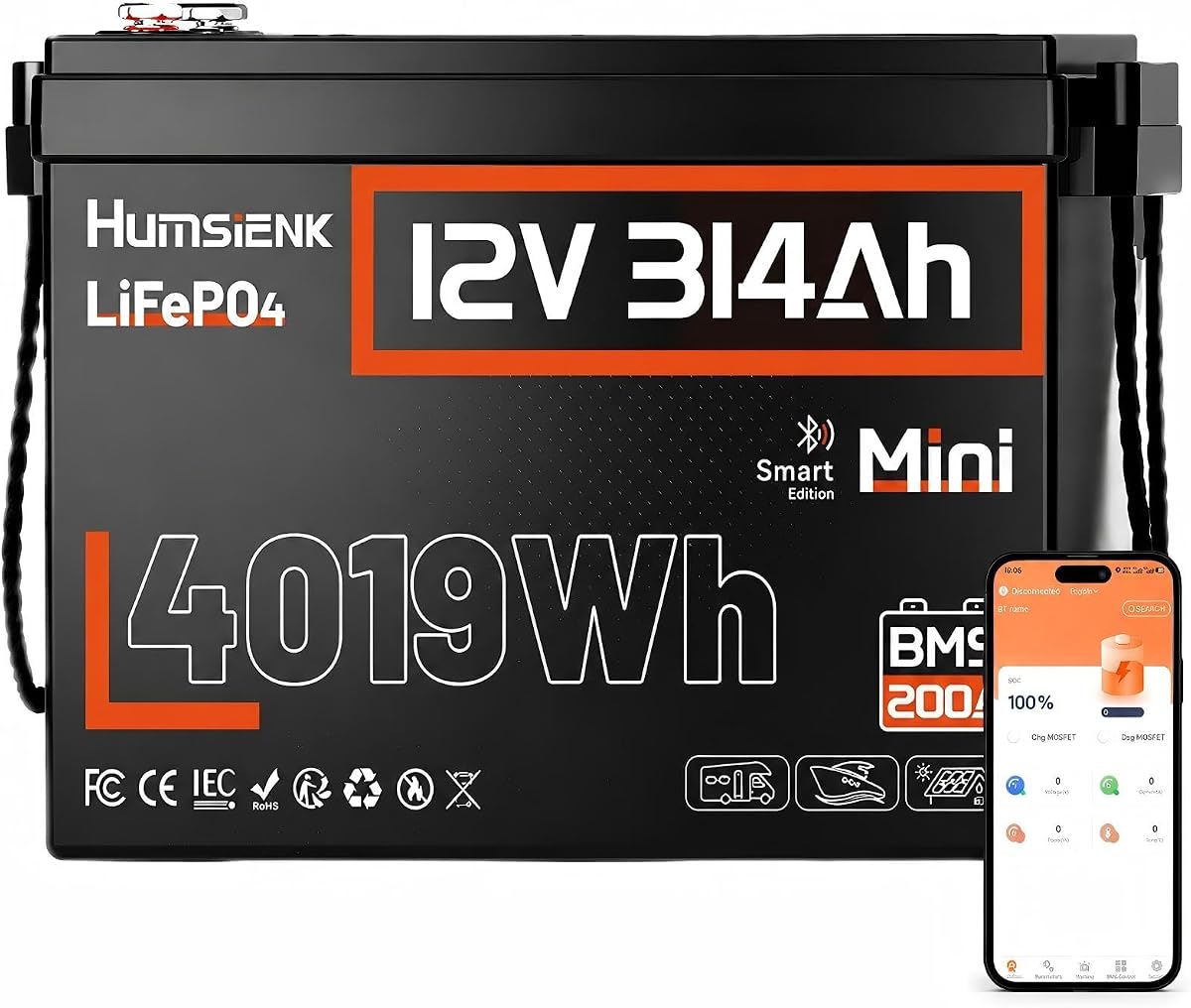
The HumsiENK 12V 300Ah, also described as a 314Ah model, offers 4.01kWh of energy and a 4.4 rating. Its distinguishing combination includes app monitoring, a relatively compact enclosure, a 200A BMS, and support for up to four batteries in both series and parallel.
We may earn a commission when you buy through this link, at no additional cost to you.
The stated maximum configuration reaches 51.2V, 1256Ah, and 64.3kWh, allowing use in large solar, home backup, and marine systems. A full-aluminum internal frame is described as adding structural strength, while the ABS case and UL62133 cell testing support its safety positioning. The battery is listed at 59.5 pounds with dimensions of 15.1 by 9.7 by 7.6 inches.
Bluetooth monitoring reports voltage, current, capacity, and temperature within a stated 15-meter range. That is useful in an RV compartment or near a home battery room, but it is not a substitute for a remotely accessible cellular monitor. The listing also references both 4.01kWh and 4.19kWh in different descriptions, so buyers should verify the final model specifications.
This is a good fit for compact installations that still need around 4kWh per battery and full 4S4P scalability. It may appeal to owners who value the stated safety testing, five-year coverage, and broad charging-method support, provided they confirm the exact capacity and warranty terms before purchase.
The listed 15.1 by 9.7 by 7.6-inch enclosure aims to reduce installation space compared with larger conventional alternatives. Measuring the actual battery bay remains essential because terminals, ventilation, and cable bend radius also consume room.
Supporting up to 64.3kWh gives owners considerable room to scale. A properly engineered array still requires compatible chargers, fusing, communications, and inverter settings to operate safely.
We may earn a commission when you buy through this link, at no additional cost to you.
The HQST 12V 300Ah, also described as a 330Ah mini battery, receives a 4.5 rating and focuses on compactness. Its listed 4224Wh usable energy and 200A continuous discharge rating make it suitable for demanding RV, cabin, marine, solar, and emergency-backup applications where space is limited.
We may earn a commission when you buy through this link, at no additional cost to you.
The battery uses new EV-grade cells, insulated cell mounting, secured internal connections, and aluminum heat-dissipation fins on the BMS board. Its stated cycle life reaches up to 8,000 cycles at 70% depth of discharge. These details suggest that physical design and thermal management are central selling points.
Series and parallel expansion supports 24V, 36V, and 48V systems, with capacity up to 1320Ah and a maximum stated energy capacity of 67.584kWh using 16 batteries. Unlike several competitors in this list, the supplied information does not highlight an app or Bluetooth monitoring feature, which may be a drawback for remote diagnostics.
This is a strong recommendation for space-conscious buyers who value usable energy and high-current delivery more than digital monitoring. Its small format should not be interpreted as eliminating thermal-management needs; owners should use the manufacturer's installation guidance and maintain adequate clearance around the battery.
The compact enclosure targets the footprint normally occupied by multiple 100Ah batteries. That makes the HQST appealing for mobile and retrofit installations where every available liter of battery space matters.
Aluminum heat-dissipation fins and secure internal cell connections support stable operation under substantial loads. External ventilation, temperature management, and sensible charging limits remain necessary.
We may earn a commission when you buy through this link, at no additional cost to you.
The Vatrer 12V 300Ah, rated at 314Ah in the supplied information, earns a 4.6 rating and focuses on outdoor energy storage. Its IP65 water resistance and applications including RV, marine, fishing, ice-fishing, solar, residential storage, and off-grid living distinguish it from installation-only alternatives.
We may earn a commission when you buy through this link, at no additional cost to you.
The enhanced 200A BMS protects against overcharging, overdischarging, low-temperature charging, overcurrent, and short circuits. It is also described as activating automatic balancing when voltage exceeds 14.1V, helping batteries in a connected system reach a similar state of charge.
The stated cycle figure exceeds 6,000 cycles to 80% depth of discharge, while the broader product title references 15,000-plus deep cycles. These figures should be treated as manufacturer claims because results depend on test conditions. The battery weighs about one-third as much as a comparable lead-acid unit at the same stated capacity, easing handling in mobile installations.
This product is a good fit for users who specifically need an energy-storage battery in a damp or exposed environment. Its clear limitation is that it must not be used for starting gasoline engines, golf carts, or jacks. The listed recommendation to charge and discharge at least once every six months is worth following during long storage periods.
An IP65 rating is useful for RV compartments, marine use, and other outdoor applications where occasional exposure is expected. It does not mean the battery is waterproof or suitable for immersion.
The manufacturer explicitly limits this battery to energy-storage use. Buyers needing engine or motor starting should choose a product whose specifications expressly include a starting function.
We may earn a commission when you buy through this link, at no additional cost to you.
The Vatrer 12V 300Ah low-temperature-cutoff battery has a 4.6 rating and combines deep-cycle storage with a stated starting-battery function. Automotive-grade LiFePO4 cells, a built-in 200A BMS, and a claimed 5,000-plus cycle life make it a versatile option for RV, boat, camper, solar, and off-grid systems.
We may earn a commission when you buy through this link, at no additional cost to you.
Protection covers overcharge, overdischarge, overcurrent, and short circuits. Charging is cut off above 167°F, while low-temperature protection helps prevent damage in cold environments. The battery can support configurations of up to four in series and four in parallel, making it suitable for larger systems when appropriate balancing and protection are installed.
The manufacturer describes the stable LiFePO4 chemistry as resistant to burning or exploding under high temperature, short circuits, impacts, and drops, and references UL testing for the internal cells. These claims should be understood in context: battery chemistry is only one part of overall safety, and correct installation, fusing, ventilation, and charger settings remain essential.
This model is most compelling for RV and marine owners who want one battery to cover storage and starting roles. Its specifications do not provide the same detailed 1,500A surge figure offered by the dual-mode DUMFUME model, so buyers should confirm whether its starting performance meets their equipment's requirements.
Combining both roles can simplify an RV or boat installation that would otherwise need separate batteries. The practical benefit depends on the starting current required and on the BMS's control behavior.
Because the battery contains no acid, the manufacturer says it can be mounted in any position. Terminal security, cable strain relief, vibration control, and access for maintenance still require attention.
We may earn a commission when you buy through this link, at no additional cost to you.
The DUMFUME 12.8V 300Ah LiFePO4 battery receives a 4.4 rating and distinguishes itself with clearly stated cycle figures: up to 4,000 cycles at 100% depth of discharge and up to 15,000 cycles at 60% depth of discharge. It also lists a service life of up to 10 years.
We may earn a commission when you buy through this link, at no additional cost to you.
Its 3840Wh capacity and 57-pound weight provide useful comparisons for RV, camper, boat, solar, off-grid, and industrial backup systems. The built-in 200A BMS protects against overcharge, overdischarge, overcurrent, overheating, and short circuits, with automatic high- and low-temperature cutoffs.
A high-strength, impact-resistant ABS enclosure supports durability, while series and parallel connections allow flexible expansion. The main limitation is that the supplied details do not highlight app or Bluetooth monitoring. Buyers who depend on remote battery telemetry may prefer one of the connected alternatives in this guide.
This battery is a solid option for owners who prioritize long-term cycle claims, compact weight, and a broad range of stationary or mobile uses. The manufacturer recommends charging and discharging at 5°C or higher, so owners in colder climates should account for that guidance when planning seasonal operation.
The stated 15,000-plus cycle figure applies at 60% depth of discharge, while the 100% figure is lower. This distinction is exactly the kind of information buyers should use when comparing lithium and lead-acid battery claims.
At 57 pounds, the battery is materially lighter than a comparable lead-acid installation but still requires two-person handling in many cases. Secure mounting against movement is especially important in RVs and marine applications.
We may earn a commission when you buy through this link, at no additional cost to you.
The right 300Ah LiFePO4 battery is the one whose electrical limits, physical size, protection features, and expansion rules match your equipment and environment. The following factors are more useful than comparing headline cycle numbers alone.
A 300Ah label at a nominal 12V or 12.8V usually corresponds to roughly 3.84kWh, but the listings here include models described as 314Ah or 330Ah and one listing presents slightly different energy figures. Compare watt-hours rather than amp-hours alone because voltage, usable capacity, and discharge conditions determine the energy available to an inverter.
Choose a capacity that matches both your battery compartment and your runtime target. More nominal capacity adds weight and may require more parallel units, so a larger battery is not automatically the better installation.
Most products in this guide include a 200A BMS, but that rating should be interpreted in context. Determine whether it refers to continuous current, allowed charging current, peak discharge, or multiple related limits, and compare those values with the inverter's surge output and the charger rating.
A properly sized BMS protects the cells, but it cannot replace correctly rated fuses, breakers, cables, disconnects, and inverter configuration. System design remains more important than the headline BMS number.
Not every 300Ah deep-cycle battery is designed to start an engine. Two products in this guide expressly support starting functions, while another explicitly says it is for energy storage only. Check the product documentation for cold-cranking or surge capability before considering it for an engine, golf cart, jack, or trolling motor.
If starting is important, distinguish a dual-mode battery from a battery that only advertises high-current discharge. The explicit startup rating, such as the DUMFUME model’s stated instantaneous current, gives buyers a more useful basis for comparison.
Low-temperature charging cutoffs differ across the list, with thresholds ranging from 0°C to -7°C, while some products also specify discharge limits. These controls can prevent cell damage but may also interrupt an intended workflow during winter travel or off-grid use.
Choose protection appropriate to your climate and understand the recovery thresholds. If the battery must charge while cold, plan a safe warming strategy and avoid treating temperature cutoffs as an inconvenience to bypass.
APP or Bluetooth monitoring can provide state of charge, current, voltage, temperature, power, and cycle information. This visibility is useful for balancing large banks, diagnosing charging behavior, and keeping an eye on unattended storage.
Local Bluetooth is convenient near the battery but has limited range. APP-based options may still require Bluetooth or a phone in proximity unless the accompanying system supports remote access. Confirm the phone compatibility, connection method, and whether additional hardware is needed.
Published weights range around 57 to 60.4 pounds, and listed dimensions vary considerably. Measure the compartment, account for terminals and cable clearance, and ensure the enclosure can be ventilated. A battery that is physically close to its limit may be difficult to remove for service.
Also consider the battery's weight in an RV, bus, or boat. Secure mounting, load distribution, and safe handling during installation are essential, especially when multiple 300Ah-class batteries are carried.
The most flexible products support 16 units in a 4S4P arrangement, allowing a 48V-class system and very large energy capacity. Other models use different configurations, such as 4P2S or 2P4S. Expansion is not merely a matter of adding cables; each battery must be at a similar state of charge, and the inverter, charger, fusing, and communications must support the resulting configuration.
For a single-battery installation, expansion room is still valuable because household energy use and solar production often grow over time. For a large planned bank, design the complete architecture before buying individual units.
Published figures range from more than 5,000 cycles to 15,000-plus cycles, but these are not directly interchangeable. Some figures assume 60% or 70% depth of discharge, while another quotes 4,000 cycles at 100% depth. Temperature, charging method, current, calendar age, and cutoff settings all influence real service life.
Prioritize a battery with clearly stated test conditions and protective BMS behavior. Treat the largest cycle claim as one variable rather than a guarantee, and budget for regular maintenance regardless of the chemistry.
Read the operation manual before installing or energizing the battery. Confirm terminal polarity, cable gauge, mounting security, BMS limits, and the required LiFePO4 charging profile. Use a charger or charge controller explicitly compatible with 12V LiFePO4 chemistry, and observe the manufacturer's cutoffs and recommended current limits.
Install the battery in a stable, well-ventilated location with protection from moisture, impact, loose objects, and conductive debris. Although several models offer water-resistance or flexible mounting features, those attributes do not make every installation location suitable. Leave the recommended clearance around the enclosure and avoid trapping heat around the case or BMS.
For long-term storage, follow the maker's instructions and charge the battery to its recommended storage level. The supplied guidance for one product recommends a charge and discharge every six months, and periodic checks are sensible across brands. Recheck voltage before returning a battery to service, especially after extreme cold, prolonged storage, or a deeply discharged state.
A 300Ah battery at 12.8V nominally stores about 3,840Wh, or 3.84kWh. Real usable energy is lower because of conversion losses, temperature, battery age, and the inverter's cutoff behavior. Continuous loads should be sized using measured system efficiency rather than the nominal label alone.
Most models in this guide support some form of series-parallel expansion, but the permitted configurations differ. Four-series, four-parallel arrangements are common among several products, while others list 4P2S or 2P4S. Use identical batteries, ensure compatible state of charge, and follow the specified voltage, wiring, fusing, and charger requirements.
No. Several products in this guide are intended only for deep-cycle energy storage, and one explicitly says it should not start gasoline engines. Choose a model that expressly identifies a starting function and lists adequate surge-current performance for the engine or motor being started.
Charging below freezing can cause lithium plating and permanent cell damage, so these batteries use low-temperature charging cutoffs. Depending on the model, charging resumes after the battery warms above a specified threshold. The cutoff protects the cells but can interrupt winter charging, so plan power and heating accordingly.
No. Cycle ratings are usually calculated under specific depth-of-discharge, temperature, current, and charging conditions. A 15,000-cycle figure at 60% depth of discharge cannot be compared directly with a 4,000-cycle figure at 100%. Look at the stated conditions and protect the battery from heat, over-discharge, and unsuitable charging.
Multiply nominal voltage by amp-hours to estimate stored energy, then subtract inverter and wiring losses and avoid planning to use every advertised watt-hour. Divide the realistic usable watt-hours by the average load in watts to estimate runtime. Very high inverter loads may also be constrained by the BMS and wiring limits.
Monitoring is not strictly required for operation, but it can be valuable in a multi-battery bank. Voltage, current, temperature, state of charge, and cycle data help identify imbalance and charging problems. Local Bluetooth is convenient near the installation, while remote monitoring may require an additional connected device.
It often can, provided the charger, inverter, wiring, and voltage limits are compatible. LiFePO4 typically has a different charge profile and may have a higher resting voltage than lead-acid, so equipment designed around flooded or AGM chemistry may need adjustment. Always follow the battery manufacturer's charging instructions.
The MEYULMOL model stands out as a budget-focused option with 3840Wh capacity, app monitoring, and 4S4P expansion. The SUPER EMPOWER model offers a balanced premium package with a five-year warranty and precise temperature controls, while the dual-mode DUMFUME battery earns the Editor's Choice for its combination of deep-cycle storage, app visibility, and starting capability.
For large solar arrays, prioritize the expansion topology, supported communication, and voltage limits that match the complete system. For outdoor or marine use, consider IP65 protection only alongside correct ventilation and secure mounting. For compact mobile installations, compare the listed dimensions and weight, and for cold climates, review every charging cutoff before finalizing the design.
Current prices, promotions, seller information, warranty terms, and product revisions can change, so confirm the live listing before ordering. Most importantly, check the battery's final specifications, charger compatibility, and manufacturer instructions against your inverter, wiring, and planned loads. That final compatibility check is often more important than a small difference in headline capacity.