
HUGEROCK X70
3.2Editor score
Exceptionally bright 2600-nit screen
Sub-meter navigation module
External antenna support
Motorcycle DC charging compatibility
A tablet for onX Offroad navigation should combine a large, readable display with dependable positioning, offline mapping, and protection against dust, water, vibration, and impacts. The best unit depends on your vehicle, screen visibility, battery needs, and whether you prefer a compact handlebar mount or a larger dashboard-style screen.
This guide compares ten trail-relevant options, including the onX Offroad membership, full-size rugged Android tablets, and a smaller motorcycle-oriented model. We evaluated the supplied specifications for display quality, GPS support, rugged certifications, battery capacity, connectivity, storage, mounting options, and practical outdoor features without claiming hands-on testing.
Each review explains where a product stands out, where compromises appear, and which type of driver or rider it best serves. The onX Offroad app is the essential mapping layer in this lineup, while the tablets supply the screen, power, connectivity, and physical durability needed to use it. Availability and pricing can change, so confirm current details before buying.
3.2Editor score

4.5Editor score

4.3Editor score
As an Amazon Associate we earn from qualifying purchases.
The comparison below covers the onX Offroad mapping membership and nine Android tablets, highlighting the screen, positioning system, rugged protection, battery, connectivity, and practical features that matter most during off-road travel.


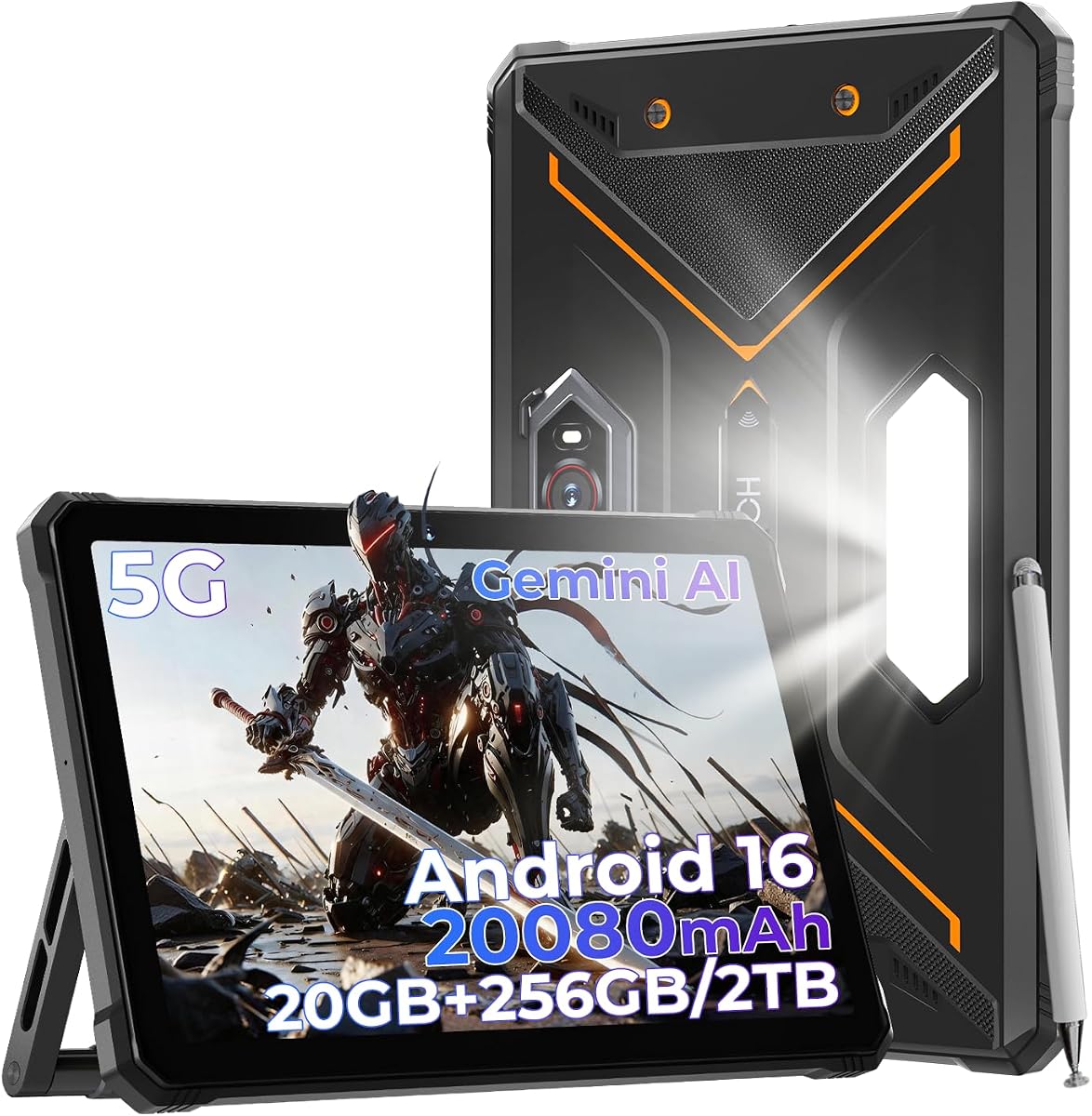



The RUGTAKE T5 Pro combines a large 11-inch 2K display, Android 16, 5G connectivity, and a 20080mAh battery in a body designed for field conditions. Its 4.5 rating reflects a well-rounded feature set, particularly for drivers who want more screen space than a compact navigation unit without moving to a conventional entertainment tablet.
We may earn a commission when you buy through this link, at no additional cost to you.
Its 120Hz display provides fluid map movement and scrolling, while 450 nits of brightness gives it a useful balance between outdoor visibility and battery demand. Multi-system GPS, dual-SIM 5G, offline storage, OTG reverse charging, a 380-lumen camping light, glove mode, and an adjustable stand create a genuinely trail-oriented feature set. The 64MP main and 20MP night-vision cameras are useful for documenting trips and campsite conditions.
The main drawback is size and weight. An 11-inch rugged tablet needs a stable dashboard, windshield, or roll-cab mount, and it can be awkward to operate with one hand. Cellular compatibility is also limited to the carriers listed in the product information, so buyers using another network should verify service before relying on 5G.
This is the strongest all-around recommendation for onX Offroad users who want a large screen, long battery life, rugged construction, and dependable connectivity. It suits overlanders, UTV drivers, 4×4 owners, and campers who need one tablet for navigation, documentation, communication, and offline entertainment.
The 11-inch 2K panel gives onX route lines, trail names, satellite imagery, and status markers more room than a small handlebar display. Its 120Hz refresh rate also makes panning and zooming feel responsive when reviewing a complex backcountry network.
A 20080mAh battery and 33W USB-C charging make the T5 Pro suitable for full-day driving without routine power anxiety. OTG reverse charging adds backup utility when a compatible phone, camera, or other device needs power.
We may earn a commission when you buy through this link, at no additional cost to you.
The HUGEROCK X70 is a seven-inch navigation tablet designed around exceptional outdoor readability, rugged construction, and motorcycle-specific power options. Its listed 3.2 rating is the lowest among these products, but its 2600-nit display and external antenna support make it a specialized option for riders who prioritize direct sunlight and positioning reliability.
We may earn a commission when you buy through this link, at no additional cost to you.
Its full-shell IP67 design, MIL-STD-810G protection, ordinary-glove touchscreen operation, and drop protection suit vibration, dust, rain, and rough trail surfaces. The sub-meter navigation module can use an external antenna, a notable advantage in forests, canyons, and other places where a standard internal receiver may struggle. Dual Nano SIM slots, a microSD slot, Bluetooth 5.0, and WiFi 5 or 4 add useful connection options.
Motorcycle users can charge through USB-C, a magnetic connection, or a DC 12V and RS232 interface. However, the supplied information notes that setup consultation is recommended for motorcycle use. Android 13 is less current than the Android 15 and Android 16 models in the list, and the 8GB of physical RAM is modest for intensive multitasking.
The X70 is best for riders who routinely navigate in intense sunlight or weak satellite conditions and are comfortable with a specialized setup. It is less compelling for drivers wanting a large dashboard display, newer software, or the broadest app performance.
A 2600-nit panel is the standout specification here and offers an advantage over the 450-, 480-, 500-, and 420-nit alternatives. That visibility can make trail junctions and small map details easier to interpret from a helmet or windscreen.
The sub-meter receiver and SMA external antenna connection give riders more control over reception in obstructed terrain. Mounting an external antenna correctly can be more valuable than extra processing power in remote forests or canyon systems.
We may earn a commission when you buy through this link, at no additional cost to you.
The AGM PAD P2 Active delivers an 11-inch FHD display, 480-nit brightness, GPS, a compass, and durable construction at a practical entry point into large-screen rugged tablets. Its 4.3 rating and Android 14 platform make it a balanced choice for onX navigation, trail planning, and general field use.
We may earn a commission when you buy through this link, at no additional cost to you.
The MediaTek Helio G99 is designed for responsive everyday multitasking, while 16GB of combined physical and virtual memory and 256GB of storage provide room for maps and media. Storage can expand to 2TB with microSD. Widevine L1 certification supports high-definition streaming, and OTG allows compatible keyboards, mice, and storage accessories to be connected.
Its IP68 and IP69K ratings, 360-degree dust protection, and claimed 1.8-meter drop resistance provide a reassuring rugged foundation. The 8000mAh battery is smaller than the 20080mAh options, and the 90Hz display is less fluid than the 120Hz models. These are acceptable compromises for buyers who want a capable large screen without moving to the largest battery configuration.
Choose the PAD P2 Active if you want an 11-inch onX display, strong durability, dependable positioning, and a mature Android ecosystem without paying for every premium feature. It is particularly suitable for 4×4 touring, camping, work sites, and passengers who prefer a larger viewing area.
The 480-nit FHD panel is bright enough for many daylight navigation tasks while avoiding the bulk and battery demands of the largest screens. A 90Hz refresh rate also keeps onX map interactions reasonably fluid.
IP68 and IP69K protection, 1.8-meter drop resistance, built-in GPS, and a compass cover the most important off-road foundations. The included case adds a layer of protection for transport and rough mounting environments.
We may earn a commission when you buy through this link, at no additional cost to you.
The OUKITEL RT11 offers a more manageable alternative to an 11-inch tablet without giving up 5G, multi-system positioning, or rugged protection. Its listed 5.0 rating is notable, although it should be understood as an aggregate product rating rather than a guarantee of fit for every vehicle.
We may earn a commission when you buy through this link, at no additional cost to you.
The 8-inch 1280-by-800 IPS display reaches 500 nits, making it brighter than most of the 11-inch alternatives in this comparison. Android 16, a 6nm UNISOC T760 octa-core processor, 24GB of combined memory, and 128GB of storage support maps, work applications, and media. Compatible microSD expansion can reach 1TB, although the card uses the second SIM slot.
Its 10000mAh battery, 18W wired charging, and reverse charging make it practical for field routes. IP68, IP69K, and MIL-STD-810H protection add durability, while GPS, GLONASS, Galileo, and BeiDou support route finding. The 800-by-800-class resolution is less detailed than 2K alternatives, and the smaller display offers less room for intricate map inspection.
The RT11 is a strong fit for UTVs, trucks, and adventure motorcycles where an eight-inch screen is easier to mount. It suits drivers who prioritize cellular speed, compactness, and battery endurance more than maximum map detail or entertainment space.
The eight-inch format is easier to position on crowded dashboards, center consoles, and handlebars than a full 11-inch device. It also creates less obstruction around vents, switches, and the driver's view.
Dual-SIM 5G can reduce delays when downloading map regions, satellite imagery, or large files before service disappears. Offline downloads remain essential, but 5G makes last-minute updates more convenient when coverage is available.
We may earn a commission when you buy through this link, at no additional cost to you.
The HOTWAV R9 Pro Max stands out for its massive battery, 11-inch 120Hz screen, 5G connectivity, and dedicated night-vision camera. Its 4.3 rating reflects a capable package for overlanders and field users who may need to document locations or campsite conditions after dark.
We may earn a commission when you buy through this link, at no additional cost to you.
A 20,080mAh battery supports long workdays and off-grid travel, while 20W fast charging helps limit downtime. The 1920-by-1200 display, 120Hz refresh rate, glove mode, multi-system GPS, dual-SIM 5G, and 256GB storage create a strong platform for onX maps and related route-planning apps.
IP68, IP69K, and MIL-STD-810H protection address dust, water, and impact exposure. The 64MP main camera and 20MP Sony night-vision sensor add useful low-light capture, and the included bracket supports a more permanent installation. Screen brightness is not specified beyond the 11-inch FHD+ panel, so it may be less effective than the HUGEROCK X70 in direct glare.
This model is ideal for campers, night-shift field workers, hunters, and drivers who value battery reserve and camera flexibility. Those who navigate in severe sunlight should prioritize brightness over camera features or carry a dedicated high-visibility GPS unit.
The dedicated 20MP night-vision camera can record low-light scenes that a standard camera may struggle to capture. It is useful for campsite setup, trail conditions, obstacles, and documentation around remote camps.
The combination of a 20,080mAh battery and 5G helps balance long offline adventures with convenient connected planning. The tablet can also provide reverse power to compatible devices through OTG.
We may earn a commission when you buy through this link, at no additional cost to you.
The ORCATAB WT1 Pro combines a sharp 11-inch 2K screen, 120Hz refresh rate, 5G, and a 20,080mAh battery in a rugged Android 16 package. Its 4.4 rating makes it one of the strongest balanced options for a driver who wants navigation and broader field utility in the same device.
We may earn a commission when you buy through this link, at no additional cost to you.
Multi-system positioning includes GPS, GLONASS, Galileo, and BeiDou, while the storage configuration allows room for offline maps, topo files, inspection photos, and work documents. The 6nm UNISOC T8200 processor, 8GB physical RAM, and 24GB virtual memory provide smooth everyday multitasking, though users should understand the distinction between physical and extended memory.
Gemini AI adds search, writing, planning, and basic photo-editing functions. The 380-lumen circular camping light can serve as a work lamp, ambient light, or emergency beacon, and the flexible stand supports hands-free route review. IP68, IP69K, and MIL-STD-810H protection add credibility for rough environments.
The WT1 Pro is a compelling all-purpose companion for overlanders, campers, field engineers, and trail reviewers. Its network restrictions should be checked before purchase, but for compatible 5G users, it offers one of the strongest combinations of resolution, endurance, and outdoor utilities in the guide.
The 2K resolution gives onX satellite imagery and topographic details more definition than standard HD panels. A 120Hz refresh rate complements that clarity with smooth zooming, panning, and route comparison.
The built-in light, adjustable stand, Gemini AI functions, reverse charging, and strong camera system give the tablet value away from the trail. These features make it useful as a camp workstation and field reference.
We may earn a commission when you buy through this link, at no additional cost to you.
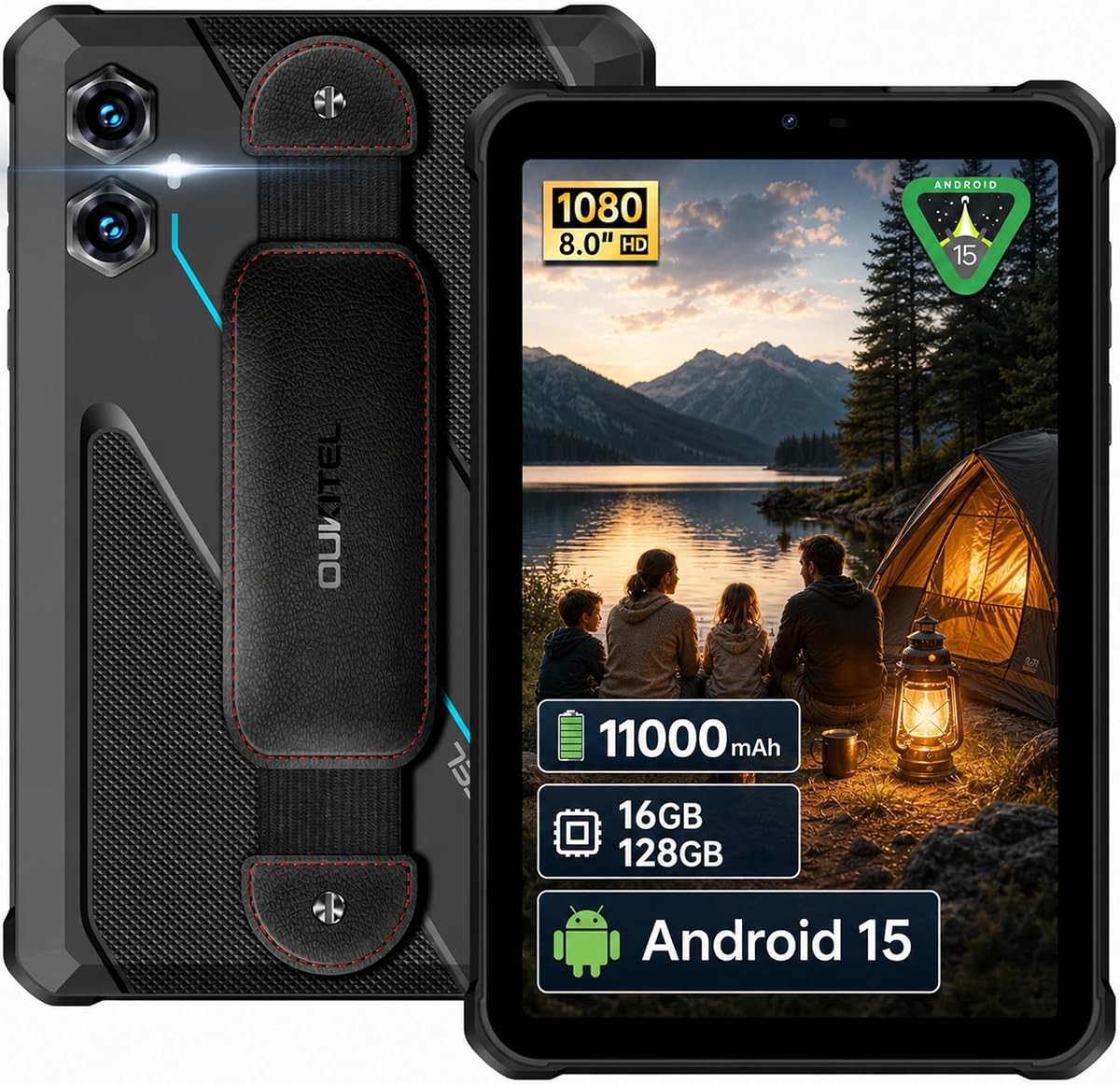
The black OUKITEL RT3 Plus is a compact 8-inch rugged Android 15 tablet that prioritizes portability, battery life, and practical navigation hardware. Its listed 5.0 rating and 11,000mAh battery make it a compelling option for riders and drivers who want ruggedness without an 11-inch footprint.
We may earn a commission when you buy through this link, at no additional cost to you.
The 1280-by-800 IPS panel reaches 420 nits and uses a 60Hz refresh rate. GPS, GLONASS, BeiDou, and Galileo support trail navigation, while 4G dual-SIM connectivity handles calls and online map updates. The 16GB combined memory, MediaTek G81 processor, and 128GB storage cover everyday mapping and media needs, with expansion up to 1TB.
Its 11,000mAh battery, OTG reverse charging, dual 100dB speakers, and included anti-slip wrist strap are useful outdoors. The 16.3mm profile is relatively slim for a rugged device, but the 8-inch screen is less visible in direct sunlight than the X70's 2600-nit panel, and 4G will not provide the same peak transfer speed as 5G alternatives.
This RT3 Plus is best for compact mounting, UTV dashboards, camping, and trail work where battery reserve matters more than maximum screen brightness. It is a sensible lower-cost way to combine the onX app with a durable Android tablet.
An 11,000mAh battery is unusually substantial for an 8-inch tablet and can support extended route days. Reverse charging is handy for a compatible phone, camera, or navigation accessory when the vehicle outlet is occupied.
The anti-slip wrist strap adds security when carrying the tablet on foot, while dual high-volume speakers can make spoken navigation prompts easier to hear in an open cabin.
We may earn a commission when you buy through this link, at no additional cost to you.
The blue OUKITEL RT3 Plus shares the compact durability of the black edition and adds Face ID as a distinct convenience. With a 5.0 listed rating, Android 15, multi-system GPS, an 11,000mAh battery, and an 8-inch screen, it is well suited to secure, map-focused off-road use.
We may earn a commission when you buy through this link, at no additional cost to you.
Face ID can offer quicker device unlocking than repeatedly entering a password, which is useful when the tablet is mounted and frequently checked. The MediaTek G81 processor, 16GB combined physical and extended memory, 128GB storage, and 1TB expansion capability support maps, documents, and media.
GPS, GLONASS, BeiDou, and Galileo provide broad satellite support, and dual SIM connectivity allows separate work and personal lines. The 420-nit screen remains readable for many trail tasks but is less impressive than the 480-, 500-, or 2600-nit alternatives. Like the black model, it uses 4G rather than 5G.
Choose the blue edition for drivers who value personal security, a distinct finish, and a compact rugged package. It is a particularly practical choice for onX users who need a simple navigation device that is less likely to be casually accessed by passengers.
Face ID improves daily usability in a moving vehicle because the owner does not need to remove gloves or enter a code for every map check. It is a convenience feature rather than a substitute for a secure screen lock.
The 8-inch body, 420-nit display, 4G dual-SIM setup, and multi-system GPS mirror the useful core of the black RT3 Plus. The blue finish simply provides an alternative appearance for different riders.
We may earn a commission when you buy through this link, at no additional cost to you.
The OUKITEL RT9 offers a middle ground between compact 8-inch navigation units and large 11-inch tablets. Its 10.1-inch FHD+ display, 11,000mAh battery, 256GB storage, and 5.0 listed rating make it a balanced choice for onX users who want a sizeable map without the largest chassis.
We may earn a commission when you buy through this link, at no additional cost to you.
Android runs on a Unisoc T606 octa-core processor with 24GB of combined physical and expanded memory. That configuration is aimed at everyday browsing, navigation, streaming, reading, and work applications. Dual-SIM connectivity adds flexibility, while glove-friendly operation helps during cold-weather trail work.
The tablet's waterproof, dustproof, and shock-resistant design is intended for construction sites, workshops, camps, and garages. Its 93dB speaker is useful for navigation prompts and calls in an open vehicle, although a 16MP rear camera is modest compared with 50MP and 64MP alternatives. The supplied specifications do not mention 5G or detailed ingress ratings.
The RT9 is a strong general-purpose pick for overlanders who want a large map, long battery life, and a manageable size. It is best for route planning, campsite entertainment, and navigation where high-resolution imaging or the most current Android version is not the priority.
The 10.1-inch FHD+ panel provides useful map detail without reaching the dimensions of the 11-inch models. It can be easier to mount in a compact cabin while still supporting comfortable touchscreen route review.
Glove-friendly controls reduce the need to remove gloves during stops, and the shock-resistant shell suits travel over uneven roads. The large battery and 93dB speaker also help make it a dependable daily travel companion.
We may earn a commission when you buy through this link, at no additional cost to you.
The onX Offroad membership is the navigation foundation for this guide rather than a standalone tablet. It provides a nationwide digital trail database for phones, tablets, and computers, with access to more than 375,000 miles of mapped off-road roads and trails across all 50 states.
We may earn a commission when you buy through this link, at no additional cost to you.
Its most valuable route-planning features include real-time open and closed status, Google Earth satellite imagery, topographic and base maps, difficulty ratings, vehicle compatibility filters, waypoint tools, track markup, and route planning. Offline downloads are essential for remote areas where cellular service disappears, while synchronization lets a route move from a desktop planning session to a vehicle-mounted tablet.
The membership does not provide the display, battery, mounting system, or physical protection of a tablet. Trail status can also change after a map update, so drivers must remain responsible for local closures, regulations, and conditions. A 4.1 rating indicates a useful service, but it should not replace careful pre-trip planning.
For anyone specifically searching for a tablet for onX Offroad use, this is the essential software layer. Pair it with a bright, rugged model such as the T5 Pro, WT1 Pro, or X70, download the relevant regions offline, and use the physical tablet for dependable route viewing away from service.
Open and closed status, difficulty ratings, and vehicle filters help narrow routes to those appropriate for a particular machine. Satellite imagery can reveal terrain around a trail before committing to a long segment.
Offline map downloads preserve route access in areas without cellular coverage. Completing the download before departure and keeping the tablet charged are essential parts of using onX safely in the backcountry.
We may earn a commission when you buy through this link, at no additional cost to you.
The best off-road tablet balances navigation visibility, satellite positioning, rugged protection, power, and software compatibility. Start with your vehicle and trail conditions, then prioritize the features that solve the biggest practical problem in your trips.
Screen size determines how much of the onX route, satellite imagery, and status information you can inspect without excessive zooming. An 11-inch model is easiest for detailed route review and can work well in a Jeep, truck, or UTV, while 7- and 8-inch models are more practical for motorcycles, ATVs, and crowded dashboards. Brightness matters as much as size because open trails are often exposed to direct sun. The HUGEROCK X70 leads this group with a 2600-nit display, while the AGM PAD P2 Active, OUKITEL RT11, and OUKITEL RT3 Plus reach 480, 500, and 420 nits respectively.
Choose a large screen for complex route planning and a compact screen for tight mounts. In bright conditions, prioritize high brightness, anti-reflective viewing, and a secure sunshade.
Built-in GPS is useful, but the quality of the receiver and the number of supported satellite systems can influence position stability. Every hardware option here supports GPS, with several adding GLONASS, Galileo, and BeiDou. The HUGEROCK X70 is the most specialized because it lists sub-meter positioning and an SMA external antenna connection, which can help in forests and canyons. Even with multi-system support, trees, rock walls, and deep valleys can obstruct satellite signals.
Check whether the tablet supports external antenna accessories and whether a compatible antenna is included. Download maps offline and avoid assuming position accuracy will remain constant in every environment.
An off-road tablet should tolerate dust, rain, splashes, vibration, and being knocked around during a trip. IP68 protection appears throughout the hardware list, and several devices also carry IP69K protection for resistance to high-pressure water jets. MIL-STD-810H or MIL-STD-810G references indicate additional testing against specified environmental and drop conditions. These claims do not mean the device can be submerged or operated in any condition; ports, covers, and manufacturer instructions still matter.
Prioritize a sealed rugged shell over a thin consumer tablet. Add a secure mount and protective case, especially if the device will be carried on foot, attached to a UTV, or used in muddy weather.
Long remote routes require enough power for onX navigation, Bluetooth or cellular radios, screen brightness, and any cameras or accessories in use. The 20,080mAh batteries in the T5 Pro, HOTWAV R9 Pro Max, and ORCATAB WT1 Pro provide the greatest stated capacity. The 10,000- to 11,000mAh alternatives remain useful for full-day activities, while the AGM PAD P2 Active has an 8,000mAh cell. Fast charging matters when a vehicle USB-C port is the only available power source.
Treat battery capacity as a starting point rather than a guaranteed runtime. Screen brightness, 5G use, video calls, and navigation settings can change consumption. A vehicle charger, cable, and backup power option remain sensible additions.
Cellular connectivity is useful for downloading new map regions, checking traffic or community information, and maintaining calls when the route stays within coverage. Most of the hardware supports dual SIM, but not every network is compatible. The T5 Pro and WT1 Pro list compatibility with T-Mobile, Mint Mobile, Google Fi, and Metro by T-Mobile and explicitly exclude AT&T, Cricket, and Verizon. The RT3 Plus models list 4G, while the RT11, R9 Pro Max, and WT1 Pro support 5G.
Verify the exact carrier, band, SIM configuration, and coverage before buying. Offline navigation should remain your primary plan in remote areas, regardless of the cellular generation.
Offline map files, downloaded routes, satellite imagery, photos, and trail documents can consume substantial storage. The T5 Pro, WT1 Pro, and AGM PAD P2 Active offer 256GB internal storage and up to 2TB microSD expansion, while the RT3 Plus models offer 128GB with expansion up to 1TB. The RT11 also supports up to 1TB expansion, though the microSD card uses the second SIM slot. Users should keep map files on the internal or primary storage location if they want them readily available during navigation.
Prioritize enough space for the regions you expect to visit, not merely the largest headline capacity. Use a quality memory card, maintain free storage, and avoid deleting offline regions before a trip.
A screen that is large enough for maps may be too large for a motorcycle, ATV, or compact UTV. Large 11-inch models need strong mounts and clear placement that does not obstruct the driver, controls, or airbags. The X70 is explicitly designed for motorcycle navigation and includes charging options suited to that use, while the 8-inch RT11 and RT3 Plus models are easier to position in tighter cabins. The HOTWAV R9 Pro Max includes a bracket, and several other tablets offer stands or straps.
Measure the mounting area before ordering and verify that the bracket supports the tablet's weight and shape. Test viewing angle and reach during daylight, then secure the device before rough terrain.
Features such as glove mode, night-vision cameras, camping lights, reverse charging, high-volume speakers, and external antenna support can make a tablet more useful beyond mapping. The X70 offers ordinary-glove operation and motorcycle-specific charging. The T5 Pro, R9 Pro Max, and WT1 Pro include night-vision or camping-light functions. The RT3 Plus models emphasize glove use, loud speakers, and wrist straps. These extras are valuable only when they match the way you travel, so avoid paying for unnecessary features while overlooking navigation fundamentals.
Prioritize battery, mounting, positioning, and screen quality first. Add cameras, lights, and connectivity when they solve a documented problem in your off-road routine.
Start by creating an onX Offroad account, planning the route on a computer or mobile device, and identifying the states, forest areas, parks, and connectors you will need. Download the relevant offline maps before leaving reliable Wi-Fi or cellular coverage. Confirm the selected route with local land managers because open and closed statuses can change and some temporary restrictions may not appear immediately.
Install the tablet in a secure, unobstructed mount, connect the charging cable with ignition-based power where appropriate, and verify that the screen remains visible in direct sunlight. Open the route before starting, test GPS acquisition in a clear location, and carry a separate paper map or backup navigation method for remote travel. Keep the tablet and charging ports dry when using protective covers, and do not use a charging setup that is not compatible with the device.
During the trip, avoid leaving the device in direct sun or a sealed hot vehicle. Clean dust from ports and the screen with a soft, dry cloth, inspect the case and mount for looseness, and keep the storage level from becoming completely full. Before a long trip, download new map regions, confirm the battery is healthy, carry the correct vehicle charger, and test offline navigation in airplane mode.
The best choice depends on the vehicle and lighting conditions. The T5 Pro is a strong all-around option for large-screen navigation, battery life, 5G, and rugged protection, while the HUGEROCK X70 is better suited to motorcycles and extreme sunlight. Compact 8-inch models such as the RT11 or RT3 Plus are easier to mount in tighter spaces.
A rugged tablet is advisable when the device will face dust, rain, vibration, frequent handling, or rough travel. A conventional tablet may work for light touring, but its sealed ports and drop resistance will be less reassuring. Look for IP68 or IP69K protection, a sturdy mount, and sufficient battery capacity for the full day.
Yes, because the onX Offroad membership supports offline map downloads. You should download every region needed for the trip before leaving coverage and test the route in airplane mode. Cellular service remains useful for last-minute map or status updates, but it should not be the only navigation plan.
Screen visibility, dependable positioning, offline storage, and secure mounting are the foundation. A rugged shell, long battery life, and compatible charging are also important. High camera resolution, AI tools, and 5G are secondary unless they address a specific part of your trip.
Usually, yes, because direct sunlight can make dark map lines and small trail labels difficult to distinguish. The HUGEROCK X70 has the highest stated brightness at 2600 nits, while the other options range from 420 to 500 nits. A sunshade and correct screen-angle adjustment can also improve visibility.
Choose 8 inches when mounting space, handling, or weight is the priority. Choose 11 inches when reviewing satellite imagery, route details, and status information is more important. The 10.1-inch RT9 and 7-inch X70 provide useful middle-size and highly specialized alternatives.
Compatibility depends on the exact model. The T5 Pro and WT1 Pro list T-Mobile, Mint Mobile, Google Fi, and Metro by T-Mobile while excluding AT&T, Cricket, and Verizon. Other models use different networks, so confirm carrier and band support before purchase rather than assuming every 5G tablet accepts every SIM.
Use a mount rated for the device's size and weight, tighten every fastener, and position the screen so it does not obstruct the driver, controls, or airbags. Test the mount on smooth pavement, inspect it after rough terrain, and use a wrist strap when carrying the tablet away from the vehicle.
The T5 Pro 5G Rugged Tablet is the most balanced overall choice because it combines a large 120Hz display, long battery life, 5G, multi-system GPS, and strong water and impact protection. The HUGEROCK X70 is the specialized premium choice for extreme sunlight, external antenna support, and motorcycle use, while the AGM PAD P2 Active delivers the strongest balance of size, durability, and value.
Your priorities should determine the winner. Choose the RT11 or RT3 Plus for a compact mount, the R9 Pro Max for night-vision imaging, the WT1 Pro for 2K resolution and a built-in camping light, or the RT9 for a balanced 10.1-inch form factor. In every case, the onX Offroad membership remains the essential navigation layer, and offline downloads should be completed before every trip.
Finally, confirm current specifications, carrier compatibility, included accessories, warranty terms, and pricing before purchasing. Rugged ratings describe tested conditions rather than unlimited protection, and software updates can change compatibility over time. A secure mount, correct vehicle charging setup, and backup navigation method complete a safer onX Offroad installation.